Where to Place a Stop Loss: Structure, Breakout Candle, Moving Average or ATR

This article is for informational and educational purposes only. It does not constitute financial advice or an investment recommendation. Trading in financial markets carries a high risk of loss.
Introduction
Every trade needs a stop loss, but many traders decide where to put it the wrong way round: they first think about how much money they are willing to lose and then place the stop at that distance. The result is a stop that has nothing to do with the market, and that is often hit by normal price movement.
This article is divided into two sections. The first explains four common ways to place a stop. The second shows how to combine them and what to take into account in MetaTrader 5.
1. Four ways to place a stop
The principle: the invalidation point
A stop loss answers one question: at what price is the reason for entering the trade no longer valid? If you buy because price is making higher lows, the trade idea fails when that higher low breaks. That price, not a round number of pips, is where the stop belongs.
Structure stop
The stop goes just beyond the last relevant swing: below the last swing low on a long trade, above the last swing high on a short trade.
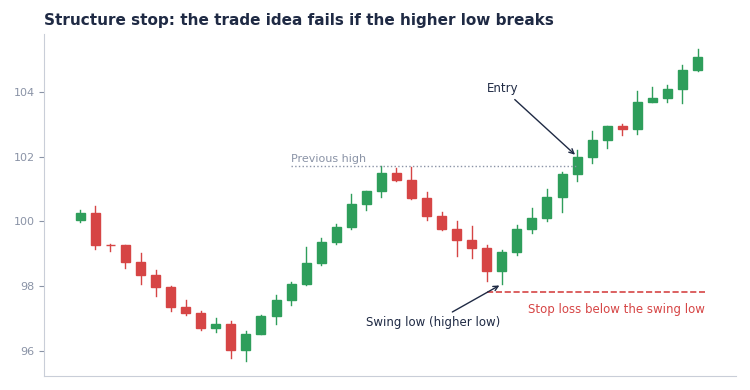
Figure 1. Structure stop below the last swing low
It is the most logical stop, because it sits exactly where the trend structure would break. Its drawback is that swing lows and highs are visible to everyone, so many stops accumulate there and price often reaches them before moving on.
Breakout candle stop
When you enter on a breakout, the stop can go below the low of the candle that broke the level. If price loses that low, the buyers who drove the breakout have been overpowered.
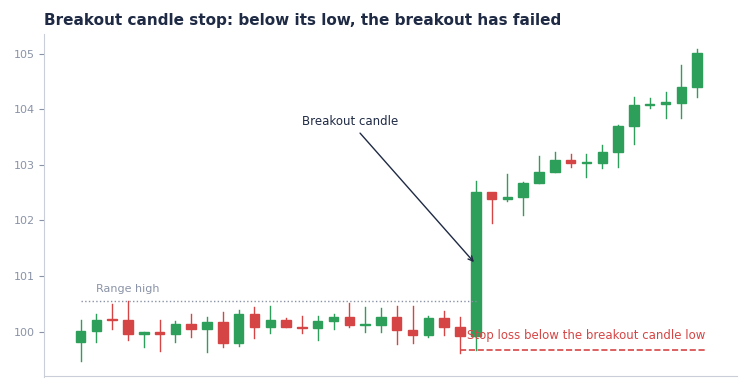
Figure 2. Stop below the low of the breakout candle
It works best when the breakout candle is clearly larger than usual. If the candle is very large, the stop will be far away and the lot size will have to be smaller.
Moving average stop
In a trend, a moving average such as the 20-period EMA can act as a trailing stop: the trade is closed when price closes below it, not when it simply touches it.
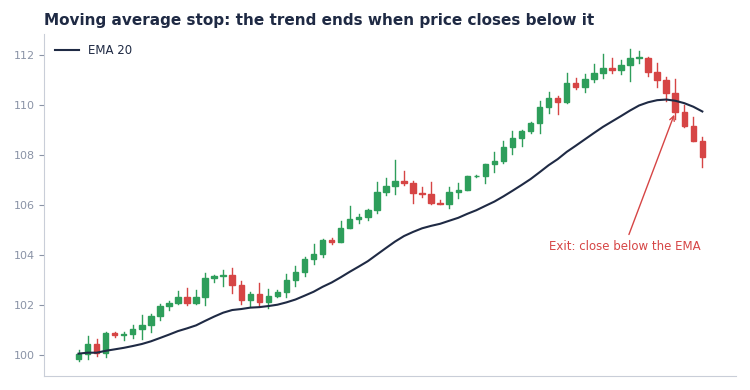
Figure 3. Exit on a close below the 20-period EMA
It is useful for following a trend without deciding in advance where it will end. The period should be the one price is actually respecting on that asset and timeframe. In sideways markets, this stop produces many small losses.
Volatility stop
The stop is placed a multiple of the ATR away from the entry or from the highest price reached. Its strength is that it adapts to how much each asset moves. Its weakness is that, on its own, it ignores the chart structure. How to choose the ATR period and multiplier was covered in a previous article on ATR volatility.
| Method | Where the stop goes | Main weakness |
|---|---|---|
| Structure | Beyond the last swing low or high | Obvious level where many stops accumulate |
| Breakout candle | Below the low of the breakout candle | Distant stop if the candle is very large |
| Moving average | On a close beyond the average | Repeated small losses in sideways markets |
| Volatility (ATR) | A multiple of the ATR from price | Ignores chart structure |
2. Combining methods and applying them in MT5
Structure plus a volatility buffer
A practical combination is to use the structure to decide where the stop goes and the ATR to decide how much margin to leave beyond it:
Stop (long) = Swing low − (k × ATR) − Spread
The buffer keeps the stop out of the area where a simple wick can reach the level and then reverse.
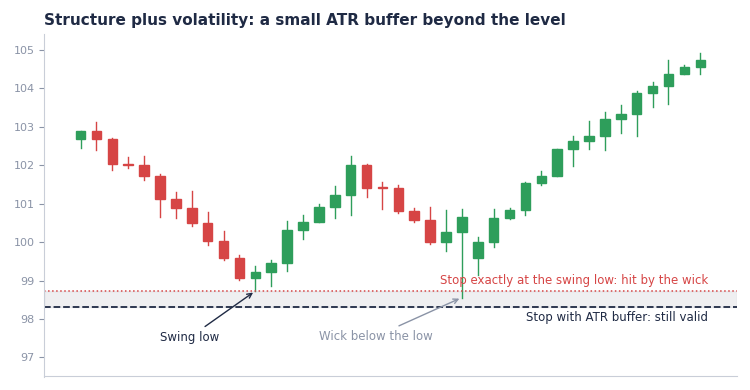
Figure 4. Stop at the swing low versus stop with an ATR buffer
A small k, for example between 0.25 and 0.5 ATR, is usually enough. (Indicative values; test them with your own data.) The stop is wider, so the lot must be calculated from that distance to keep the same risk.
Stop first, lot size second
The correct order is always the same: first decide where the stop goes according to the market, then calculate the lot size so that the distance equals the planned risk.
Lot = Risk in money ÷ Risk per lot
If the stop the market requires leads to a lot size below the minimum allowed, the right decision is not to tighten the stop: it is to skip the trade.
What to check in MetaTrader 5
- Bid and Ask: in MT5, the stop of a buy position is triggered by the Bid price and that of a sell position by the Ask price. A short trade can be closed by a widening spread even if the chart, which shows the Bid, never reached the stop.
- Minimum stop distance: some symbols have a stop level, a minimum distance between the current price and the stop. You can find it in the symbol specification.
- Gaps and slippage: when the stop is triggered it becomes a market order. On a gap or during news, the execution price can be worse than the stop price.
Common mistakes
- Placing the stop by money, not by market. The risk is controlled with the lot size, not by moving the stop.
- Placing the stop exactly on the level. A swing low or a round number attracts price; leave some margin.
- Moving the stop further away when price approaches it. The stop can move in favour of the trade, never against it.
- Ignoring the spread on low timeframes. On M1 or M5, the spread can take up a large part of a tight stop.
Conclusions
- Four ways to place a stop: the stop belongs at the price where the trade idea is no longer valid. Structure, breakout candle, moving average and volatility are four ways to find it, each with its own weakness.
- Combining and applying them: using the structure for the location and the ATR for the margin gives a more robust stop. The lot size is always calculated afterwards, and in MT5 it is worth remembering how Bid, Ask, stop levels and gaps affect execution.
No stop guarantees that a trade will end well. A well-placed stop only ensures that, when the trade fails, the loss is the one that was planned. Test any method with your own data on demo or in the Strategy Tester, and combine it with disciplined risk management.
References
- Alexander Elder, The New Trading for a Living, 2014.
- MQL5 Reference: Order properties and symbol trading specifications (MetaTrader 5 documentation).
Disclaimer
This content is for informational and educational purposes only. It does not constitute financial advice or a recommendation to buy or sell any instrument. The charts are illustrative and do not represent real trades. Every asset and every broker is different, and the values and examples shown are for illustration only. Trading forex, CFDs and other leveraged products carries a high risk of loss. Every trading decision, and its outcome, is the sole responsibility of the reader. The author accepts no liability for any loss arising from the use of this information.