
Moving Average Crossover Strategy: The Complete Forex Trading Guide to Buy and Sell Signals

Moving Average Crossover Strategy:
The Complete Forex Trading Guide to Buy and Sell Signals
One of the biggest challenges Forex traders face is identifying trend reversals early and finding high-probability entry and exit points. Among the most widely used technical analysis methods, the Moving Average Crossover Strategy is a popular
approach for identifying market direction, tracking momentum, and spotting potential trading opportunities.
By combining two moving averages with different periods, traders can identify potential changes in market momentum and follow emerging trends. Whether you are a scalper, day trader, or swing trader, understanding how moving average crossovers work can help you build a more structured trading strategy.
In this guide, we will explore how the Moving Average Crossover Strategy works, the differences between SMA and EMA, the Golden Cross and Death Cross patterns, the best moving average settings for Forex, and how to use crossover signals in real trading conditions.
What Is the Moving Average Crossover Strategy?
The Moving Average Crossover Strategy is a technical trading method that uses the intersection of two moving averages with different periods to identify potential trend changes.
Typically, this strategy uses two moving averages:
-
Fast Moving Average: A shorter-period moving average that reacts more quickly to price changes.
-
Slow Moving Average: A longer-period moving average that provides a broader view of the market trend.
When the fast moving average crosses above the slow moving average, it may indicate increasing bullish momentum. Conversely, when the fast moving average crosses below the slow moving average, it can signal growing bearish pressure.
One important point to understand is that moving averages are lagging indicators. They react to historical price movements rather than predicting future price action. Therefore, crossover signals should ideally be combined with price action and additional technical confirmation tools.
Types of Moving Averages Used in Crossover Strategies
Understanding the different types of moving averages is essential for building an effective Moving Average Crossover trading system.
1. Simple Moving Average (SMA)
The Simple Moving Average calculates the average price over a specified number of previous candles.
For example, the SMA 50 calculates the average price of the last 50 candles. It gives equal weight to each price observation and generally reacts more slowly to short-term market fluctuations.
Traders often use SMA settings to identify medium-term and long-term market trends.
2. Exponential Moving Average (EMA)
The Exponential Moving Average assigns greater weight to recent price data. As a result, it responds more quickly to price movements than the SMA.
This makes EMA particularly useful for short-term traders and scalpers who want to identify changes in market momentum.
In general:
-
SMA is useful for identifying broader market trends.
-
EMA reacts faster to recent price changes.
-
The choice between SMA and EMA depends on your trading style and timeframe.
What Are Golden Cross and Death Cross Patterns?
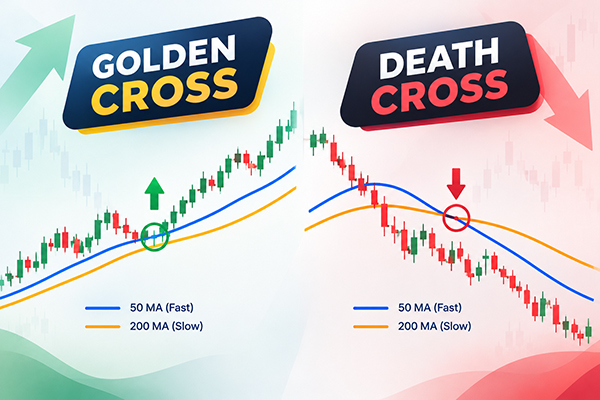
Two of the most recognized patterns in Moving Average Crossover trading are the Golden Cross and Death Cross.
Golden Cross: A Potential Bullish Trend Signal
A Golden Cross occurs when a shorter-term moving average crosses above a longer-term moving average.
One of the most popular combinations is the 50-period SMA crossing above the 200-period SMA.
This pattern may indicate:
-
Increasing bullish momentum.
-
A potential shift from a bearish or neutral market structure to a bullish trend.
-
Growing buying pressure.
-
A possible medium-term or long-term upward movement.
However, a Golden Cross does not guarantee that the market will continue rising. Traders should also examine price structure, support and resistance levels, and overall market conditions.
Death Cross: A Potential Bearish Trend Signal
The Death Cross is the opposite of the Golden Cross.
It occurs when a shorter-term moving average crosses below a longer-term moving average.
This pattern may indicate weakening bullish momentum and increasing selling pressure.
Forex traders often monitor Death Cross formations to identify potential selling opportunities or confirm a broader bearish market trend.
Best Moving Average Crossover Settings for Forex Trading
Choosing the right moving average settings depends on your trading style, timeframe, and market conditions. There is no single combination that works perfectly across all currency pairs and market environments.
Some commonly used Moving Average Crossover settings include:
| Moving Average Combination | Trading Application |
|---|---|
| EMA 9 and EMA 21 | Scalping and short-term trading |
| EMA 20 and EMA 50 | Short-term trend identification |
| SMA 50 and SMA 200 | Long-term trend analysis |
| EMA 50 and EMA 200 | Medium- and long-term trend analysis |
For example, traders using the H1 timeframe may prefer EMA 20 and EMA 50 to identify short-term market direction.
On higher timeframes, SMA 50 and SMA 200 can provide a broader perspective on the overall market trend.
It is important to backtest your preferred settings on historical price data before applying them to a live trading account.
How to Trade Using the Moving Average Crossover Strategy
A successful crossover trading system requires more than simply identifying where two moving averages intersect. Traders should also define their entry conditions, stop-loss placement, and exit strategy.
Step 1: Identify the Market Trend
Start by adding two moving averages to your trading chart.
When the fast moving average is above the slow moving average, the market can be considered bullish from a moving-average perspective.
When the fast moving average is below the slow moving average, the market has a bearish moving-average structure.
Step 2: Wait for a Trading Signal
For a potential buy opportunity, wait for the fast moving average to cross above the slow moving average.
For a potential sell opportunity, look for a bearish crossover.
It is generally better to wait for the candle to close before confirming the crossover. Temporary intersections during an unfinished candle can produce misleading signals.
Step 3: Confirm the Signal with RSI
One way to filter weaker crossover signals is to use RSI Confirmation.
For example, when considering a buy position, traders can check whether the RSI also supports bullish momentum.
For sell positions, they can examine whether the RSI indicates weakening momentum or bearish market conditions.
RSI should be treated as a confirmation tool rather than an independent entry signal.
Step 4: Set Stop Loss and Take Profit
After entering a trade, determine your stop-loss level based on recent swing highs and lows, market structure, or volatility.
For trade exits, you can consider:
-
Fixed risk-to-reward ratios.
-
Important support and resistance levels.
-
Trailing Stop techniques.
-
Opposite moving average crossover signals.
Proper position sizing and risk management are more important than finding an attractive entry signal.
Disadvantages of Moving Average Crossover and the Whipsaw Problem
Although the Moving Average Crossover Strategy is widely used, it has several limitations that traders should understand.
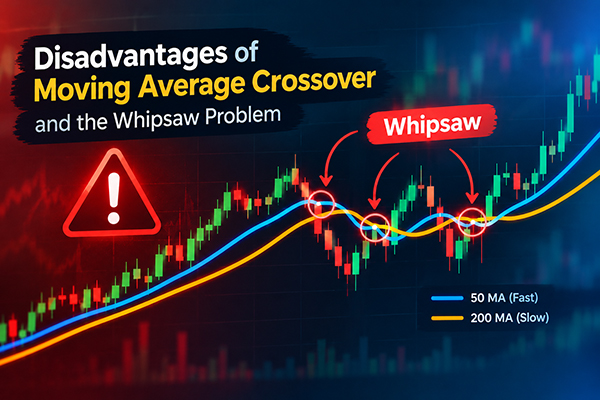
One of its biggest challenges is Whipsaw Trading.
Whipsaw occurs when the market moves sideways within a narrow range, causing moving averages to cross each other repeatedly.
As a result, traders may receive a buy signal, enter a position, and then quickly receive a sell signal as price reverses.
This can lead to multiple losing trades, especially in low-momentum or ranging markets.
To reduce the impact of whipsaw signals, consider the following techniques:
-
Confirm the overall trend using a higher timeframe.
-
Use RSI or MACD to evaluate market momentum.
-
Identify important support and resistance levels.
-
Avoid entering trades during choppy market conditions.
-
Wait for candle-close confirmation.
-
Apply proper stop-loss and position-sizing rules.
Keep in mind that no technical indicator or filter can completely eliminate false signals.
Is the Moving Average Crossover Strategy Suitable for Every Trader?
The Moving Average Crossover Strategy is particularly useful for traders who prefer trend-following approaches and want to identify potential changes in market direction.
Swing traders may prefer longer moving average combinations, while scalpers often use faster settings such as EMA 9 and EMA 21.
However, applying the same settings in every market condition can lead to inconsistent results.
A better approach is to treat Moving Average Crossover as one component of a complete trading plan rather than a standalone system that guarantees profitable trades.

Improve Trade Management with TW Position Guardian MT4
Identifying a good trading opportunity is only one part of successful trading. Managing open positions and protecting trading profits are equally important.
TW Position Guardian MT4 is a trade management Expert Advisor designed for MetaTrader 4. It can complement strategies such as Moving Average Crossover by providing additional tools for managing open positions.
Its features include Partial Close, Hidden Stop Loss, and Multi-Level Trailing Stop, helping traders manage their positions with greater flexibility.
The Expert Advisor does not generate buy or sell signals and does not open new trades in live or demo accounts. Instead, it is designed to manage manually opened positions and trades created by other Expert Advisors.
This makes it a useful trade management tool for traders who use technical strategies to identify entries and want more control over their open positions.
Final Thoughts
The Moving Average Crossover Strategy is a popular technical analysis method for identifying potential trend changes and trading opportunities in the Forex market.
By combining fast and slow moving averages, understanding Golden Cross and Death Cross patterns, and using confirmation tools such as RSI, traders can develop a more structured approach to market analysis.
However, lagging signals and the risk of whipsaw trading mean that successful implementation requires patience, proper confirmation, and disciplined risk management.
Ultimately, professional trading is not just about finding the right entry point. It is also about managing risk, controlling open positions, and following a consistent trading plan.