We Tested 86 Hypotheses. Only 4 Survived — How the BUSHIDO EA Was Built

■ First things first — this is not a "please buy" article
Let's be honest: the world of automated trading (EAs) deserves the skepticism it gets.
Ads that are nothing but profit screenshots. "Guaranteed X% per month." Funnels into DMs and chat groups. There is a reason so many warning videos exist.
We are a small research project called ORIGIN-U, and we cannot change that environment. What we can do is show our entire validation process.
This article introduces BUSHIDO, our USDJPY-only EA. But what it describes is not "how it wins" — it is what we tested, what we discarded, and where it loses. If you finish reading and decide there is no reason to buy, then this article has done its job correctly.
■ We tested 86 hypotheses
BUSHIDO is not an EA that was built because "the logic seemed promising".
We took methods described in trading books and communities, translated them into mechanical rules, and tested them on roughly 20 years of real tick data — 86 hypotheses in total.
The results were brutal. Famous methods, line trading, Elliott waves — once mechanized and tested, most of them showed no edge at all.
After more than 200,000 simulations, only 4 survived. BUSHIDO is a bundle of exactly those 4.
We believe "what we discarded" is as important as "what we adopted". Behind these 4 strategies is a pile of more than 80 rejections.
■ Why 4 strategies
Logic that wins in trending markets loses in ranges. What works in the Tokyo session does not hold in the New York session.
That is why BUSHIDO combines 4 strategies built on different market structures instead of one "ultimate logic".
- Trend Following — riding sustained directional moves
- Tokyo Range Break — range formation in the Tokyo session and its breakdown
- Tokyo Fix Fade — the reversal of flow imbalances around the Tokyo fix
- NY Break Continuation — the follow-through of New York session breakouts
Our adoption condition was that each strategy's edge can be explained by market structure. Profits we could not explain were not adopted, even when the backtest looked good.
By the way, BUSHIDO has days when it does not trade at all. On Japanese public holidays there is no Tokyo fix flow, so the Fix Fade strategy automatically takes the day off. Trading every day has no value in itself — the job is to enter only when the edge exists.
■ "No martingale" — decided by testing, not by slogan
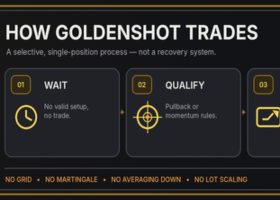
"No martingale" is a common marketing phrase. We did not want it to remain a policy statement, so we actually tested it.
We tested 14 variants — 8 martingale patterns, 4 averaging-down, 2 grid — on 12 years of data. The number we could adopt was zero.
The classic double-down martingale was symbolic: on paper it quadruples total profit. But on the historical path it hit −18% of equity in the first year of operation, with the maximum lot reaching 32x. The profit grew because the lots grew — in other words, pure leverage, not an edge.
That is why BUSHIDO contains no mechanism that increases lot size after a loss.
■ Our figures are always labeled as backtest results
Everything below is a backtest figure based on roughly 20 years of real tick data. These are past results and do not guarantee future performance.
- 19-year test period, every year finished positive
- Average annual return 12.7% (19-year CAGR, default setting)
- Maximum drawdown about 5.2% (default setting, balance basis)
If 12.7% per year sounds low to you, that reaction is healthy. BUSHIDO is not an EA that doubles your money — it is an EA designed with "do not lose big" as the top priority.
And one important disclosure: BUSHIDO's 2026 is negative as of July (around −3%). Even with 19 positive years in testing, losing periods are normal. We did not want to hide that and claim "it wins every month".
■ The feature that stops
When equity falls 18% from its peak, BUSHIDO permanently stops itself.
There is no "win it back" feature. In our testing, mechanisms that try to recover from that state (by increasing lots) only raised the probability of ruin.
If your capital survives, you can start again. We believe the strongest defense an EA can offer is the ability to stop.
■ Where it loses
We think the most important question when choosing an EA is not "why does it win" but "under what conditions does it lose".
The market environments each BUSHIDO strategy struggles with are documented in the User Guide: sudden volatility regime changes, range-to-trend transition points, interest rate events. We wrote down the losing conditions without hiding them. Please read it before purchasing.
👉 BUSHIDO User Guide (free): https://www.mql5.com/en/blogs/post/772982
■ Live execution — the gap between backtest and real money
"EAs with great backtests die with real money", people say. We agree.
That is why we measure execution quality in forward testing. Across 8 market orders, adverse slippage was at most 0.1 pips, and the average was actually in our favor. The Tokyo session has deep liquidity and good execution conditions — a side effect of being selective about trading hours.
We are also preparing to publish live results via MQL5 Signals. Until that track record accumulates, BUSHIDO should be judged as what it is: an EA at the backtest-only stage.
■ About the price
BUSHIDO uses a ladder pricing model: the price rises step by step as live track record accumulates. The more evidence there is, the lower the buyer's risk — so the price follows. Put differently, today's price is the "pre-track-record" price. Please check the current price on the product page.
■ Summary
- A portfolio of 4 strategies that survived out of 86 tested hypotheses (USDJPY only, MT5)
- Martingale, averaging-down and grid: rejected by testing, not by slogan
- All figures are labeled as backtest results. 2026 is negative as of July — we are not hiding it
- Permanent stop at −18% equity. There is no "win it back" feature
- The losing conditions are documented in the User Guide
👉 Product page: https://www.mql5.com/en/market/product/186851
👉 User Guide: https://www.mql5.com/en/blogs/post/772982
All test figures in this article are based on historical data and do not guarantee future performance. Forex trading involves the risk of losing your principal. Please trade only with funds you can afford to lose.