Gold Catalyst Evolution V6.11 — Losing Trades, Expectancy, and Streak Controls

Hello traders,
UPDATE NOTE — 8 October 2026
This article has been revised for Gold Catalyst Evolution V6.11. Losing trades are unavoidable in real trading, but the legacy win-rate and streak statistics below must not be presented as V6.11 expectations.
👉 Gold Catalyst Evolution V6.11
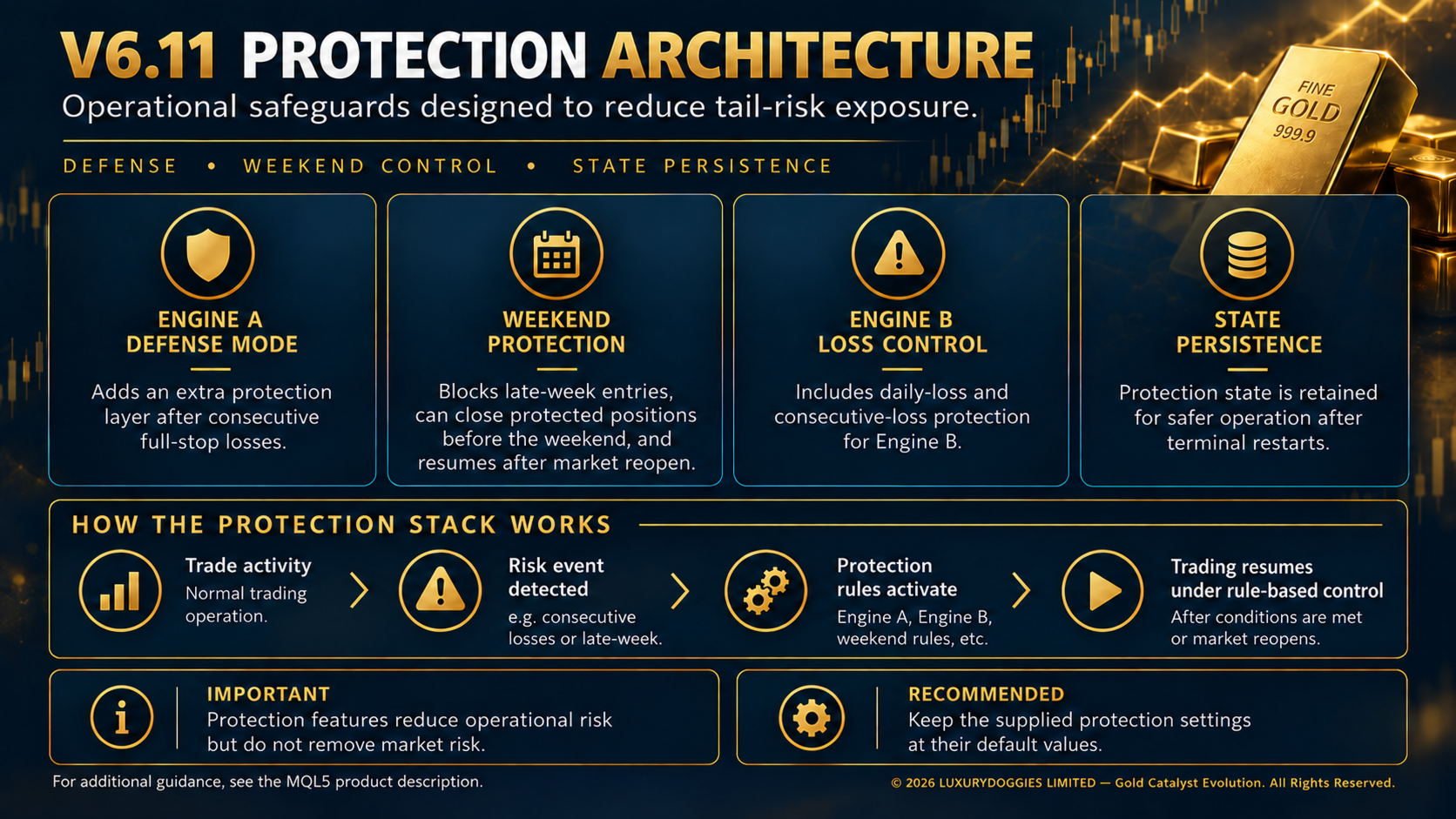 V6.11 protection architecture — current product operating illustration; not a performance result.
 Expectancy matters more than win rate alone
A strategy’s simplified expectancy before trading costs is:
(win probability × average win) − (loss probability × average loss)
For illustration only, a 12% win rate with an average winner eight times the average loss gives 0.12 × 8 − 0.88 × 1 = +0.08 units per trade before spread, commission, swap, and slippage. This example explains the relationship; it does not claim that V6.11 has those statistics or will remain profitable.
A high win rate can still lose money if occasional losses are much larger than winners. A low win rate can still make money only if the payoff relationship and execution costs remain favorable. All three must be measured together.
The legacy figures
The roughly 12% win rate, approximately 8:1 average winner/loss relationship, and reported 46 consecutive losses came from an earlier pre-V6 generation monitored on a broker demo account. The streak reportedly contributed about a 21.2% decline during 17–24 November 2025.
These are historical demo observations—not live results, independently audited results, or V6.11 targets. The fact that a winner followed that old streak does not mean a winner is “due” after any number of losses. Each future sequence remains uncertain.
What changed in V6.11
V6.11 has two independent engines. Engine A is selective directional logic with its own protection and exits. Engine B has independent positions and includes daily-loss and loss-streak controls.
Engine B includes daily-loss and consecutive-loss monitoring with cooldown behavior. Keep the supplied V6.11 loss-control defaults. Engine A has its separate Defense Mode, and Weekend Protection follows broker-session timing. Participation controls do not guarantee recovery or a maximum account drawdown.
Engine A and Engine B have separate magic numbers and USD 1,000 dual-engine reference lots of 0.02 and 0.04. Their combined equity risk must still be evaluated at account level.
When to investigate
- A position has no intended protective level after broker acceptance.
- The Journal repeatedly shows invalid-volume, invalid-stop, permission, or modification errors.
- Actual fills differ materially from the tested execution assumptions.
- The wrong symbol, timeframe, magic number, or inputs are being used.
- Combined drawdown exceeds what you can financially or emotionally tolerate.
A Stop Loss reduces intended risk but cannot guarantee an exact loss. Gaps, slippage, spread expansion, and broker execution may produce a different fill.
Practical conclusion
Do not continue merely because “the next trade might recover the streak,” and do not stop merely because a fixed number of losses occurred. Compare actual behavior with the documented configuration, review execution evidence, and make decisions from account-level risk—not from the belief that the market owes a winner.
👉 V6.11 setup and protection guidance
👉 Account size, fixed lots, and risk configuration
👉 Historical pre-V6 stress periods
Capital and manual fixed lots in V6.11
- USD 400 minimum suggested entry configuration: Engine A enabled at 0.01 lot; Engine B disabled.
- USD 1,000 dual-engine reference: Engine A at 0.02 and Engine B at 0.04; both engines enabled for this reference.
- At USD 1,000 and above, Engine A only, Engine B only or both engines may be selected according to the reviewed capital and risk profile. Engine B may be reduced or disabled for a more conservative profile.
- Lots are set manually and remain static. There is no automatic balance/equity scaling or profit-based compounding.
- For non-USD accounts, convert account equity to its USD-equivalent value before applying USD-based guidance.
These are operating references, not safety guarantees. Increased lots increase potential gains and losses; each selected engine/lot combination needs evaluation under the operating broker’s conditions.
V6.11 protection and operating defaults
- Engine A Defense Mode: an additional protective state after a configured sequence of full-stop losses; internal recovery handling is automatic.
- Protection state persistence: retains protection state across terminal restarts where applicable.
- Weekend Protection: uses the broker’s session timing to block new entries near the weekly close, close protected EA positions before the weekend and resume after the market reopens.
- Engine B loss controls: daily-loss and consecutive-loss monitoring with cooldown behavior.
- Margin and execution checks: available margin and broker volume requirements are checked before orders are sent.
For normal customer operation, adjust engine selection and manual lots according to the evaluated capital and risk profile. Keep strategy, protection, sealed-profile, filter and diagnostic parameters at the supplied defaults. These controls do not guarantee recovery, exact Stop Loss fills, a maximum drawdown or any trading result.
⚠️ Risk disclaimer: Trading leveraged products such as Forex and CFDs involves substantial risk. Historical, backtest, and demo results do not guarantee future performance. Never risk money you cannot afford to lose.