Gold Catalyst Evolution V6.11 — Backtest, Forward Demo, and Evidence Hierarchy

Hello traders,
UPDATE NOTE — 8 October 2026
This article has been revised for Gold Catalyst Evolution V6.11. Backtests and forward tests answer different questions. Neither one proves future profitability, and a historical record from an earlier version must not be transferred to V6.11.
👉 Gold Catalyst Evolution V6.11
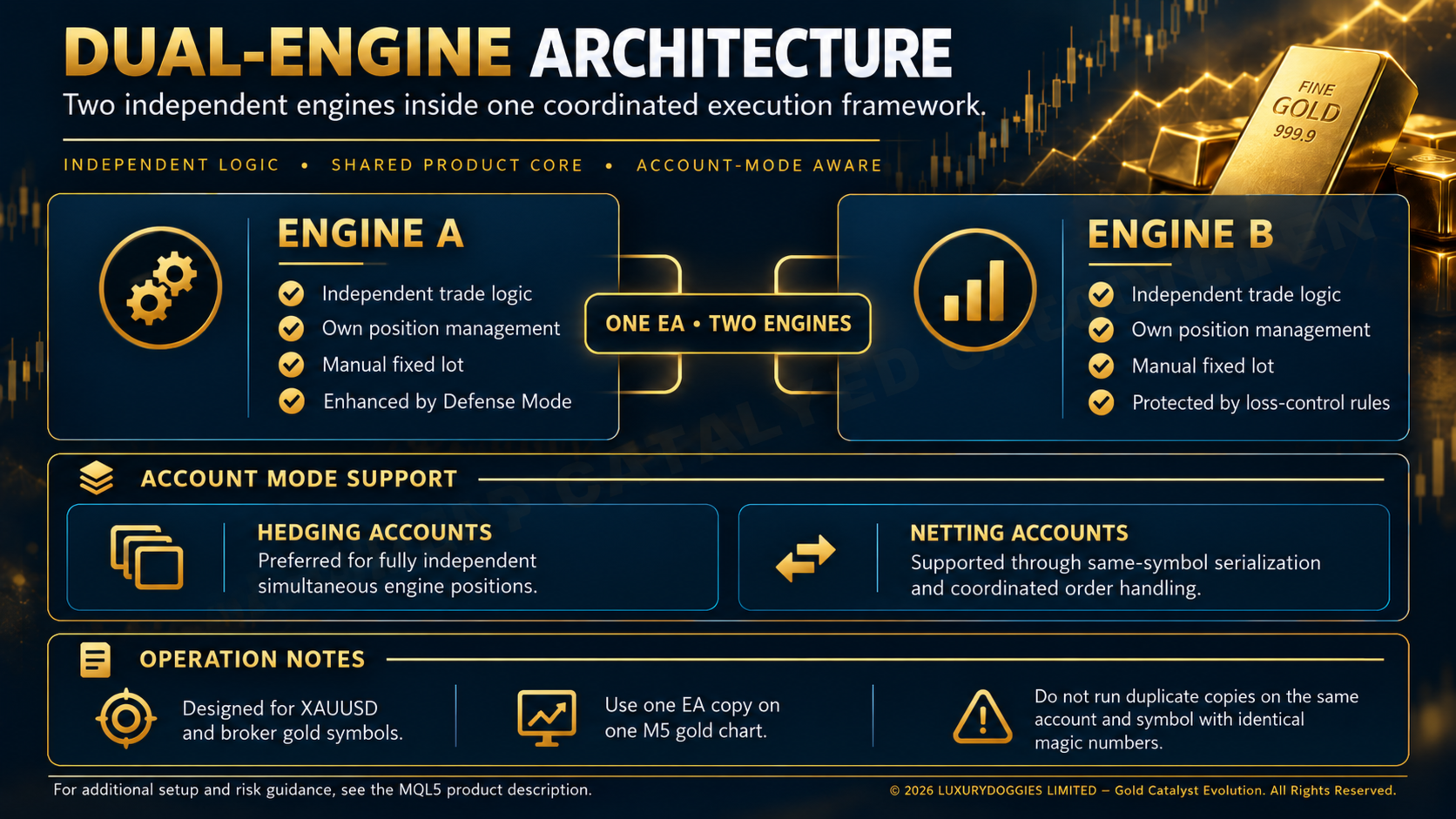 Dual-engine architecture and account-mode support — current product operating illustration; not a performance result.
 What a backtest can show
A backtest can reveal historical trade logic, drawdown, trade frequency, sensitivity to settings, and obvious execution or risk defects. It is useful for comparing configurations and rejecting weak ideas quickly.
Its limitations include data quality, modelled ticks, spread assumptions, missing or simplified slippage, broker-specific symbol differences, and repeated optimization on the same history. A beautiful curve can be the result of genuine structure, overfitting, or both.
What a forward demo can show
A forward demo exposes the unchanged configuration to future prices and current broker timing. It can reveal live spread behavior, order errors, VPS interruptions, and results outside the development sample.
Demo is still not live trading. Liquidity, fills, slippage, rejections, and trader psychology can differ. A forward demo is stronger evidence for unseen-period behavior than an in-sample backtest, but its value depends on duration, trade count, unchanged settings, broker conditions, and transparent record keeping.
What live evidence adds
A small live account can reveal execution effects absent from demo, but “live” does not automatically mean statistically meaningful. A few trades or a short profitable month remain weak evidence. Account statements also require context: deposits, withdrawals, settings, broker, leverage, and whether intervention occurred.
No universal conversion rule
It is too simplistic to say that one year of forward testing always outweighs ten years of backtesting. A short, low-trade forward sample may contain less information than a broad and carefully designed historical test. The strongest evaluation combines multiple forms of evidence and understands each limitation.
The historical Gold Catalyst record
The earlier 2,400+ trade record from March 2024 to July 2026 belongs to a pre-V6 generation monitored on a broker demo account. Its reported near-40% peak-to-low drawdown and other legacy statistics are preserved as historical development evidence. They are not live results, independently audited results, or V6.11 performance statistics.
V6.11 preserves the dual-engine trading core: Engine A is a selective directional engine and Engine B is an independent market-participation engine. Each has separate execution, manual fixed lots, unique magic number, protective levels and position management. The V6.11 additions are Engine A Defense Mode, broker-session-aware Weekend Protection and persistent protection state across terminal restarts.
An honest V6.11 evidence workflow
- Test the exact V6.11 configuration using “Every tick based on real ticks” where available.
- Use relevant broker data, spread, commission, deposit, leverage, and symbol specifications.
- Run sensitivity checks rather than reporting only the best parameter combination.
- Reserve unseen periods for out-of-sample testing.
- Forward-test on demo without changing settings mid-sample.
- If settings or version change materially, label the new record separately.
- Only consider live use at risk you can afford to lose.
Questions to ask any seller
- Which exact version and settings produced each result?
- Was the record backtest, demo, or live?
- Were deposits, withdrawals, intervention, and re-optimization disclosed?
- What was the worst period, and how was drawdown calculated?
- Can the buyer reproduce the setup on their broker?
The current V6.11 specification promises no fixed drawdown level. Evaluate balance drawdown and equity drawdown separately for the exact tested version, engine selection, fixed lots, broker and period. A development screenshot or an earlier version’s observation cannot establish a V6.11 drawdown ceiling or future outcome.
👉 V6.11 Strategy Tester and demo guide
👉 Exact V6.11 setup
👉 Historical pre-V6 stress record
Capital and manual fixed lots in V6.11
- USD 400 minimum suggested entry configuration: Engine A enabled at 0.01 lot; Engine B disabled.
- USD 1,000 dual-engine reference: Engine A at 0.02 and Engine B at 0.04; both engines enabled for this reference.
- At USD 1,000 and above, Engine A only, Engine B only or both engines may be selected according to the reviewed capital and risk profile. Engine B may be reduced or disabled for a more conservative profile.
- Lots are set manually and remain static. There is no automatic balance/equity scaling or profit-based compounding.
- For non-USD accounts, convert account equity to its USD-equivalent value before applying USD-based guidance.
These are operating references, not safety guarantees. Increased lots increase potential gains and losses; each selected engine/lot combination needs evaluation under the operating broker’s conditions.
V6.11 protection and operating defaults
- Engine A Defense Mode: an additional protective state after a configured sequence of full-stop losses; internal recovery handling is automatic.
- Protection state persistence: retains protection state across terminal restarts where applicable.
- Weekend Protection: uses the broker’s session timing to block new entries near the weekly close, close protected EA positions before the weekend and resume after the market reopens.
- Engine B loss controls: daily-loss and consecutive-loss monitoring with cooldown behavior.
- Margin and execution checks: available margin and broker volume requirements are checked before orders are sent.
For normal customer operation, adjust engine selection and manual lots according to the evaluated capital and risk profile. Keep strategy, protection, sealed-profile, filter and diagnostic parameters at the supplied defaults. These controls do not guarantee recovery, exact Stop Loss fills, a maximum drawdown or any trading result.
⚠️ Risk disclaimer: Backtests, demo monitoring, live history, and past performance do not guarantee future results. Trading leveraged products such as Forex and CFDs involves substantial risk.