Gold Catalyst Evolution V6.11 — How to Read a Strategy Tester Report Honestly

Hello traders,
UPDATE NOTE — 8 October 2026
This guide has been updated for Gold Catalyst Evolution V6.11. A tester report is useful evidence only when its data, settings, costs, and limitations are visible. Profit alone is never enough.
👉 Gold Catalyst Evolution V6.11
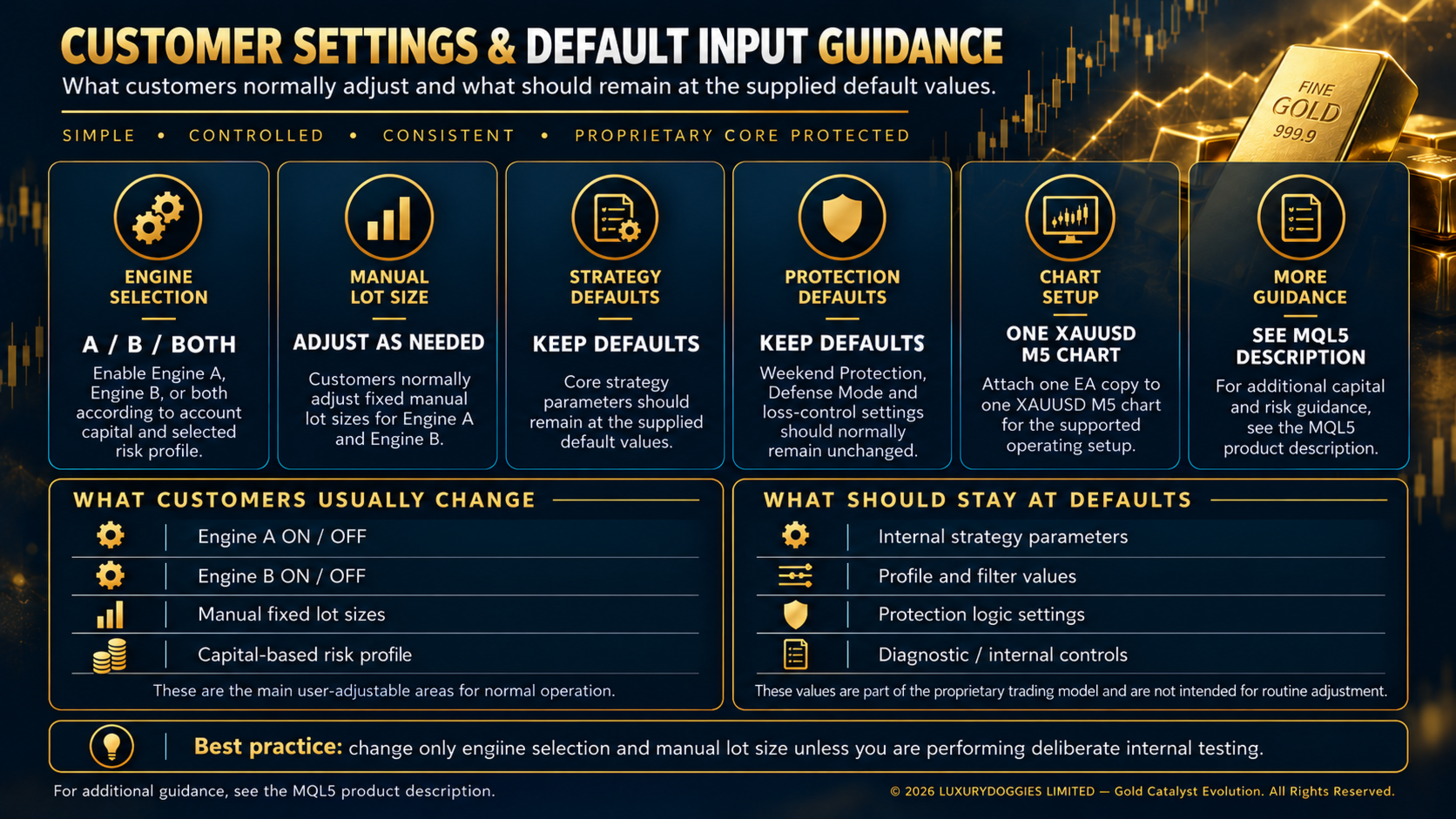 Customer settings and supplied-default guidance — current product operating illustration; not a performance result.
 1) Confirm the exact test identity
- EA version: Gold Catalyst Evolution V6.11
- Gold symbol containing XAU or GOLD
- Timeframe: M5
- Exact date range, deposit, currency, leverage, and account mode
- Every input, including both fixed lots and magic numbers
A report from an earlier version or different settings is not evidence for the current configuration.
2) Check modelling and data
“Every tick based on real ticks” is generally the preferred MT5 mode when intrabar movement can affect entries, stops, or targets. It still does not reproduce every live fill. Check history coverage, missing periods, broker data source, and whether the symbol specification changed during the sample.
3) Include realistic costs
Review spread behavior, commission, swap, and any tester assumptions about execution. Backtests commonly underrepresent slippage, rejections, gaps, and latency. Run additional tests with less favorable costs instead of relying on one optimistic scenario.
4) Match balance and fixed lots
V6.11’s USD 1,000 dual-engine reference lots are 0.02 for Engine A and 0.04 for Engine B. They do not scale automatically with balance. A large test deposit can make the same lots appear safer in percentage terms than they would on a smaller account. Use a balance and leverage relevant to your intended evaluation.
5) Read drawdown correctly
Distinguish balance drawdown from equity drawdown and absolute drawdown from maximal/relative drawdown. Record the calculation method, peak, trough, duration, and recovery—not only the headline percentage. Open-position equity risk may be larger than closed-trade balance data suggests.
6) Separate both engines
Use the distinct engine magic numbers supplied by the installed build to attribute trades. Inspect each engine’s trade count, profit/loss distribution, drawdown, holding time and errors, then inspect the combined account. Strong results from one engine can hide weakness or risk in the other.
7) Respect uncertainty
There is no magic trade count that makes results “true.” A larger, more varied sample is usually more informative, but trade dependence, regime concentration, and a few extreme outcomes can still dominate thousands of trades. Show results by year, regime, direction, and engine where possible.
8) Look for overfitting
Ask how many optimization passes were run, whether neighboring settings behave reasonably, and whether an untouched out-of-sample period was reserved. Parameter stability is helpful evidence, not proof. Repeatedly selecting the best historical result increases selection bias.
9) Stress-test the report
- Wider spreads and higher commissions
- Delayed or worse fills where the tester permits approximation
- Different historical periods and broker data
- Reasonable neighboring input values
- Separate Engine A, Engine B, and combined results
10) Require forward evidence—but label it correctly
A forward demo tests unseen prices and current broker timing, but demo is not identical to live trading. The earlier 2,400+ trade Gold Catalyst record belongs to a pre-V6 generation on a broker demo account. It is not a live record, independently audited evidence, or V6.11 performance.
The current V6.11 specification promises no fixed drawdown level. Evaluate balance drawdown and equity drawdown separately for the exact tested version, engine selection, fixed lots, broker and period. A development screenshot or an earlier version’s observation cannot establish a V6.11 drawdown ceiling or future outcome.
👉 Backtest, forward demo, and evidence hierarchy
👉 V6.11 validation workflow
👉 Exact V6.11 setup
Capital and manual fixed lots in V6.11
- USD 400 minimum suggested entry configuration: Engine A enabled at 0.01 lot; Engine B disabled.
- USD 1,000 dual-engine reference: Engine A at 0.02 and Engine B at 0.04; both engines enabled for this reference.
- At USD 1,000 and above, Engine A only, Engine B only or both engines may be selected according to the reviewed capital and risk profile. Engine B may be reduced or disabled for a more conservative profile.
- Lots are set manually and remain static. There is no automatic balance/equity scaling or profit-based compounding.
- For non-USD accounts, convert account equity to its USD-equivalent value before applying USD-based guidance.
These are operating references, not safety guarantees. Increased lots increase potential gains and losses; each selected engine/lot combination needs evaluation under the operating broker’s conditions.
V6.11 protection and operating defaults
- Engine A Defense Mode: an additional protective state after a configured sequence of full-stop losses; internal recovery handling is automatic.
- Protection state persistence: retains protection state across terminal restarts where applicable.
- Weekend Protection: uses the broker’s session timing to block new entries near the weekly close, close protected EA positions before the weekend and resume after the market reopens.
- Engine B loss controls: daily-loss and consecutive-loss monitoring with cooldown behavior.
- Margin and execution checks: available margin and broker volume requirements are checked before orders are sent.
For normal customer operation, adjust engine selection and manual lots according to the evaluated capital and risk profile. Keep strategy, protection, sealed-profile, filter and diagnostic parameters at the supplied defaults. These controls do not guarantee recovery, exact Stop Loss fills, a maximum drawdown or any trading result.
⚠️ Risk disclaimer: Backtests, demo monitoring, and past performance do not guarantee future results. Trading leveraged products such as Forex and CFDs involves substantial risk.