Volatility as a Trading Edge: Why the Traders Who Fear It Are Missing the Point Entirely

Volatility as a Trading Edge: Why the Traders Who Fear It Are Missing the Point Entirely
Most traders treat volatility as a threat to survive, something to avoid, wait out, or minimize exposure to. This instinct is understandable and almost entirely backwards. Volatility is not the enemy of profit. It is the raw material profit is made from. A market that never moves offers no opportunity at all, regardless of how sophisticated your strategy is. The real skill separating professionals from everyone else is not avoiding volatility. It is building every layer of decision making, position size, stop placement, entry filtering, to adapt intelligently to whatever volatility level currently exists, rather than pretending the market holds still.
This article reframes volatility as a structural edge rather than a danger to be feared, explains precisely why fixed position sizing and fixed stop distances fail the moment real market conditions shift, and breaks down how volatility indicators such as ATR should actually be used to build a genuinely adaptive trading approach.
Why High Volatility Is Opportunity, Not Simply Risk
Consider the alternative. A market with zero volatility, price frozen in place indefinitely, offers precisely zero profit potential to any strategy, no matter how brilliant. Every dollar ever made in trading was made because price moved, and the magnitude of that movement is exactly what volatility measures. Fearing volatility as a category is, in a very real sense, fearing the only mechanism through which trading profit can exist at all.
The genuine danger was never volatility itself. It is unstructured exposure to volatility, a fixed position size or a fixed stop distance that assumes the market will behave with the same intensity today as it did during a calm period last month. That mismatch, not volatility itself, is what actually destroys accounts. Once you separate these two ideas, volatility stops being something to fear and becomes something to structure around deliberately.
The Fatal Mistake: Fixed Sizing and Fixed Stops in a Market That Never Stays Fixed
A stop loss set at an arbitrary fixed number of points, or a position size chosen once and applied regardless of conditions, makes a silent, dangerous assumption, that current volatility will resemble whatever volatility existed when that number was originally chosen. During calm conditions, an oversized fixed stop wastes risk capital on a cushion the market never needed. During genuinely volatile conditions, that same fixed stop, now far too tight relative to normal price swings, gets clipped repeatedly by ordinary noise rather than genuine reversal, an experience every trader has lived through without necessarily understanding why it kept happening.
The deeper issue is that a fixed point value represents a wildly different real exposure depending on current conditions. The same fifty point stop might be comfortably wide during a quiet session and dangerously narrow during a genuinely volatile one. Treating these as equivalent is the single most common structural mistake in retail risk management.
Adapting Position Size to Real Market Volatility
The professional standard solves this by making position size a function of current volatility rather than a fixed number. The principle is straightforward once stated plainly. If your stop distance widens because volatility has increased, your position size should shrink proportionally, so that the actual dollar risk taken per trade remains consistent regardless of how wild or calm the market currently happens to be.
This is precisely the mechanism built into ICONIC BTC AI+ and ICONIC GOLD AI+, where position sizing is derived from a defined percentage of account equity risked per trade, combined with a stop distance calculated from current ATR readings. The elegance of this combination is structural rather than accidental. When ATR widens during a genuinely volatile period, the calculated stop distance widens with it, and because the risk percentage is held constant, the resulting position size automatically shrinks to compensate. When volatility contracts, the reverse happens, tighter stops allow for larger size while the same percentage of equity remains at risk. The system never has to guess. The math enforces volatility adjusted exposure automatically, every single trade.
Adapting Stop Placement Instead of Guessing a Fixed Number
The same logic applies directly to stop placement itself. A stop loss should reflect what the market is actually doing right now, not an arbitrary number chosen once and left unchanged indefinitely. ATR based stop calculation solves this directly, scaling protective distance dynamically with real, current volatility rather than a static point value calibrated for conditions that may no longer exist.
Both ICONIC BTC AI+ and ICONIC GOLD AI+ apply exactly this approach, with stops calculated dynamically from ATR while still respecting an absolute point cap as a final safety boundary, ensuring the stop remains genuinely volatility adaptive without ever becoming unreasonably wide during an extreme, temporary spike.
Volatility Indicators: Reading ATR and Using It Correctly
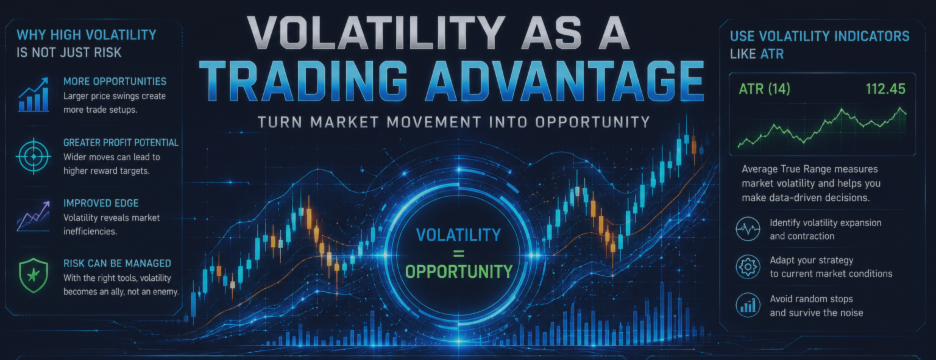
Average True Range measures the typical magnitude of price movement over a defined lookback period, accounting properly for gaps between sessions rather than relying purely on a simple high to low range that can understate real volatility around a gap. Understanding ATR properly opens up several genuinely practical applications beyond simply widening or narrowing a stop.
- Setting stops that scale with reality. As already covered, using a multiple of ATR for stop distance keeps protection proportional to actual current volatility rather than a fixed guess.
- Sizing positions to maintain consistent dollar risk. Combining a fixed risk percentage with an ATR derived stop distance automatically adjusts position size to compensate for changing volatility.
- Filtering entries by minimum volatility distance. A potential structural level sitting too close to current price relative to ATR represents a weak, low quality setup likely to trigger on noise rather than a genuine move. ICONIC BTC AI+ and ICONIC GOLD AI+ both apply a minimum ATR based distance filter specifically to reject levels that fail this basic quality standard before a pending order is ever placed.
- Anticipating a volatility regime shift before it fully arrives. Beyond simply measuring current volatility, identifying compression, a period of unusually tight, contracting range, can signal an approaching expansion. ICONIC HULLX AI incorporates a dedicated volatility band squeeze engine specifically designed to flag this exact compression pattern, one of the clearest early warnings available that a significant volatility expansion may be approaching.
Turning Volatility Into a Genuine Structural Edge
The traders and systems that consistently perform well are not the ones who successfully avoid volatile conditions. Volatility cannot be avoided indefinitely in any market worth trading. The real edge belongs to those whose entire decision architecture, position sizing, stop placement, entry filtering, and regime awareness, adjusts automatically and honestly to whatever volatility level actually exists at any given moment, rather than applying the same fixed assumptions regardless of context. This is precisely the philosophy engineered into the risk layer across the ICONIC.FX lineup, treating volatility as information to be measured and adapted to, never as a threat to be feared or ignored.
Frequently Asked Questions About Volatility as a Trading Edge
Is high volatility always more dangerous for traders? Not inherently. High volatility is dangerous specifically when position size and stop distance remain fixed and fail to adjust, not because of the volatility itself. A properly volatility adjusted approach can trade high volatility conditions safely and profitably.
Why does a fixed stop loss fail across different market conditions? Because a fixed number of points represents a very different real exposure depending on current volatility, too tight during volatile periods, causing frequent premature stop outs, and too wide during calm periods, wasting risk capital unnecessarily.
How does ATR based position sizing actually work? By combining a defined risk percentage of account equity with a stop distance calculated from current ATR, position size automatically shrinks when volatility and stop distance widen, and grows when volatility contracts, keeping actual dollar risk consistent across changing conditions.
What is Average True Range and why is it preferred over a simple price range? ATR measures typical price movement over a lookback period while properly accounting for gaps between sessions, giving a more accurate picture of real volatility than a simple high to low range that can understate movement around a gap.
Can volatility indicators predict an upcoming volatility expansion? Certain patterns, such as a volatility band squeeze indicating unusually tight price compression, can signal that an expansion may be approaching, giving traders an early signal before the move fully develops.
Stop Fearing Volatility. Start Structuring Around It.
Every meaningful profit opportunity in any market exists because price moved, and the size of that movement is precisely what volatility measures. The professional distinction was never about avoiding volatile conditions. It is about building position sizing, stop placement, and entry filtering that genuinely adapt to whatever volatility currently exists, rather than applying the same rigid assumptions regardless of what the market is actually doing.
Explore systems engineered around exactly this principle, including the ATR adaptive sizing and stops of ICONIC BTC AI+ and ICONIC GOLD AI+, alongside the volatility compression detection of ICONIC HULLX AI, at iconicfx.tech.
Risk Disclaimer. Trading foreign exchange, cryptocurrencies, commodities and other leveraged financial instruments carries a high level of risk and may not be suitable for all investors. The high degree of leverage can work against you as well as for you. Past performance is not indicative of future results. Automated trading systems, indicators and Expert Advisors do not guarantee profits and can produce losses. ICONIC.FX provides software tools only and does not provide investment advice, portfolio management or financial recommendations. You are solely responsible for your own trading decisions. Seek advice from an independent licensed financial advisor if you have any doubts.