Why Your Stop Loss Keeps Getting Hit on Gold - And What to Actually Check Before Your Next Trade

I had a trade stopped out around 3 AM once. I don't remember the exact time, but I remember the spread. RAW account, usually runs clean. That night it blew out to something I had no business trading through. Position closed. Price came back fast. Later traded through what would have been my original target.
Annoying? Obviously.
But here's the thing I had to sit with afterward: the broker was not the whole problem. I had placed a normal-session stop in abnormal liquidity conditions. I knew 3 AM was thin. I opened the trade anyway and slapped on the same stop I'd use at 10 AM London. That's on me.
I spent probably two years blaming execution for losses that were actually placement problems. And I've spent the years since trying to think about stop placement more carefully. What follows is how I actually do it now - including where it still fails.
🌟 Fixed Stops Are a Lazy Habit. They're Also Expensive.
Most traders pick a number and stick to it. "50 pips." "100 points." Whatever they're comfortable with.
The problem is gold doesn't care about your comfort number. Daily range on XAUUSD right now sits somewhere around $60–$120 - that's 600 to 1200 points depending on how your broker labels it. A stop that makes structural sense during a quiet Asian accumulation phase is sitting inside one-minute noise after New York opens. Same number, completely different environment.
The other habit I see constantly - and did myself for longer than I want to admit - is placing stops at "obvious" levels. Just below a swing low. Just above the last significant high. The logic sounds right. The problem is these areas attract orders. Lots of them. When enough liquidity clusters at a visible level, price moves through it. Whether that's mechanical or intentional doesn't really matter. The result is the same: you get stopped, price reverses, you stare at the screen.
I'm not saying avoid structure. I'm saying don't assume the obvious level is automatically the correct level.
🌟 Start With Invalidation, Not Distance
This is where I think most stop placement advice gets it backwards.
The question isn't "how many pips should my stop be?" The question is: what price action would prove my original trade idea is wrong?
That's the invalidation point. The stop goes there - or beyond it. Not at a round number. Not at a Fibonacci ratio I copied from a YouTube video. At the point where, if price reaches it, my reason for being in the trade no longer exists.
For a London session BUY entry after an Asian range sweep, the invalidation is usually below the sweep candle low. Not below the session range. Not at the nearest 50-pip increment. Below the candle that defined the sweep. If price comes back through there, the structure I was trading is gone.
For a breakout entry, invalidation is a confirmed return inside the broken level - body close, not just a wick. For a trend continuation entry, it's below the last higher low. The setup defines the location. Always.
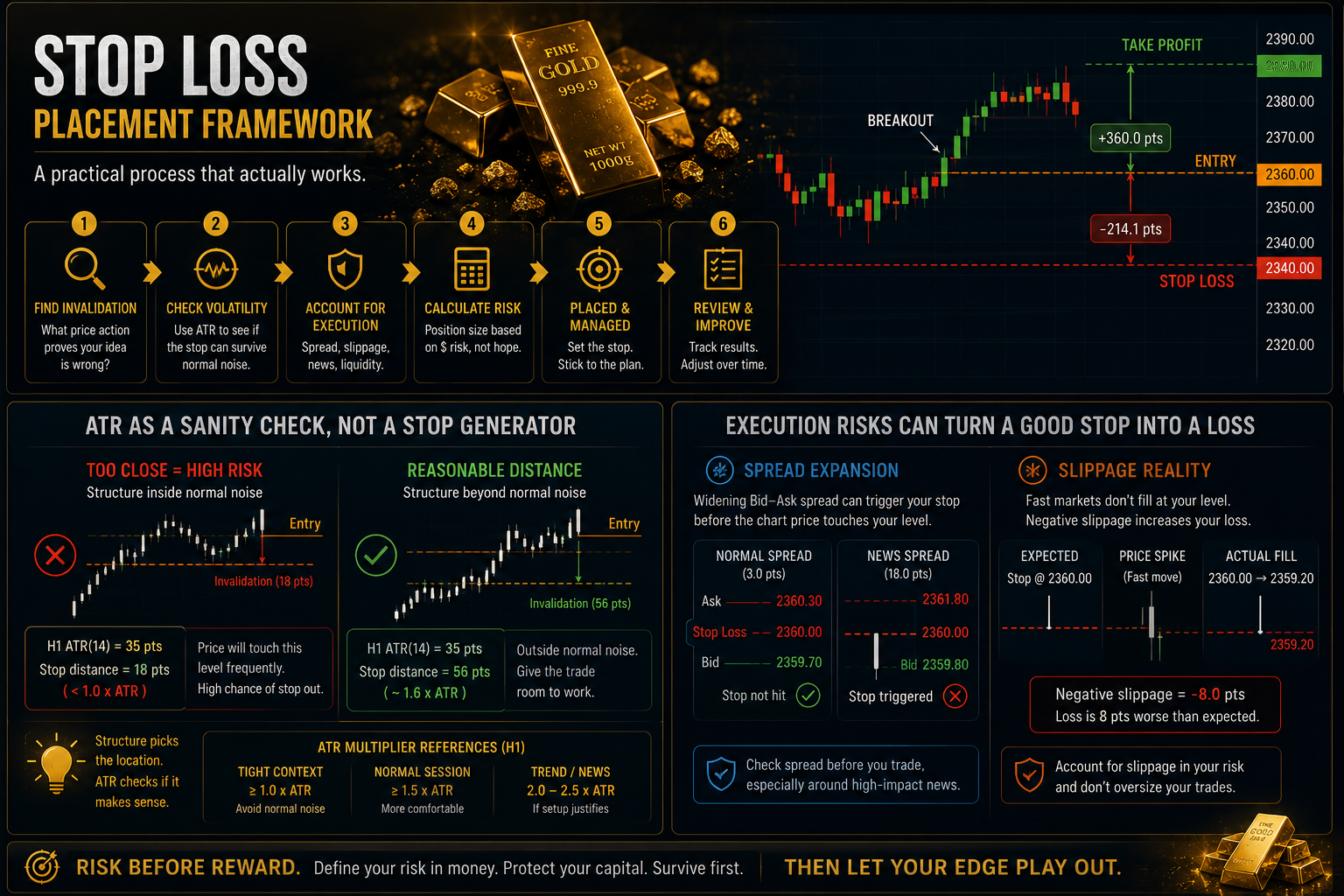
Once I have the structural level, then I look at ATR.
🌟 ATR as a Sanity Check, Not a Stop Generator
I use ATR differently than most people describe it.
I'm not using it to calculate where the stop goes. I'm using it to check whether the structural level I already found is sitting inside normal market noise.
If my invalidation level is 18 points away and the H1 ATR is 35, that's a problem. Price will touch 18 points on a typical candle without any directional intent. My stop isn't wrong structurally - it's just too close to survive normal volatility. I either need a different entry, a different setup, or I don't take the trade.
Conversely, if structure puts my stop 80 points away but ATR is 20, I should ask whether I've misread the invalidation level. An 80-point stop during low volatility probably has too much slack.
The rough reference I use on H1 for XAUUSD:
- Tight context: stop distance should be at least 1.0× ATR to avoid normal noise
- Normal session: 1.5× ATR is more comfortable
- Trend day or news environment: 2.0–2.5× ATR if the setup justifies it
These are starting references only. Structure picks the location first. ATR tells me whether that location is reasonable.
A note on units: I'm expressing movement in price terms here. A move from 4400.00 to 4401.00 is a $1.00 move. Your broker may display this as 10 pips, 100 points, or something else depending on symbol specification. Check before copying any number.
I got tired of recalculating this manually every session and built Gold ATR Risk Calculator MT5 to handle it. It reads ATR across timeframes, takes a multiplier input, and spits out the stop distance reference alongside a position size calculated from a percentage of account equity. The main value isn't the ATR number - it's that it forces me to define monetary risk before I enter, not while I'm already watching a candle move.
What it can't do: identify invalidation structure. That's still a judgment call.
🌟 Spread, Slippage, and the Stuff Backtests Ignore
Even when stop placement is structurally correct, execution can still make it wrong.
On MT5, long and short positions don't trigger from the same side of the quote. A widening Bid-Ask spread can make a stop appear to trigger even when the visible chart hasn't touched your level - because you're looking at Mid or Bid while the Ask is already through. This gets worse during news when spreads can go 10–20× normal. Check how your broker's chart displays the quote before placing tight stops around high-impact events.
Slippage goes the other direction. You have a stop at 4420.00. Price runs through it fast. Your fill comes back at 4419.20. That's 8 points of negative slippage - meaning your actual loss was 8 points worse than the stop implied. It doesn't shrink your stop distance; it expands your loss. Multiply that across a month of trades and it matters.
The practical answer isn't to widen stops arbitrarily. It's to:
Know which sessions have acceptable spreads for your strategy. London open and overlap are different from 3 AM. Check the spread monitor before entry, not after.
Build a small execution buffer into the stop level for setups near news events. If I'm trading a level that could get swept by a spike, I'll push the stop 5–10 points further out - not as a rule, as a conscious decision.
Run an audit on fills. Check what you requested versus what you actually received on stop exits. If you're seeing consistent negative slippage of 5+ points on most exits, that's a broker conversation, not a strategy tweak.
I've done that audit on my own accounts. Switched from a market-maker environment to a RAW ECN setup and the difference in stop fills was noticeable. But I'll say this: don't trust the account label. ECN and RAW are marketing terms as much as technical specifications. Measure the fills on your own history.
🌟 News Candles Deserve a Separate Thought
I'm pulling this out because it's one of the most common ways traders destroy structurally sound positions on gold.
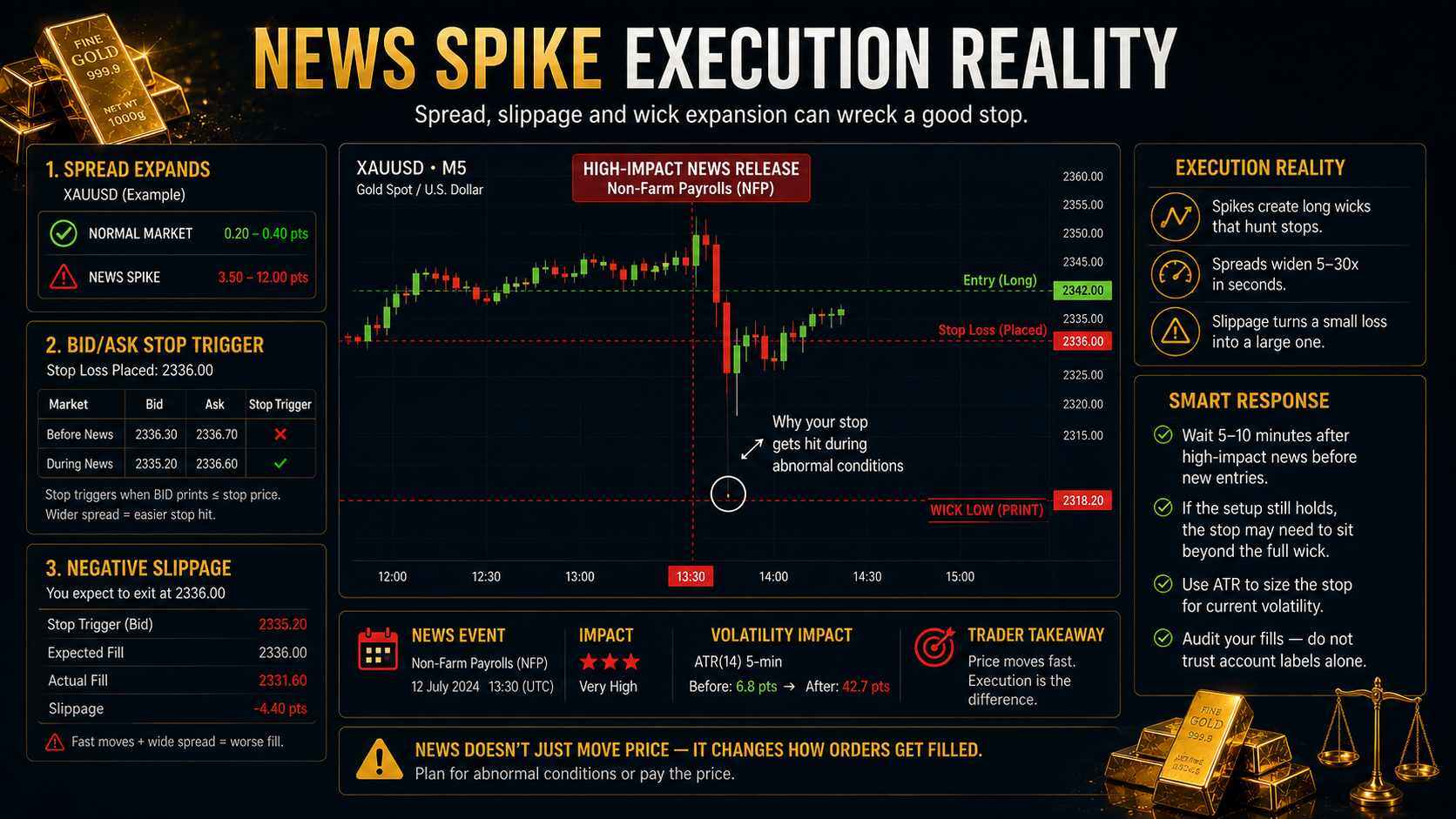
During high-impact news - NFP, CPI, FOMC - gold can move 80–150 points in seconds. The candle's wick will often far exceed the body. A setup that was technically valid before the release may have a completely different structure after.
Two rules I follow that have saved me more than once:
No new entries for 5–10 minutes after release. The initial spike is noise. Price finding its direction after the spike is structure. I'm interested in structure.
For stops on existing positions during news: if the setup remains valid after the spike, the stop generally needs to be beyond the full wick of the news candle, not just the body. The wick defines how far the market reached during the chaos. If price comes back inside that wick range and reverses, the trade may still be alive. If it closes beyond the wick on the next few candles, structure has changed and the stop should have already been hit.
This is not a perfect rule. Sometimes the "valid" wick level is 120 points away and the trade simply isn't worth holding. That's a normal result of running the analysis.
🌟 Position Size Is Part of Stop Placement
This doesn't get said enough: stop distance and risk are not the same thing.
A 100-point stop with 0.05 lots risks different money than a 20-point stop with 0.25 lots. Most traders focus entirely on the stop distance and treat the lot size as a separate decision made afterward. That's backwards.
Monetary risk = stop distance × tick value × position size
The correct sequence is: I know how much I'm willing to lose on this trade (in dollar terms). I find the structural invalidation level. I calculate the stop distance. The position size is the output, not the input.
If the position size that results from this calculation is below minimum lot for the account - or requires leverage I don't want - then the stop is too wide for this account size on this setup. Which might mean the setup isn't worth taking. That's a valid outcome. The calculator doesn't force entries.
🌟 TP Placement: Same Logic, Other Side
Stop placement gets all the attention. TP placement fails in quieter ways - you leave money on the table, or you hold through a reversal trying to get a better price.
For most setups, the first realistic target is at or before the next significant structure level - resistance for longs, support for shorts. If I'm already long and resistance is 40 points away, my TP goes at or slightly before that level. Not beyond it, unless the trade thesis is specifically about a breakout above that resistance and I have reason to believe it'll hold.
Partial closes are underrated on gold because it rotates. A trade up 40 points may give back 20 before running another 35. Holding the full position through that rotation requires conviction I often don't have. Scaling 50% out at a technical target and letting the rest run with a break-even stop is a cleaner way to manage that uncertainty.
Smart TP SL Manager MT5 handles the mechanics of this - one-click level placement at pre-calculated distances, partial close execution, RR confirmation before entry. The reason I built it was fumbling with MT5's native order management while a candle was running. The platform isn't designed for fast manual execution during volatility. The tool is.
🌟 When the Primary Stop Logic Fails
EAs and manual traders both run into this: the stop is placed correctly, but something in the execution chain breaks.
A terminal drops connection and an EA's position update never reaches the server. A partial fill changes the position size and the original stop is now wrong for the new size. A trailing stop locks in at an unfortunate tick because the feed lagged 3 seconds during a spike.
These aren't backtestable scenarios. They show up in production.
For account-level protection - particularly for EA runners - I use Gold Stop Guardian MT5 as a monitoring layer. It watches open positions against configurable loss thresholds and account equity floors. The key word is "layer." It's not a replacement for a broker-side hard stop. If the terminal loses connection, any client-side monitoring tool loses connection with it. Broker-side stops survive a VPS reboot. Client-side rules don't.
Use both. The hard stop at the broker protects against disconnection. The monitoring layer catches operational failures that happen while the terminal is still running.
🌟 What I Stopped Using (And Why)
ATR trailing stops. Effective in clean trends. Gold chops enough that the trailing stop gets hit repeatedly during accumulation phases, eating into equity before any real move develops. I've backtested this extensively. The curve looks fine. The live experience is more friction than the numbers suggest.
Fibonacci levels as primary stop placement. I still use Fibonacci for general reference, particularly the 61.8 and 78.6 retracement levels. But a Fibonacci number by itself has never been reliable enough for me as a stop location. If it overlaps with actual swing structure, it gets weight. Standalone, it doesn't.
"Tight stop, high RR" as a system. This approach backtests beautifully because historical data has clean fills. Live trading on XAUUSD with a 10-point stop means any negative slippage on entry or exit materially changes the trade. I've had setups where the intended entry and actual fill were 4 points apart - that's 40% of the stop gone before the trade even begins. The math only works if execution is as clean as the backtest assumes.
📊 A Full Check Before Entry
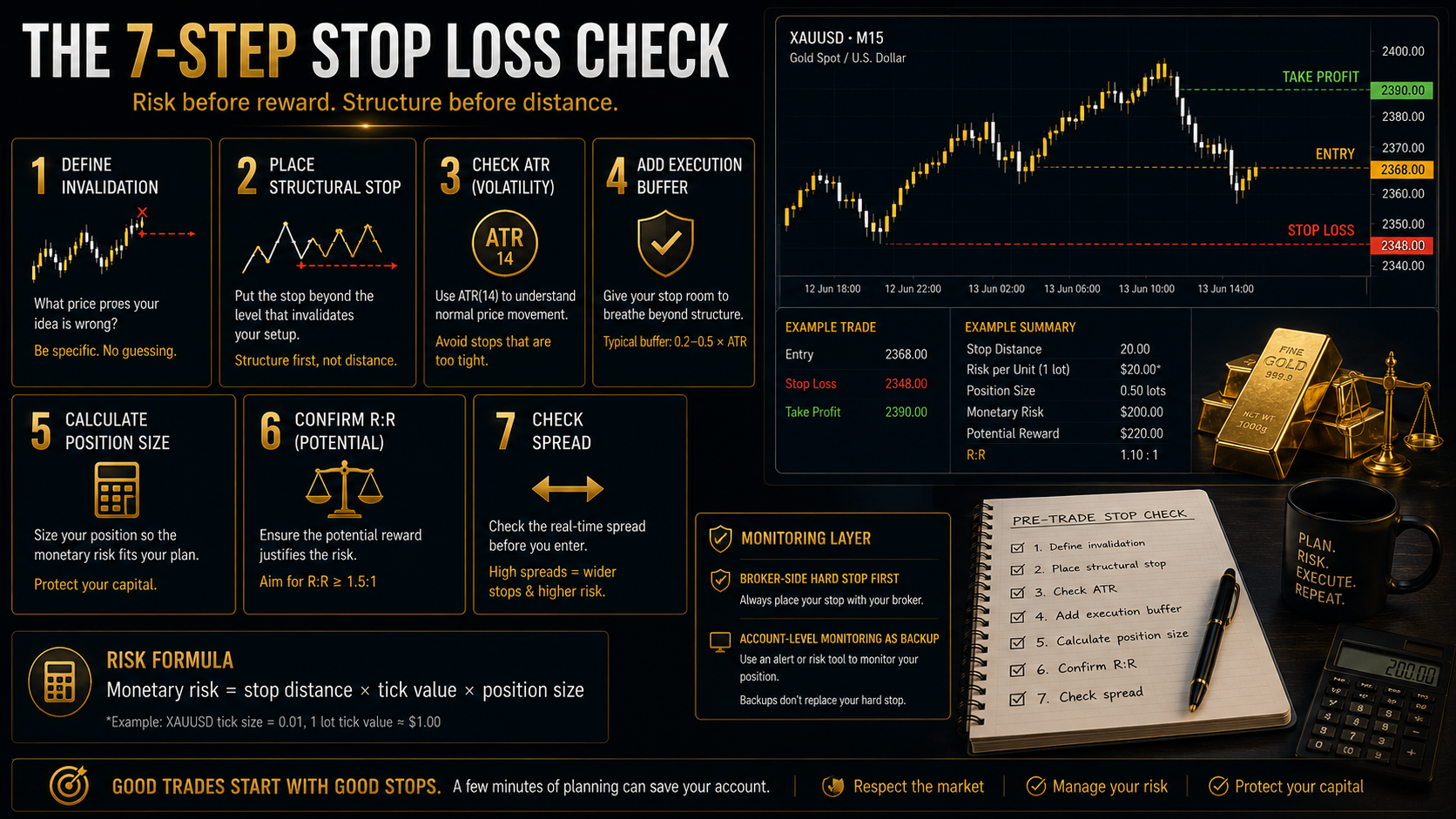
This is the process I actually use, simplified:
1. Define invalidation. What price action makes the trade idea wrong? Where does that happen?
2. Place the structural stop. Beyond the invalidation level, accounting for what the candle structure actually shows. Not at the level - beyond it.
3. Check against ATR. Is the stop distance inside normal noise? Too wide for current volatility? Adjust entry or skip the trade.
4. Add execution buffer for session/event. London open, news window, thin hours - add points accordingly. Not always. Consciously.
5. Calculate position size from the stop. Dollar risk fixed. Stop distance known. Lot size is the output.
6. Confirm the RR. Where's the realistic target? Does the ratio justify the trade given the conditions?
7. Check spread. Is current spread acceptable for this stop distance? If not, wait or skip.
If any step produces a result that doesn't work, I don't trade the setup. That's not a problem with the process. That's the process working.
📢 One Thing I Still Get Wrong
Gold can still run a level, take the stop, and reverse even when everything was correctly placed. That's not always a bad stop. Sometimes the structure was genuine, the timing was off, and the trade would have worked 20 minutes later with a different entry. I still have trouble telling those situations apart in real time.
The tools above don't solve that. Nothing does. They handle the mechanical layer - consistent sizing, consistent placement, execution speed, account monitoring. The judgment layer is still mine to get wrong.
That's where I am after 8 years. Better at the mechanics. Still uncertain about some of the judgment calls. Probably always will be.
Related: Broker execution and spread behavior on XAUUSD - a useful read alongside this post.
🎁 New to Gold Algo Lab?
Start with the Gold Algo Lab Tool Map - a practical guide that organizes our MT5 tools into 6 connected stages: market context, setup selection, risk planning, trade execution, position management and account protection.
→ Gold Algo Lab Tool Map: Where to Actually Start With MT5 Tools for XAUUSD
https://www.mql5.com/en/blogs/post/771930
Do not choose a tool by its name alone. Start with the part of your trading process that needs the most control, then build your workflow one layer at a time.
Gold Algo Lab builds practical, risk-first MT5 tools for serious XAUUSD traders, shaped by 8 years of developing and trading real systems to help traders identify clearer setups, manage risk with greater confidence and execute with more discipline.