Neural Networks in Algorithmic Trading: Why Real AI Systems Are Rewriting the Rules in 2026

Neural Networks in Algorithmic Trading: Why Real AI Systems Are Rewriting the Rules in 2026
Let me say something that most people in this space would rather avoid.
The algorithmic trading industry has a credibility problem so severe that it is genuinely difficult to distinguish products built on years of serious quantitative research from products built on a marketing team updating a product description. Both look identical from the outside. Both use the same vocabulary. Both promise the same outcomes. And yet one of them will quietly destroy your account while the other compounds your capital through mathematical discipline.
This article is about understanding the difference. Not on a surface level, not through vague principles, but in concrete, technical, actionable terms. By the time you finish reading this, you will know exactly what separates legitimate machine learning infrastructure from the majority of products flooding the MQL5 marketplace right now.
The Market Has Fundamentally Changed
Retail traders in 2026 are not competing against other retail traders. They are competing against institutional grade algorithms executing at speeds measured in microseconds, against high frequency systems that have mapped every major liquidity cluster at every key level, and against market makers who structure order flow specifically to harvest stop losses placed at technically obvious locations.
This is not a conspiracy theory. It is the documented, publicly acknowledged reality of how modern financial markets operate. High frequency trading firms account for a substantial portion of daily volume in both forex and major crypto pairs. Their systems are not looking at the same RSI and MACD readings you are. They are processing order book depth, tick by tick aggressor ratio, spread dynamics, and institutional flow signals in ways that are simply inaccessible to any human trader watching a chart.
In this environment, an automated system built on traditional technical indicators is not slow. It is structurally outclassed. The indicators themselves are lagging by design. A 50 period moving average is telling you what the average price was over the last 50 candles. By the time it signals anything, the institutional participants who caused the move are already positioned. You are reacting to their footprint, not acting on your own edge.
Building a sustainable edge in modern markets requires processing information that classical technical analysis does not reach: the raw order flow, the live microstructure of the book, the real time volatility surface, and the statistical signatures of institutional accumulation before it becomes visible on a standard price chart.
Getting to that information and making sense of it requires a completely different class of computational architecture.
What Real Neural Networks Actually Do
A neural network is not a smarter indicator. It is a categorically different approach to processing market information.
The training process is what makes the difference. You feed the network enormous quantities of market data alongside known outcomes. The network makes predictions, measures how wrong those predictions are, and adjusts millions of internal parameters through a process called backpropagation. Repeat this across enough data and enough iterations, and the network develops a representation of market structure that no human developer could have written as explicit rules.
This matters for one specific reason: the network discovers relationships in the data that human analysis would never identify. You do not tell it what to look for. It finds the patterns itself, weighted by their actual statistical relevance to the outcomes you are training toward. Features that carry no predictive signal get pushed toward zero. Features that genuinely matter get amplified. The result is a model that encodes what the data actually contains rather than what a developer believed it contained.
The second crucial component for financial applications is temporal context. Standard neural networks process inputs independently. Market data is not independent. Whether the current price action represents the beginning of a sustained institutional trend or a brief engineered spike before reversal depends entirely on what happened in the hours and weeks before it. Long Short Term Memory networks solve this by maintaining internal memory cells that carry information forward through time sequences. The system does not just see the current candle. It sees the current candle in the context of the structural phase that preceded it, which is the only honest way to distinguish genuine breakouts from manufactured fakeouts.
The third component is reinforcement learning. Rather than training the network to predict a specific output, reinforcement learning trains an agent to make decisions that maximize cumulative reward over time. In trading terms: the system does not try to forecast price. It learns a policy for when to enter, when to exit, and how much to risk, calibrated directly against the risk adjusted outcomes you define. This framing is considerably more aligned with what a trading system actually needs to do than simple directional prediction.
The Epidemic of Fake AI
It would be irresponsible to discuss genuine machine learning in trading without addressing how comprehensively the terminology has been abused.
The mechanics of the fraud are straightforward. A developer builds a conventional indicator based system, runs it through MetaTrader's built in genetic optimizer to find the historically best parameter combination, and then relabels the result as an AI system powered by machine learning. The optimization is called neural processing. The parameter sweep is called deep learning. The resulting product launches with a polished sales page and a backtest equity curve that trends beautifully upward.
What the backtest does not disclose: those parameters were selected specifically because they fit that historical data sequence. When the live market takes a different path, the edge disappears. This is called overfitting, and it is the single most common failure mode in retail algorithmic trading products.
The even more dangerous category is position averaging disguised as intelligent risk management. These systems carry no hard stop losses on individual trades. Instead they accumulate positions against losing trades, adding size as the market moves adversely in order to lower the average entry price. In a ranging or oscillating market, this produces extraordinary looking statistics: high win rates, smooth equity curves, rapid recovery from every drawdown. Then a sustained directional trend occurs, and the position stack spirals into a margin call that the system's mechanics have no way to prevent. The maximum theoretical loss is always one hundred percent of the account. That failure mode is structurally embedded in the mathematics and no optimization or relabeling removes it.
A real machine learning system is technically describable. There is a training process on a defined dataset. There are architectural choices that can be named. There is a clear explanation of what the model predicts and how that prediction interacts with execution. When a developer cannot answer specific technical questions about their system's architecture with concrete specifics, the most likely explanation is that there is no architecture to describe.
ICONIC BTC AI: Execution Built for the World's Most Extreme Market
The Bitcoin market demands a specific approach because its characteristics are unlike any other liquid asset class. Intraday moves of five to ten percent are not rare events. Liquidity at key levels evaporates almost instantly during high volatility episodes. The order book undergoes dramatic structural changes as large participants place and cancel significant orders, generating false signals for any system relying on price chart patterns.
ICONIC BTC AI does not use price chart indicators as its primary input. Its core inputs are order flow and microstructure data: the actual sequence of trades occurring in real time, the structure and depth of the order book across multiple price levels, the behavior of large market orders relative to available liquidity, and the real time dynamics of spread and transaction size distribution.
These inputs are processed through deep learning layers trained extensively on historical tick level data. The model learned to distinguish between price movements representing genuine institutional accumulation and movements engineered to harvest retail stop loss liquidity before reversing. An institutional participant building a significant position leaves a statistical footprint in the microstructure data even when their orders are structured specifically to minimize market impact. The system identifies those footprints and positions accordingly, before the resulting move becomes visible on a standard retail chart.
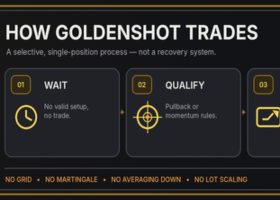
Execution follows a clean, single position model with a defined hard stop loss on every trade. No averaging. No accumulation of losing positions. Every trade has a defined maximum loss before the order is placed. Individual trades lose. That is not a flaw. That is the honest reality of any system that does not hide risk inside position averaging mechanics.
ICONIC NEUROCORE AI: The Cognitive Risk Governance Layer
ICONIC NEUROCORE AI does not function as an execution engine. It functions as the risk governance layer that oversees the entire system and determines whether and how much the execution layer should be operating at any given moment.
Most algorithmic systems apply fixed risk parameters regardless of what the market is doing. When market conditions change radically, these systems continue executing their fixed logic into an environment that no longer resembles the conditions they were calibrated for. Flash crashes, liquidity crises, regime transitions, and high impact economic events all represent conditions where a system running fixed parameters may be systematically taking the wrong level of risk.
NEUROCORE is built on a reinforcement learning framework trained to identify market regimes and quantify the statistical energy of the current market environment in real time. It is continuously comparing incoming market data against the statistical distributions it learned during training. When current conditions fall within the range associated with reliable system performance, full execution proceeds. When the system detects signatures associated with regime deviation or elevated systemic stress, it responds proportionally.
That response can take three forms depending on the severity of what is detected. Position sizing is compressed automatically, reducing exposure across all active execution while maintaining the same number of trades. Stop levels are adjusted dynamically based on current volatility metrics rather than fixed pip parameters, ensuring stops reflect the actual statistical range of price movement rather than an arbitrary number that may be completely inappropriate for current conditions. In extreme cases, execution is suspended entirely until the market environment returns to a measurable, reliable state.
This is not reactive risk management that triggers after a loss has occurred. It is proactive risk reduction implemented before adverse conditions translate into adverse outcomes. The result is a system that does not just manage risk at the individual trade level but manages risk at the portfolio level, across the full range of market conditions it may encounter.
The Philosophy Behind No Grid and No Martingale
Position averaging strategies, regardless of how they are labeled or what technology claims are made about them, share one fundamental mathematical property: the theoretical maximum loss from any trade sequence is the full value of the account. There is no position in a Martingale sequence where you can state the maximum risk in absolute terms. The maximum risk is always the amount remaining in the account before margin is exhausted.
This matters because it makes honest performance comparison impossible. A system generating consistent returns with a twelve percent maximum drawdown through position averaging is not the same risk profile as a system generating the same returns with the same drawdown figure through structured single position logic. The first has a catastrophic tail risk embedded in its mechanics that historical statistics cannot capture because the triggering event may not have occurred during the measurement period. The second's drawdown figure represents an honest worst case boundary.
At ICONIC.FX, every trade that enters the market has a defined maximum loss calculated before the order is placed. That number does not change based on subsequent market movement. The stop is structural. There are no exceptions, and there is no override logic that converts a losing trade into a larger position in order to recover it mathematically. This costs something in terms of individual trade win rates. It earns everything in terms of the honesty and boundedness of the system's actual risk profile.
No Profit, No Fee
The standard subscription model for algorithmic trading products creates a fundamental misalignment between the developer's financial interests and the client's trading outcomes. A monthly fee is charged regardless of whether the system is in drawdown, regardless of whether the account is above or below its previous high, and regardless of whether the underlying logic continues to perform under current market conditions.
ICONIC.FX operates exclusively on a performance fee basis. Revenue accrues only when the trading activity generates net new profits above the previous high water mark. During drawdown periods, no fee is charged. The business earns only when the client earns. That alignment is not a marketing claim. It is the economic structure of every product we offer, and it has a direct effect on what the team is incentivized to prioritize: sustainable, protected capital growth rather than subscriber acquisition regardless of performance outcomes.
For the copytrading service specifically, this means no monthly overhead draining the account during quiet periods, no capital lock in, and complete transparency over every trade executed on the account. The underlying activity is fully visible in real time through the MetaTrader 5 environment.
What the Live Performance Data Shows
Verified live performance is tracked through MQL5 Signals, the independent trade tracking infrastructure built into the MetaTrader ecosystem. Every trade is recorded in real time and cannot be retroactively adjusted. The equity curve, drawdown figures, win rates, and full trade history are publicly accessible and auditable by anyone considering the product.
We do not lead with backtest screenshots as primary evidence of system performance. We lead with the independently tracked live record because that is the only honest basis for evaluation. Backtests are models of what would have happened under simulated conditions. Live tracked performance is what actually happened, with real spreads, real slippage, and real market conditions.
Closing Thoughts
The evolution of algorithmic trading technology has created a real divide in the market: between systems that genuinely use the computational tools now available to quantitative developers and systems that use the vocabulary of those tools as a marketing layer over fundamentally unchanged indicator based logic.
That divide has direct, measurable consequences for traders and investors allocating capital to automated systems. The systems on the wrong side of that divide do not fail randomly. They fail in predictable, structurally embedded ways that are visible before the fact if you know what to look for.
We built ICONIC.FX on the conviction that the only sustainable foundation for this business is systems that actually perform, documented transparently, with a business model tied directly to client outcomes. Everything in our architecture, from the deep learning execution layer to the reinforcement learning risk governance system to the performance only fee structure, follows from that conviction.
The live performance record is publicly available. The architecture is documentable and specific. The risk philosophy is non negotiable.
Evaluate it on those terms.
ICONIC NEUROCORE AI+ is available on the MQL5 Marketplace for MetaTrader 5, supporting XAUUSD and BTCUSD.
Risk Disclosure: Trading in leveraged financial instruments involves significant risk of loss. Past performance does not guarantee future results. Capital is at risk. This content is informational in nature and does not constitute financial advice.