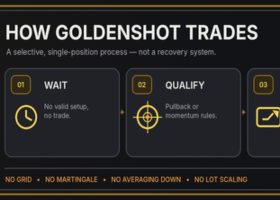
The Mathematics of Capital Protection: Why Risk Management is the Only Real Alpha in Algorithmic Trading
In the hyper-volatile arena of digital assets and quantitative trading, there is a brutal axiom that separates the amateur retail trader from the elite fund manager: The market does not reward courage; it rewards mathematics.
The vast majority of automated trading accounts on MetaTrader 5 and MQL5 do not fail because of an incorrect market prediction. They fail due to a fundamental misunderstanding of asset correlation, catastrophic position sizing, and a complete absence of a structured risk architecture.
When we talk about quantitative trading at ICONIC.FX, we do not talk about catching "the next massive Bitcoin candle." We talk about Clean Risk Architecture - the precise science of engineering automated survival.
1. The Myth of "High Risk, High Reward" in Quantitative Trading
A persistent delusion dominates the retail trading community: the belief that achieving market-beating returns requires accepting outsized risk. This is not trading; it is a statistical death sentence disguised as performance.
An unhedged, over-leveraged account relies entirely on a single directional outcome. Conversely, institutional-grade quantitative systems rely on statistical edges repeated across thousands of iterations.
The fundamental difference lies in the concept of Mathematical Expectancy. A trading system with a high win rate can still bankrupt an account if its average loss is orders of magnitude larger than its average win. By treating risk as a dynamic variable rather than a static afterthought, professional algorithms shift the odds from pure chance to structural inevitability.
2. Decoloring "Performance Theater": Why Grid and Martingale Are Toxic Assets
If you browse the MQL5 Signal market or public copytrading leaderboards, you will find equity curves that look like a perfect 45-degree angle upward - until they suddenly drop to absolute zero. This is Performance Theater, usually powered by toxic money-management loops:
- Retail Strategy (Martingale): Market moves against position -> Double the lot size -> Complete Account Liquidation
- Institutional Strategy (ICONIC): Market hits structural invalidation -> Strict Stop-Loss -> Capital Preserved
The Fatal Flaw of Grid and Martingale Systems
Infinite Capital Assumption: Martingale systems operate on the assumption that you have infinite capital to survive a prolonged directional trend. In reality, the crypto market can trend without a significant retracement far longer than your account can remain solvent.
Risk-to-Reward Distortion: In a grid setup, you risk 100% of your account equity to secure a profit of less than 1%. This is a negative risk-to-reward ratio that fails over any statistically significant timeline.
Hidden Drawdown (The Floating Loss Trap): These bots look profitable because they rarely close trades at a loss. Instead, they leave massive floating drawdowns open, eating away at your free margin until the broker executes a forced stop-out.
At
ICONIC.FX, our philosophy is absolute: We strictly reject Grid and Martingale mechanics. Our systems treat a losing trade for what it is—a data point that has reached its structural invalidation. We cut the loss, protect the core equity, and re-evaluate the market with a clean slate.
3. Core Pillars of Clean Risk Architecture
To build a trading system that survives multi-year market cycles, your risk management must be proactive, non-linear, and hardcoded into the execution layer.
A. Dynamic Position Sizing & Volatility Surface Mapping
Standard trading bots risk a fixed lot size regardless of market conditions. An institutional system assesses the Volatility Surface of Bitcoin before every entry. If the Average True Range (ATR) spikes, the position size must automatically contract to maintain an identical risk profile in terms of absolute currency value.
B. Structural vs. Monetary Invalidation
Amateurs place stop-losses based on arbitrary dollar amounts (e.g., "I will risk $100 on this trade"). Institutional systems place stop-losses based on structural invalidation. The stop-loss is placed at the exact price point where the statistical pattern is proven wrong. The position size is then calculated backward from that point to fit the precise risk tolerance of the portfolio.
C. Correlation and Exposure Management
Trading multiple pairs or assets that are highly correlated to Bitcoin (such as major altcoins) without an exposure ceiling creates systemic risk. A robust risk engine tracks your Total Net Exposure. If multiple algorithms trigger buy signals simultaneously on highly correlated assets, the system must throttle execution to prevent catastrophic compound drawdowns.
4. The Cognitive Superiority of the ICONIC NEUROCORE Engine
The absolute weakest link in any risk management system is the human element. Even with the best strategy on paper, human execution suffers from specific cognitive failures:
Loss Aversion: Moving a stop-loss further away because you "hope" the market will turn around.
FOMO (Fear of Missing Out): Executing sub-optimal trades out of boredom or revenge trading.
Execution Latency: Failing to exit a toxic market structure during high-volatility events due to emotional paralysis.
To eliminate this human vulnerability, we engineered the ICONIC NEUROCORE Engine - a kognitive Entscheidungsebene (cognitive decision layer) that operates entirely above human emotion.
The Neurocore Engine acts as a cold, calculating governor over the ICONIC BTC AI. It features a Deep Learning Layer to identify non-linear data structures in order flow, alongside Adaptive Risk Shielding to continuously adjust position sizes based on real-time volatility surfaces.
It reads institutional order flow and filters out market micro-noise. If Bitcoin’s market structure shifts into a chaotic, low-probability environment, the Neurocore Engine immediately dampens exposure or sidelines the execution bot. It protects your capital by enforcing absolute discipline when human traders are most prone to panic.
5. Conclusion: Treat Trading as an Infrastructure, Not a Lottery
If you want to treat the financial markets like a lottery, the retail market is full of signals willing to sell you that illusion. But if you want to approach the crypto markets as an institutional asset class, you must adopt an institutional risk mindset.
Risky trading behavior is simply a lack of mathematical discipline. By deploying systems built on a Clean Risk Architecture, you stop playing the role of the gambler and start acting as the house. The market always transfers wealth from the undisciplined to the systemic.
Take the Human Factor Out of Your Portfolio
Do not let your financial growth depend on emotional stability or luck. Discover how our hybrid neural-statistical infrastructure can bring institutional-grade risk control to your MetaTrader 5 account.