
The Myth of the Universal Trading Bot
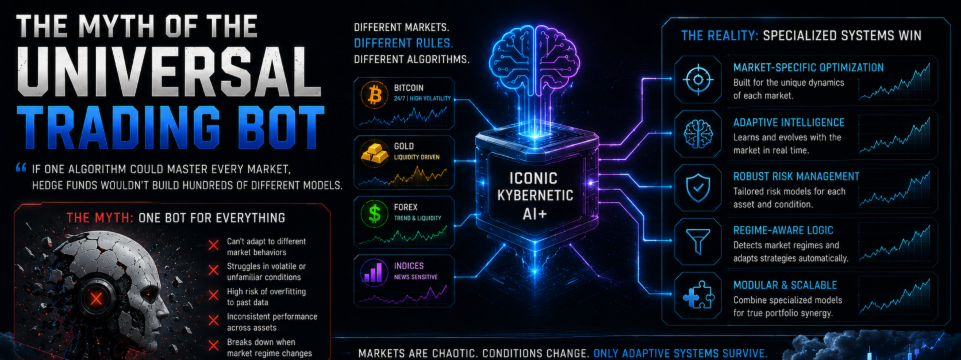
If one algorithm could genuinely master every market, hedge funds would not build hundreds of different models. This single observation should end the debate on its own, but it rarely does, because the myth of the universal trading bot remains one of the most persistent and most expensive misconceptions in retail trading. Somewhere, a product is being marketed right now with language implying it trades everything equally well, Forex, indices, commodities, crypto, all through one shared engine, one shared logic, one shared set of assumptions. The most sophisticated, best resourced quantitative operations on the planet, firms with essentially unlimited research budgets and every incentive imaginable to simplify their infrastructure if a single universal model actually worked, have already tested this idea exhaustively and rejected it in practice, repeatedly, across decades of accumulated institutional experience that retail marketing rarely acknowledges. They do not converge on one model. They build hundreds, each deliberately narrow, each deliberately specialized. This article explains precisely why, in real depth, and why the same principle should shape how you evaluate every trading system you ever consider.
Part One: Why This Question Matters Considerably More Than It Sounds
There is an intuitive but badly mistaken assumption running through a large share of retail trading marketing, that broader capability signals greater sophistication. A system claiming to trade every major asset class sounds, on the surface, more impressive and more valuable than one narrowly focused on a single market. This intuition is not merely wrong, it is backwards, and understanding precisely why requires examining what actually happens inside a model when it is forced to serve fundamentally different underlying realities at once. The stakes here are not academic. Every trader who has ever deployed a supposedly universal system and watched it perform adequately on one asset while quietly bleeding on another has already paid the real cost of this misconception, often without ever understanding why it happened.
Part Two: Why Different Markets Genuinely Possess Different Dynamics
This is worth examining asset class by asset class, in real detail, because the differences are not stylistic. They are structural, driven by fundamentally different participants, fundamentally different information flows, and fundamentally different mechanisms of price formation.
Foreign exchange is, at its core, a relative value market. A currency pair's price reflects the comparative strength of two entire economies against one another, driven substantially by interest rate differentials, central bank policy divergence, and carry trade positioning that can persist for extended periods based on relative monetary policy rather than any single, isolated catalyst. Liquidity in this market ebbs and flows with overlapping global trading sessions, producing genuinely distinct behavior during major session overlaps compared to thinner, quieter overnight hours. A model built to understand Forex has to understand, at a structural level, the relationship between two separate economic systems, not merely the behavior of one instrument in isolation.
Equity indices operate under an entirely different logic again. Price action here is driven heavily by correlated sentiment across many underlying constituent companies, reacting sharply to earnings cycles, sector rotation dynamics, and broad shifts in risk appetite that ripple across dozens or hundreds of individual securities simultaneously. An index is not one asset behaving independently, it is an aggregate expression of collective sentiment across an entire basket of companies, and modeling it correctly requires understanding correlation structure and sentiment contagion in a way that has almost nothing in common with modeling a single currency pair's relative value dynamics.
Gold and broader commodities introduce yet another distinct mechanism. Gold specifically behaves as a macro sensitive safe haven asset, reacting powerfully to interest rate expectations, inflation data, and geopolitical uncertainty in a way most instruments simply do not. A meaningful share of Gold's genuinely tradeable structure is directly tied to scheduled macroeconomic information rather than emerging purely from technical price action, meaning a model genuinely understanding Gold has to weight calendar bound information heavily in a way that would be largely irrelevant noise to a model built for a continuously trading, sentiment driven asset.
Bitcoin and crypto assets represent perhaps the most structurally distinct category of all. Trading continuously with no session structure whatsoever, Bitcoin's price behavior is driven overwhelmingly by sentiment, adoption dynamics and momentum rather than the relative economic comparisons that drive Forex or the macro sensitivity that drives Gold. Its volatility character exhibits genuine long memory, meaning past price behavior continues influencing the present over a longer horizon than conventional models typically assume. And crucially, a very large share of crypto trading activity flows through derivative instruments, particularly perpetual swaps, meaning leveraged positioning and mechanical liquidation cascades can amplify price moves in ways that have no direct equivalent in traditional markets at all.
Four asset classes. Four fundamentally different driving mechanisms, four different information structures, four different volatility characters, four different liquidity dynamics. Pretending a single model can genuinely internalize all four of these realities simultaneously, without compromise, is not ambition. It is a failure to understand what is actually being asked of the model in the first place, and no amount of computational power or clever engineering changes the underlying mathematics of that mismatch.
Part Three: Why Hedge Funds Build Hundreds of Specialized Models Instead of One
This is not a theoretical preference, it is standard, well established practice across the quantitative finance industry, refined over decades of real capital deployed under real market conditions, and the reasoning behind it deserves to be understood rather than simply cited as an appeal to authority. Sophisticated quantitative operations maintain large numbers of genuinely distinct models, each tuned to a specific instrument, timeframe, or market regime, precisely because doing so allows every individual model's assumptions, feature set and calibration to be genuinely optimized for the conditions it actually operates in, rather than averaged into a compromise that serves no single condition particularly well. If a single universal model reliably outperformed this specialized approach, the infrastructure savings alone, one system to build, maintain and monitor instead of hundreds, would create overwhelming pressure to adopt it. That pressure exists, and has existed for decades, and the industry has still converged on specialization rather than universality, which is itself powerful empirical evidence about which approach actually wins in practice rather than merely in theory.
Part Four: The Statistical Argument for Specialization, Made Concrete
The deeper reason specialization wins is genuinely mathematical, not merely a matter of industry convention. A model's parameters, whatever form they take, are implicitly calibrated to the statistical distribution of the data used to train or tune it. When one shared parameter set is forced to serve multiple genuinely different underlying distributions simultaneously, those parameters do not somehow capture the best of every distribution. They converge toward a compromise that fits none of them precisely, a mathematical inevitability rather than a design flaw specific to any one implementation.
Consider a concrete, verifiable illustration. A regime classification threshold tuned to feel reasonable for Gold's comparatively measured volatility character will misfire constantly against Bitcoin's genuinely more violent swings, either triggering far too often on ordinary crypto noise, or, calibrated the other direction to avoid that problem, missing genuine Gold opportunities entirely because the same numeric threshold was never appropriate for both markets at once. This is not a hypothetical concern. Systems that genuinely coordinate multiple markets under one architecture, rather than forcing identical treatment across them, apply meaningfully different calibrated thresholds to the exact same underlying concept, trend strength classification, precisely because a single shared number would misclassify conditions for at least one of the markets involved. When this kind of divergent calibration shows up as a deliberate design choice inside a single coordinated system, it is direct, quantifiable proof that universal treatment fails even within one product built by people who fully understand both markets involved.
What a Genuinely Universal Model Would Actually Have to Sacrifice
It is worth walking through this hypothetically, because the specific sacrifices required become genuinely uncomfortable once stated plainly rather than glossed over. Imagine an engineering team genuinely committed to building one model covering Forex, indices, Gold and Bitcoin equally well. The volatility normalization that correctly scales risk for Forex's comparatively contained ranges would need to be loosened enough to avoid constant false triggers on Bitcoin, directly weakening its precision on Forex in the process. The macro news sensitivity genuinely required to handle Gold correctly would need to be dampened enough to avoid overreacting to irrelevant noise on a continuously trading crypto asset, directly weakening Gold specific performance in the process. The session aware liquidity logic genuinely useful for Forex would need to be stripped out or ignored entirely for Bitcoin, since no equivalent session structure exists there at all, and the momentum persistence assumptions genuinely appropriate for Bitcoin's long memory behavior would need to be muted enough to avoid producing false signals on more mean reverting Forex conditions.
Every single one of these adjustments is not an enhancement. It is a subtraction, a deliberate weakening of the model's precision in one domain specifically to avoid breaking it in another. Stack four asset classes worth of these compromises on top of each other, and what remains is not a universal model that understands everything. It is a model that understands nothing particularly well, a averaged, diluted compromise wearing the marketing language of comprehensive capability. This is not a flaw specific to any one team's engineering effort. It is the unavoidable mathematical consequence of the underlying problem itself, regardless of how skilled or well funded the team attempting it happens to be, and no amount of additional development time changes that fundamental constraint.
Part Five: Why Professional Systems Are Deliberately Optimized for Specific Conditions
Professional quantitative systems do not attempt to maximize generality. They deliberately narrow their operating scope to the specific conditions where their underlying edge is genuinely strongest, and they build explicit mechanisms to recognize and handle conditions outside that scope differently, rather than applying identical logic regardless of context. This is a design philosophy, not a limitation grudgingly accepted. A system that knows precisely which conditions it is built for, and knows precisely how to behave when those conditions are not present, is structurally more trustworthy than one claiming universal competence across every condition simultaneously, because the narrow system's claims can actually be verified, tested, and validated against the specific scope it was built for, while the universal system's claims are, almost by necessity, considerably harder to fully substantiate across the full breadth of what it claims to handle.
The Lifecycle Economics Most Traders Never Consider
There is a further, practical dimension to this entire discussion worth examining honestly, what happens after a system is initially deployed. Markets evolve continuously, and any serious trading architecture requires ongoing recalibration, monitoring and refinement to remain genuinely aligned with current conditions rather than an aging snapshot of the past. A specialized system's maintenance burden is genuinely tractable, refining Bitcoin specific parameters based on Bitcoin specific evidence, refining Gold specific parameters based on Gold specific evidence, each update informed by data genuinely relevant to the component being adjusted.
A universal model's maintenance burden compounds in a far less tractable way. Any adjustment intended to improve performance on one asset risks quietly degrading performance on every other asset the shared model also serves, since the underlying parameters were never cleanly separable in the first place. Diagnosing which specific input caused a given behavioral shift becomes genuinely difficult when every market's data flows through the exact same shared calibration. This is not merely a theoretical inconvenience. It is precisely why the ongoing engineering cost of maintaining a genuinely universal model well tends to exceed the cost of maintaining several smaller, cleanly separated specialist systems, even before accounting for the performance compromises already covered above.
Part Six: How Modular, Specialized Architecture Is More Robust Than a Universal One
This is where the robustness argument becomes concrete rather than merely theoretical. A modular system built from genuinely specialized components tends to be considerably more robust in aggregate than one universal model attempting to cover every condition, for three specific, verifiable reasons.
- Isolated failure modes. When a specialist component genuinely tuned to one specific market or condition degrades or underperforms, that degradation does not automatically propagate into every other component of the system. A universal model has no such isolation, a flaw or a genuine shift in one dimension of its combined training data can quietly distort its behavior everywhere else it operates simultaneously.
- Independent verification. Each specialist component can be tested, audited and validated against its own specific, narrow domain, a considerably more tractable task than attempting to fully verify one opaque model's behavior across every condition it claims to handle at once. Specialization makes claims checkable. Universality tends to make claims considerably harder to fully substantiate.
- Independent evolution. A specialist component can be upgraded, retrained or replaced entirely without destabilizing the rest of a modular system, since its scope of responsibility is genuinely bounded. A universal model rarely offers this same flexibility, since every component of its shared logic is entangled with every other, making meaningful, isolated improvement considerably harder to achieve safely.
Part Seven: Coordination Without Sacrificing Specialization, the Architecture That Actually Solves This
This is precisely where ICONIC KYBERNETIC AI+ becomes the clearest possible demonstration of everything argued throughout this article, not an exception to the thesis, but its most complete expression. ICONIC KYBERNETIC AI+ is explicitly not a single universal model applied blindly across two markets. It maintains two genuinely isolated, specialist brains, one tuned specifically to Bitcoin's continuous, momentum driven character, one tuned specifically to Gold's macro sensitive, news driven character, each with its own independently calibrated parameters, thresholds and learned state, precisely the modular specialization this entire article has argued is structurally superior to a shared, compromised alternative.
What elevates this beyond simple isolation is the coordination layer sitting above these two specialists, the OMNI NEXUS core, built on a binned Transfer Entropy causal gate measuring the genuine directed flow of influence between Bitcoin and Gold, and Stochastic Tunneling capital allocation searching for a mathematically balanced distribution of risk between the two. This coordination layer manages the relationship between the specialists without homogenizing their individual specialization, each brain remains free to behave according to what its own specific market actually demands, while the coordinating intelligence above them handles portfolio level risk and genuine cross market relationship, the best of both approaches operating together rather than forcing a false choice between specialization and coordination. This is not a universal bot wearing a sophisticated label. It is precisely the modular, specialized, coordinated architecture this article has argued professional systems should be built around, implemented directly rather than merely described.
Part Eight: What This Means for How You Should Evaluate Any Does Everything Trading Product
Everything covered throughout this article converts directly into a practical evaluation standard. Treat any single system claiming equal, undifferentiated mastery across genuinely different asset classes, with no meaningful internal specialization visible anywhere, with real skepticism rather than admiration for its apparent versatility. Look specifically for evidence of genuine, asset specific tuning even within systems that legitimately handle multiple markets, different calibrated thresholds, different feature weighting, different risk parameters, rather than one shared configuration quietly reused everywhere. And understand that genuine multi asset capability, when it is real, comes from coordinated specialists working together under principled governance, not from forcing one compromised model to become a jack of all trades across markets it was never built to genuinely understand.
It is worth noting honestly that not every legitimate multi market tool violates this principle, symbol agnostic signal engines built around probability calibration and multi timeframe scoring, such as ICONIC TITAN AI, can legitimately be applied across different instruments without the same structural mismatch, because their intelligence comes from statistical calibration and quality gating rather than assumptions baked in about any one specific market's personality. The distinction that actually matters is not whether a tool touches multiple markets at all, it is whether it does so through genuine specialization and calibration, or through a naive, one size fits all shortcut pretending every market behaves the same way underneath the surface.
The Broader Lesson Beyond Trading Alone
This principle extends well beyond algorithmic trading specifically, and recognizing that broader pattern makes it easier to trust. Genuinely elite performance in almost any complex domain comes from deep specialization coordinated deliberately, not from a single generalist attempting to cover everything adequately. Medicine organizes around specialists rather than one physician claiming equal mastery of every subfield. Engineering organizes around distinct disciplines working together rather than one engineer designing an entire aircraft alone. The myth of the universal trading bot survives specifically because trading software feels abstract enough that this same, otherwise obvious principle gets forgotten, replaced by the comforting but false idea that a sufficiently clever algorithm can simply absorb every market's complexity into one shared brain. It cannot, for the same structural reasons no other complex domain works that way either.
Frequently Asked Questions
Why don't hedge funds just build one universal trading model? Because forcing one shared parameter set to serve multiple genuinely different market distributions produces a mathematical compromise that fits none of them precisely, and specialized models allow each one's assumptions and calibration to be genuinely optimized for the specific conditions it actually operates in.
Are Forex, indices, Gold and Bitcoin really that different from each other? Yes, structurally. Forex is a relative value market driven by interest rate differentials, indices reflect correlated sentiment across many constituent companies, Gold reacts to macro and geopolitical events as a safe haven, and Bitcoin is driven primarily by sentiment and momentum with a continuous, session free trading structure unlike any of the others.
Is a modular, specialized system actually more robust than a universal one? Yes, for three specific reasons, isolated failure modes that do not automatically propagate across the whole system, independent verification of each specialist's narrow claims, and the ability to upgrade or replace individual components without destabilizing the entire architecture.
How does ICONIC KYBERNETIC AI+ avoid the universal bot problem while still trading two markets? It maintains two genuinely isolated, independently calibrated specialist brains, one for Bitcoin and one for Gold, coordinated by a separate causal and allocation layer that manages their relationship without forcing either specialist to compromise its own market specific tuning.
Is it ever legitimate for one tool to handle multiple markets? Yes, specifically for symbol agnostic tools built around statistical calibration and probability scoring rather than asset specific execution rules, since their intelligence comes from genuine calibration rather than an assumption that every market behaves identically underneath the surface.
What should I look for to spot a genuinely specialized multi market system versus a naive universal one? Evidence of meaningfully different calibrated thresholds, feature weighting or risk parameters across the different markets it handles, rather than one shared configuration quietly reused everywhere regardless of the underlying asset.
Does specialization mean a system can only ever trade one market forever? No. Specialization describes how a system's intelligence is built and calibrated, not how many markets it can ultimately cover. A well engineered architecture can genuinely expand to new markets by adding new, independently tuned specialists under the same coordinating framework, exactly the model demonstrated by pairing dedicated single asset systems alongside a coordinated multi asset flagship within one lineup.
Professional Trading Isn't About One Bot for Everything, It's About Using the Right System for the Right Market
The myth of the universal trading bot survives because it sounds efficient and impressive on the surface. The reality, proven by the practice of the most sophisticated quantitative operations on earth and confirmed by the underlying mathematics of how models actually work, is the opposite. Genuine capability comes from specialization, genuine multi market intelligence comes from coordinated specialists rather than a single compromised model, and genuine robustness comes from modular architecture rather than forced universality. The next time a product promises to master every market equally well with one shared engine, remember exactly why the firms with the deepest resources and the strongest incentive to find that shortcut have never actually found it.
Explore the specialized, coordinated architecture built around exactly this principle, including ICONIC BTC AI+ and ICONIC GOLD AI+ as dedicated specialists, the flagship ICONIC KYBERNETIC AI+ as coordinated dual asset intelligence, and ICONIC TITAN AI for genuinely calibrated multi market signal awareness, at iconicfx.tech.
Risk Disclaimer. Trading foreign exchange, cryptocurrencies, commodities and other leveraged financial instruments carries a high level of risk and may not be suitable for all investors. The high degree of leverage can work against you as well as for you. Past performance is not indicative of future results. Automated trading systems, indicators and Expert Advisors do not guarantee profits and can produce losses. ICONIC.FX provides software tools only and does not provide investment advice, portfolio management or financial recommendations. You are solely responsible for your own trading decisions. Seek advice from an independent licensed financial advisor if you have any doubts.