What Separates Professional Trading Systems from Consumer Trading Bots?

What Separates Professional Trading Systems from Consumer Trading Bots?
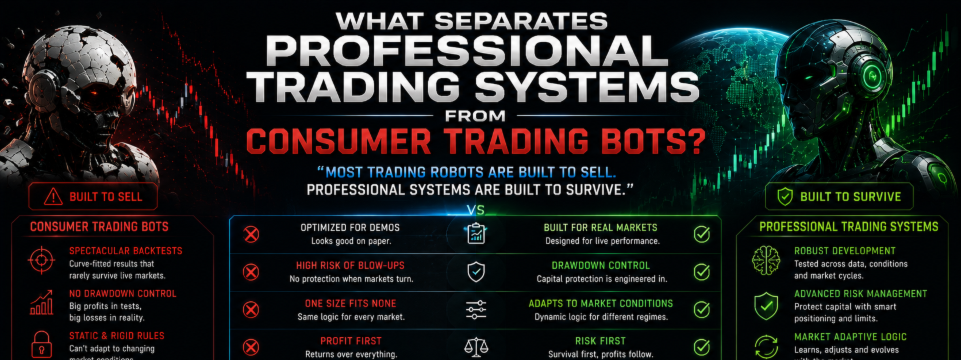
Most trading robots are built to sell. Professional systems are built to survive. This single distinction, rarely stated this plainly, explains almost every technical difference this article is about to cover, because the four specific differences that actually separate professional architecture from consumer marketing are not a random collection of features. They are the predictable, downstream consequence of one deeper decision made before a single line of code was ever written, what the system was actually optimized to achieve.
Part One: The Incentive That Shapes Everything Downstream
A system built primarily to be sold is optimized for whatever metric makes its sales pitch compelling in the moment, most often one impressive backtest or a flashy early live screenshot capable of converting a purchase decision quickly. A system built primarily to survive is optimized for what actually matters across years of real deployment, genuine consistency, controlled drawdown, and honest adaptability. This is not a minor difference in emphasis. It is a completely different optimization target from the very first design decision, and every specific technical failure covered throughout this article, curve fit backtests, oversized risk, rigid unchanging rules, is not a random engineering mistake. It is the entirely predictable output of optimizing for how a product looks at the moment of purchase rather than how it behaves for the years afterward.
Part Two: Robust Development Instead of Spectacular Backtests
A system built to sell needs exactly one impressive historical curve, and has no structural incentive to test that curve against genuinely unseen data that might reveal it does not generalize. A system built to survive requires real, rigorous out of sample and walk forward validation, not because its developers are more virtuous in the abstract, but because their actual incentive is genuinely aligned with the system working after deployment, not merely appearing to work at the exact moment someone decides to buy it. Robust development is not an extra feature layered on top of a good backtest. It is what naturally happens when the builder's own success genuinely depends on the system surviving contact with real, unseen conditions.
Part Three: Drawdown Control as a Design Priority, Not an Afterthought
A system built to sell has every incentive to downplay drawdown discussion, since a serious conversation about maximum historical loss actively works against the sales pitch. A system built to survive treats drawdown control as a primary design constraint from the outset, because genuine survival depends mathematically on capital preservation considerably more than it depends on maximizing upside, a fifty percent drawdown demands a full one hundred percent gain simply to recover. When drawdown control is genuinely central to the design process rather than a footnote added afterward, it shows up as hard, structurally enforced boundaries rather than an optional setting quietly buried in a configuration menu.
Part Four: Adaptation to Market Conditions as Insurance, Not a Marketing Feature
A static, set and forget system is genuinely easier to market, simpler to explain, cleaner to demonstrate, and requires no ongoing engineering investment after the sale is complete. A system built to survive needs continuous, genuine adaptation, because its builders remain accountable for what happens long after the transaction closes, not merely for how convincing the product looked in the moment someone decided to purchase it. Adaptation, in a professionally built system, is not a headline feature designed to sound impressive. It is structural insurance against the certainty that market conditions will eventually diverge from whatever conditions existed when the system was first calibrated.
Part Five: Risk Minimization Over Profit Maximization as the Actual Objective
Here is the difference that shows up directly in how the underlying engineering problem is framed from day one. A system built to sell is implicitly optimized to maximize the specific number that appears in marketing material, headline return. A system built to survive is implicitly optimized to minimize the probability of catastrophic failure first, with profit pursued only as a secondary objective constrained by that primary boundary. These are not two versions of the same optimization problem with different settings. They are genuinely different objective functions, and a system's entire architecture, from position sizing to stop placement to how aggressively it pursues any given setup, reflects which of these two objectives it was actually built to serve.
Part Six: Long Term Stability as the Actual Development Goal
Every technical difference covered above collapses into a single, unifying explanation. All of it is simply what naturally happens when the honest development question guiding every decision is whether the system will still be genuinely trustworthy three years from now, rather than whether its screenshot converts a sale this month. Long term stability is not one feature among several a professional system happens to include. It is the actual goal every other design decision quietly serves.
Where This Alignment Actually Shows Up
The clearest external evidence of this alignment is not a technical specification at all, it is the incentive structure a provider operates under. Performance based copytrading, offered under a No Profit No Fee model, binds the provider's own outcome directly to the client's genuine, sustained results, structurally the same incentive alignment professional, survival oriented development requires internally. This is precisely the philosophy underlying ICONIC BTC AI+, whose continuously adaptive neural architecture, ATR based dynamic risk sizing, and categorical rejection of grid and martingale reflect engineering built for years of real deployment rather than one impressive month. The flagship ICONIC KYBERNETIC AI+ extends this same philosophy to its most uncompromising expression, a Physics Informed margin floor enforced as unbreakable structural law, a three tier portfolio drawdown framework that escalates automatically rather than depending on a human noticing danger in time, and a continuously self calibrating confidence gate that keeps the system honestly validated against live evidence rather than resting on a single historical claim. Neither system was engineered around what would look impressive at the moment of purchase. Both were engineered around what would remain genuinely trustworthy years afterward.
Frequently Asked Questions
What is the single biggest difference between a professional trading system and a consumer trading bot? The underlying incentive the system was optimized for, whether it was built primarily to look impressive at the moment of sale, or built primarily to remain genuinely trustworthy across years of real deployment afterward.
Why does drawdown control matter more than headline returns in professional system design? Because capital preservation is mathematically more important than maximizing upside, a fifty percent drawdown requires a full one hundred percent gain simply to recover, making drawdown control a primary survival requirement rather than an optional feature.
Why do consumer trading bots tend to rely on rigid, unchanging rules? Static systems are easier and cheaper to market and demonstrate, and require no ongoing engineering investment after the sale, an incentive structure that favors simplicity over the continuous adaptation genuine long term survival actually requires.
How can a trader tell whether a provider's incentives are genuinely aligned with their own results? Performance based structures, such as a No Profit No Fee copytrading model, directly bind the provider's own outcome to the client's sustained results, a structural signal of alignment that a one time product sale simply does not provide.
The Difference Isn't Automation, It's Engineering
Automation alone explains nothing about whether a trading system deserves your trust. The real difference was always the incentive shaping the engineering underneath it, whether a system was built to convert a sale or built to survive everything a real market eventually throws at it.
Explore systems engineered for genuine, long term survival rather than a single impressive screenshot, including ICONIC BTC AI+ and the flagship ICONIC KYBERNETIC AI+, at iconicfx.tech.
Risk Disclaimer. Trading foreign exchange, cryptocurrencies, commodities and other leveraged financial instruments carries a high level of risk and may not be suitable for all investors. The high degree of leverage can work against you as well as for you. Past performance is not indicative of future results. Automated trading systems and Expert Advisors do not guarantee profits and can produce losses. Backtests and simulated results have inherent limitations and do not represent actual trading. ICONIC.FX provides software tools only and does not provide investment advice, portfolio management or financial recommendations. You are solely responsible for your own trading decisions. Seek advice from an independent licensed financial advisor if you have any doubts.