The Holy Grail of Algorithmic Trading: Why Your Portfolio Matters More Than Your Strategy

Introduction
You found a great EA.
The backtest looked solid. Consistent equity curve, reasonable drawdown, good risk/reward. You ran the optimization, picked the best parameters, and went live. For a few months, it worked. Then it didn't.The drawdown stretched longer than the backtest suggested. You held on. It recovered partially. Then dropped again. You started questioning everything: the parameters, the broker, the timeframe. Maybe the market had changed. Maybe the strategy was broken. Maybe you just needed a better EA.
So you went looking for another one.If this sounds familiar, you are not alone and more importantly, you were not making a mistake with your EA. You were making a mistake with your approach.
The Trap of the Perfect Strategy
The search for the perfect strategy is the most common and most costly mistake in systematic trading. It is built on a false premise: that somewhere out there exists a single system capable of performing consistently across all market conditions, indefinitely. It does not exist.Every strategy is, by design, optimized for a specific type of market behavior. Trend-following systems thrive in directional markets and bleed during prolonged consolidations. Mean-reversion systems perform well in ranging conditions and get destroyed during strong breakouts. Volatility-based systems have their own windows of edge and periods of silence.
Markets are not stationary. They cycle through regimes — trending, ranging, high volatility, low volatility — and no single strategy holds its edge across all of them. When your EA underperforms, it is often not broken. It is simply operating outside its optimal regime.
The solution is not to find a better strategy. The solution is to stop relying on just one.
What the Nobel Prize and the World's Largest Hedge Fund Have in Common
In 1952, economist Harry Markowitz published a paper that would eventually earn him the Nobel Prize in Economics. His insight was deceptively simple: combining assets that do not move together reduces the overall risk of a portfolio without proportionally reducing its expected return. The mathematics showed that diversification — real diversification, based on low correlation, not just holding more of the same thing — was the most reliable way to improve the quality of returns.
Decades later, Ray Dalio, founder of Bridgewater Associates — the largest hedge fund in the world — had what he described as his biggest "aha!" moment in investing. He asked a mathematician to chart what would happen to a portfolio's risk and return quality as you incrementally added uncorrelated return streams.
The result stopped him cold.
"I saw that with fifteen to twenty good, uncorrelated return streams, I could dramatically reduce my risks without reducing my expected returns. It was so simple but it would be such a breakthrough... I called it the Holy Grail of Investing because it showed the path to making a fortune."
— Ray Dalio, Principles
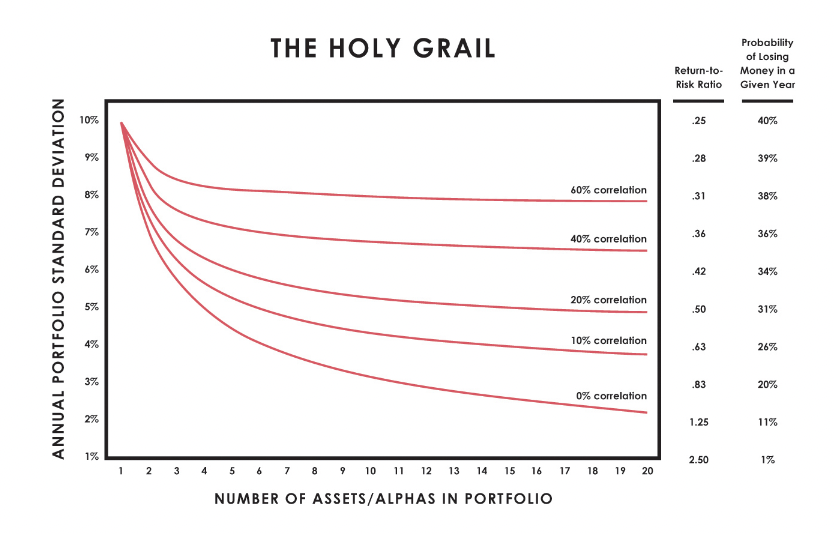
The chart showed that improving returns per unit of risk by a factor of 3 to 5 times was achievable — not by finding better strategies, but by combining good-enough strategies with low correlation between them.
This is not a theoretical abstraction. It is the operating principle behind the most successful systematic trading operations in history.
The key insight is worth repeating: you do not need perfect strategies. You need good-enough strategies that are sufficiently uncorrelated with each other. Five highly correlated strategies behave almost like one. Fifteen low-correlation strategies behave like a fundamentally different — and far more resilient — system.
The Portfolio Approach in Practice
Applying this principle to algorithmic trading means running multiple EAs simultaneously, each targeting different instruments, different market regimes, or different logic — with risk distributed across all of them.
The practical benefits are immediate:
- Drawdown smoothing — when one strategy is in a losing streak, others are likely in different phases of their cycle, cushioning the equity curve.
- More consistent compounding — a smoother equity curve compounds more efficiently over time than a volatile one with the same average return.
- Regime resilience — the portfolio as a whole is less dependent on any single market condition to perform.
- Reduced ruin risk — no single strategy failure can destroy the account.
This is not about diversifying for the sake of it. It is about deliberately selecting strategies with different behavioral profiles and letting the mathematics of low correlation do the heavy lifting.
The Problem Nobody Talks About: Testing a Portfolio in MT5
At this point, you are probably convinced. Running a portfolio of strategies makes sense. So you open the MT5 Strategy Tester, load your first EA on XAUUSD, run the backtest. Then you load the second EA on EURUSD. Then a third on GBPUSD.
You have three separate equity curves. Three separate reports. Three separate drawdown figures. But what you actually need to know is: what does the combined portfolio look like? What is the real drawdown when all three are running simultaneously? What is the true equity curve of the system as a whole?
The MT5 Strategy Tester was not designed for this. It runs one EA on one symbol at a time. There is no native way to consolidate multiple backtests into a single portfolio-level view. You can try to manually combine the results in a spreadsheet, but that approach loses the time-dimension entirely — it cannot show you what happens when two strategies are simultaneously in drawdown, or when their open positions overlap in time.
Now, a reasonable question arises: why not simply build one EA that trades multiple symbols at once? It is a valid approach, and it does exist. But it comes with real trade-offs that are rarely discussed honestly.
The first is complexity. A multi-pair EA must simultaneously manage signals, positions, and state across several instruments. The logic that works cleanly for a single symbol becomes entangled when applied to five or ten — edge cases multiply, execution flow becomes harder to reason about, and bugs become harder to isolate. What looks like a strategy problem may actually be a code problem, and vice versa.
The second is strategic fit. Not every strategy belongs on every instrument. A logic that captures Gold's volatility structure may be poorly suited to a currency pair with different liquidity dynamics and spread behavior. Forcing a single EA to operate across mismatched instruments in the name of convenience often means accepting suboptimal performance on most of them. Separating strategies by instrument — and optimizing each independently — tends to produce more robust results precisely because it respects the behavioral differences between markets.
The third is risk management. In a multi-pair EA, position sizing, exposure limits, and drawdown controls must account for all instruments simultaneously, within a single codebase. This is not impossible, but it is significantly harder to implement correctly, audit, and maintain over time. A bug in the risk logic affects everything at once. In a portfolio of independent EAs, risk is naturally compartmentalized — a problem in one does not cascade into the others.
Finally, there is maintenance. Markets evolve. Parameters that worked well on EURUSD last year may need recalibration today. In a monolithic multi-pair EA, updating one instrument's parameters risks unintended side effects on the others. With separate EAs, each component can be updated, replaced, or retired independently — without touching the rest of the portfolio.
None of this means multi-pair EAs are wrong. It means they carry hidden costs that compound over time. The portfolio approach — running independent, purpose-built EAs in parallel — is not just theoretically cleaner. It is operationally more honest.
This is the gap between knowing that portfolio trading is the right approach and actually being able to validate it with data.
The PFA System: Portfolio Analysis Inside the Strategy Tester
The Portfolio Analyzer (PFA) was built specifically to close this gap. It is a three-component system that allows you to export, merge, and simulate an entire multi-strategy portfolio inside the native MT5 Strategy Tester — producing a single, consolidated equity curve and performance report for the portfolio as a whole.
The workflow has three steps:
- Step 1 — PFA Exporter (built into the EA): every time you run a backtest, the EA exports all opened positions to a CSV file. Each setup, each symbol, each configuration — generates its own file. This is your raw data.
- Step 2 — PFA Merger (free script): the PFA Merger script reads all your exported CSV files, merges them into a single dataset, sorts all positions chronologically, and removes any duplicates. The output is one clean, unified file representing the full position history of your entire portfolio.
- Step 3 — PFA Simulator (free EA): the PFA Simulator loads the merged file and replays every position — across all symbols and strategies — inside the MT5 Strategy Tester in chronological order, with millisecond timestamp precision. The Strategy Tester generates balance/equity curves and a single performance report for the entire portfolio.
For the first time, you can see the real drawdown. The real Sharpe ratio. The real behavior of your portfolio under historical market conditions — not as a collection of isolated backtests, but as a unified system.
From Theory to Decision
With the PFA system, the portfolio construction process becomes concrete and testable:
- Run backtests for each strategy and symbol combination.
- Export the positions from each backtest via the PFA Exporter included in the EA.
- Merge all exports with the PFA Merger script.
- Simulate the full portfolio with the PFA Simulator EA.
- Evaluate the consolidated equity curve — drawdown, return, Sharpe ratio.
- Adjust the composition: add or remove strategies, change allocations, re-simulate.
You are no longer guessing whether the portfolio is robust. You are measuring it. This is the difference between hoping your collection of EAs works well together and actually knowing it does, before committing real capital.
The question is not "which EA is the best?" The right question is: "which combination of good-enough strategies, running in parallel with low correlation between them, produces the most robust portfolio?"
Markowitz proved the mathematics. Dalio built a $150 billion fund on the principle. The PFA system gives you the tools to apply it inside the MT5 Strategy Tester, with your own strategies, on your own terms.
Practical Case Study: The Resilience of the Asset Basket
To illustrate the impact of portfolio construction, we analyzed three scenarios using the SteelTrend EA (which has the PFA Exporter module). The goal was to observe how the addition of assets (even those with known historical correlations) affects account robustness.
The cases compared are:
- SteelTrend XAUUSD (Single Asset): Base strategy on XAUUSD.
- PF_001 (2 Assets): A combination of XAUUSD and XAGUSD (Silver).
- PF_002 (4 Assets): XAUUSD, XAGUSD, HK50, and EURUSD.
A Quick Note on the "Correlation Trap" and Parameter Diversification
By applying the SteelTrend logic to both metals but using different optimized parameter sets, we create a "pseudo-uncorrelated" environment. Because the EA might trigger a signal on Silver minutes or hours before Gold, or because the volatility of one allows for a tighter stop while the other requires more room, the equity curves do not overlap perfectly. This slight "phase shift" between correlated assets is enough to provide the cushion needed during drawdowns.

Case 1 - SteelTrend XAUUSD (Single Asset).

Case 2 - PF 001 (XAUUSD, XAGUSD).

Case 3 - PF 002 (XAUUSD, XAGUSD, HK50, EURUSD).
Performance Comparison Table
| Metric | Case 1 (XAUUSD) | Case 2 (PF_001) | Case 3 (PF_002) | Δ (C1 vs. C2) | Δ (C1 vs. C3) | Δ (C2 vs. C3) |
|---|---|---|---|---|---|---|
| Total Trades | 122 | 723 | 943 | +492.6% | +673.0% | +30.4% |
| Net Profit ($) | 57,069 | 45,257 | 91,742 | -20.7% | +60.7% | +102.7% |
| Max DD (%) | 5.89% | 3.42% | 4.40% | -41.9% | -25.3% | +28.6% |
| Recovery Factor | 8.23 | 11.60 | 15.13 | +40.9% | +83.8% | +30.4% |
| Sharpe Ratio | 4.93 | 5.13 | 5.64 | +4.0% | +14.4% | +9.9% |
Analytical Breakdown: Strength in Diversity
The results highlight a crucial lesson for algorithmic traders:
- Capping the Drawdown: Moving from a single asset to PF_001 (Gold and Silver) reduced the maximum drawdown by 41.9%. Even with high correlation between the symbols, the diversification of entry timing and exit logic prevented the account from suffering deep, synchronized losses.
- Improving Return Quality: The Sharpe Ratio rose from 4.93 to 5.64 (C1 vs. C3). This indicates that as we added more symbols (including EURUSD and HK50, which carry significantly lower correlation to Gold), the returns became more predictable and less volatile per unit of risk.
- The Power of the Recovery Factor: Case 3 achieved a Recovery Factor of 15.13 (+83.8% vs. Case 1). This is the hallmark of a robust system: the ability to return to new equity highs with minimal pain time.
A Final Thought for the Systematic Trader
If we can achieve a 40% reduction in drawdown and an 80% increase in recovery speed simply by combining a few symbols — some of which are highly correlated — what is the true potential of a professional portfolio?
Imagine the results when you combine the SteelTrend logic with a Mean Reversion strategy, or when you trade metals alongside European equities and G10 currencies. The "Holy Grail" isn't about finding an EA that never loses; it's about building a team of EAs that never all lose at the same time.
By using the PFA System, you now have the tools to stop guessing and start measuring exactly how that "team" will perform. Ready to build your portfolio?
The PFA Merger and PFA Simulator are free and compatible with any EA from this profile that includes the PFA Exporter module.