Golden Pocket Indicator Series, Part 2: ATR Fibonacci Trend Envelopes

Full Blog Series
This is Part 2 of the Golden Pocket Indicator Series.
Part 1 explained the basic Golden Pocket idea: the 0.618-0.786 Fibonacci retracement zone can be used as an area of interest, but it should not be treated as an automatic entry signal.
This article looks at a more dynamic interpretation: ATR Fibonacci Trend Envelopes.
The classic Golden Pocket workflow is usually based on manually drawn Fibonacci retracements. That can be useful, but it also creates a problem. Two traders can draw different swings on the same chart and end up with different zones. Even the same trader may choose different swings depending on the timeframe, recent price action or personal bias.
ATR Fibonacci Trend Envelopes try to reduce that subjectivity by combining two ideas:
Fibonacci logic gives proportional structure.
ATR gives volatility adaptation.
Together, they can create a more flexible way to evaluate Golden Pocket areas in MetaTrader 5.
1. The Limitation of Static Fibonacci Drawings
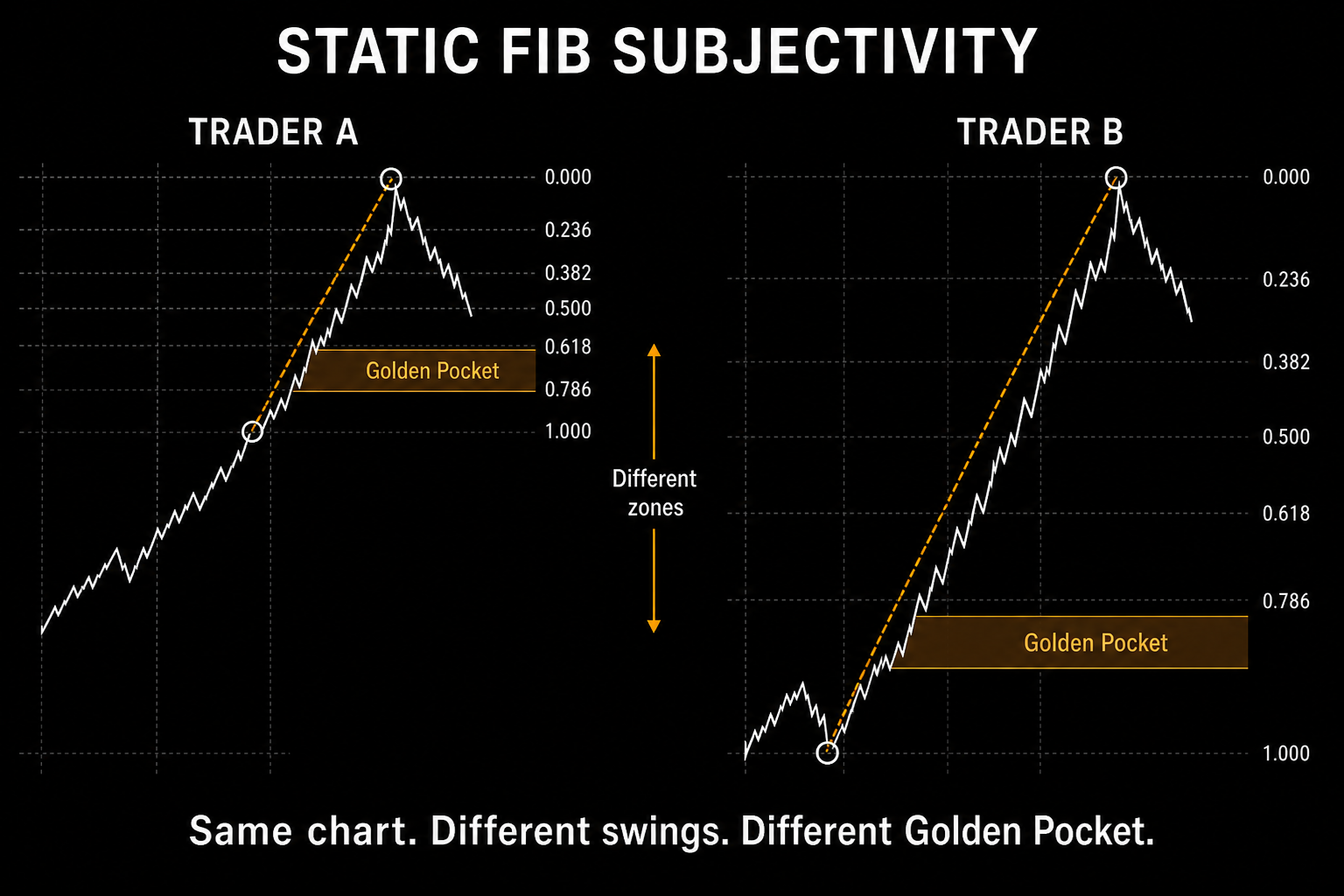
Manual Fibonacci retracements depend on selected swing points.
In a bullish move, the trader chooses a swing low and a swing high. In a bearish move, the trader chooses a swing high and a swing low. The retracement levels are then drawn between those points.
The quality of the result depends on the quality of the selection.
Common questions appear quickly:
- Which swing is the relevant one?
- Should the trader use the full trend leg or only the most recent impulse?
- Is the move large enough to matter?
- Should the Fibonacci be updated after a new high or low?
- Is the pullback still part of the same structure?
There is no problem with manual analysis itself. The problem starts when the drawing logic changes from chart to chart. Inconsistent measurement produces inconsistent decisions.
A dynamic model can help by applying a more stable structure to the chart.
2. What ATR Adds
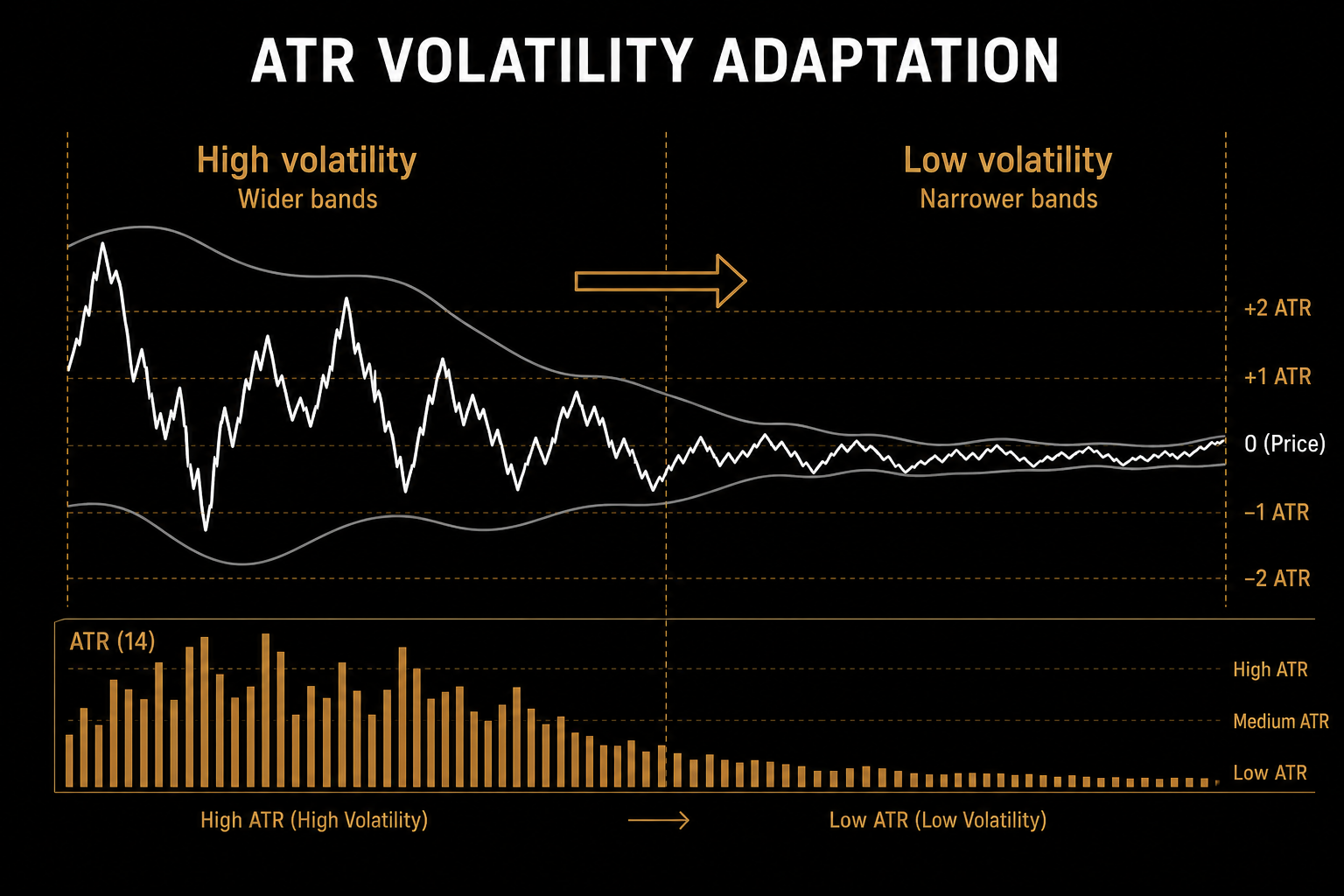
ATR stands for Average True Range.
It measures how much price has moved on average over a selected period. In practical terms, ATR is a volatility measure. When volatility expands, ATR rises. When volatility contracts, ATR falls.
This matters because the meaning of a pullback depends on volatility.
A 100-point pullback can be large in one symbol and normal in another. It can be significant on a quiet day and insignificant during a high-volatility session. Fixed distances do not adapt to this difference.
An ATR-based envelope adjusts with the market:
- wider bands during high volatility
- narrower bands during low volatility
- more consistent distance logic across symbols and conditions
- less dependence on fixed point values
This makes ATR useful for building adaptive trading tools.
3. Combining ATR with Fibonacci Logic

Fibonacci levels describe proportional zones.
ATR describes current market distance.
An ATR Fibonacci Trend Envelope uses volatility-adjusted distance as the base structure and then applies Fibonacci-style levels to that structure.
In a bullish environment, the Golden Pocket area can appear as a dynamic pullback zone below the trend reference. In a bearish environment, it can appear as a dynamic retracement zone above the trend reference.
The purpose is not to claim that dynamic zones are always better than manual Fibonacci. The purpose is to make the analysis more systematic:
- the zone updates with changing volatility
- the trader does not need to force random swing drawings
- the chart can stay cleaner
- the workflow becomes easier to review and test
This is especially useful for traders who want repeatable rules rather than discretionary drawings on every chart.
4. Dynamic Golden Pocket vs Manual Fibonacci
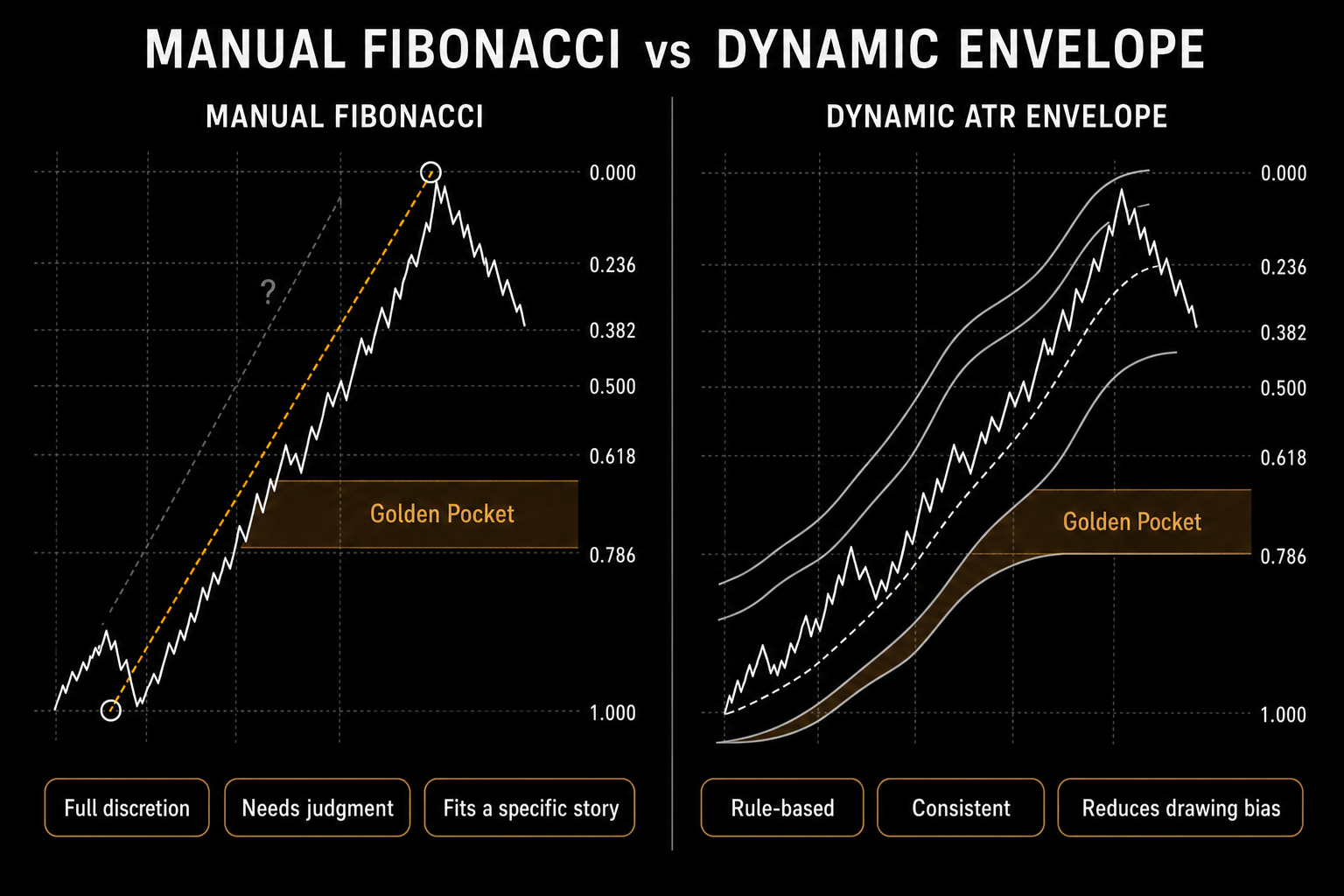
Manual Fibonacci and dynamic envelopes are related, but they are not the same thing.
Manual Fibonacci is useful when the trader wants to measure a specific swing. It is flexible and intuitive, but it requires judgment. That judgment can be a strength for experienced traders and a weakness for traders who change their logic too often.
A dynamic ATR Fibonacci envelope is more rule-based. It is less about choosing one perfect swing and more about reading a structured zone that adapts to market volatility.
The tradeoff is clear:
- manual Fibonacci gives full discretion
- dynamic envelopes give more consistency
- manual Fibonacci can fit a specific market story
- dynamic envelopes can reduce drawing bias
- manual Fibonacci may be better for deep chart analysis
- dynamic envelopes may be better for repeatable signal review
Many traders can use both. The important part is knowing which job each tool is doing.
5. The Role of the 0.618-0.786 Zone
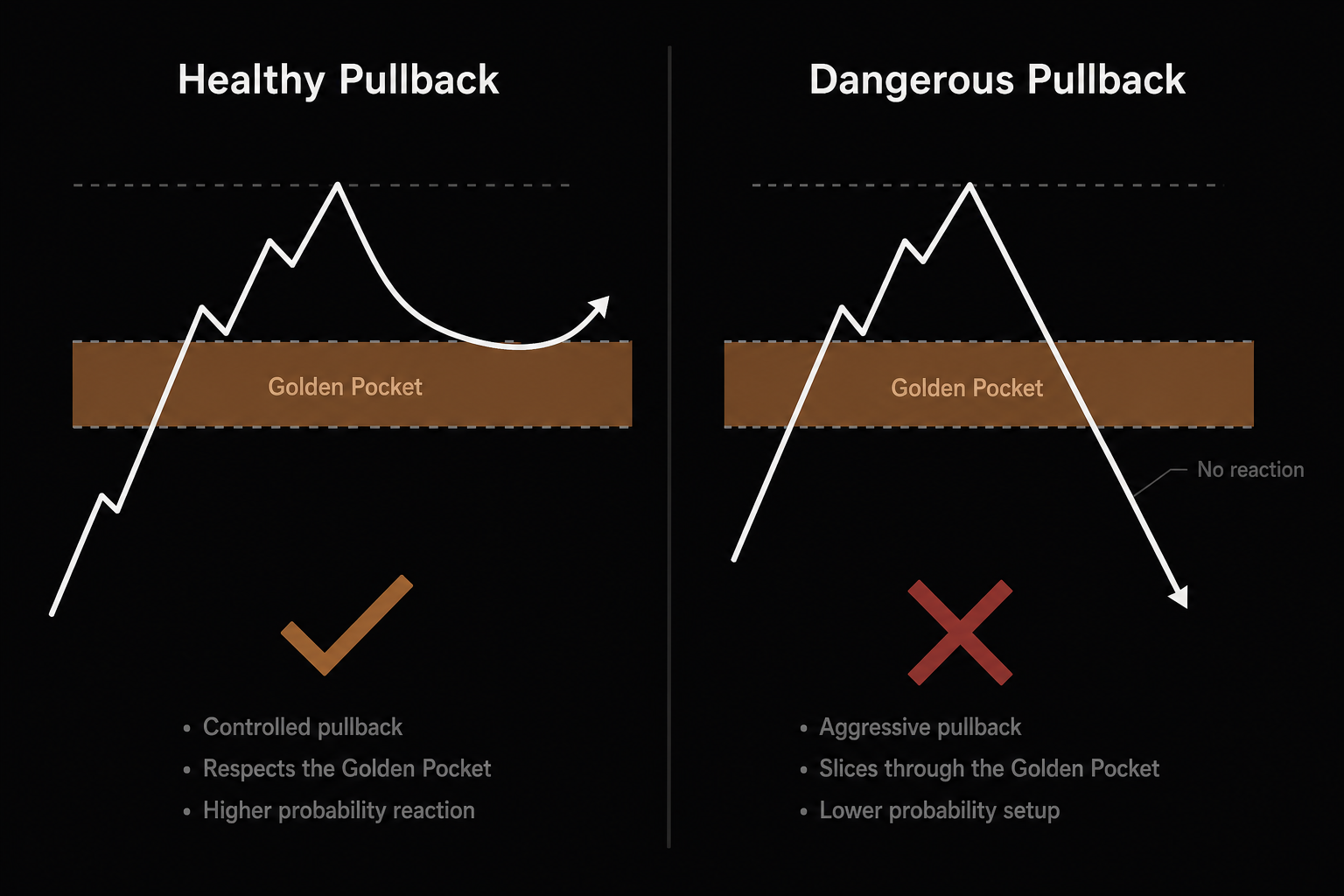
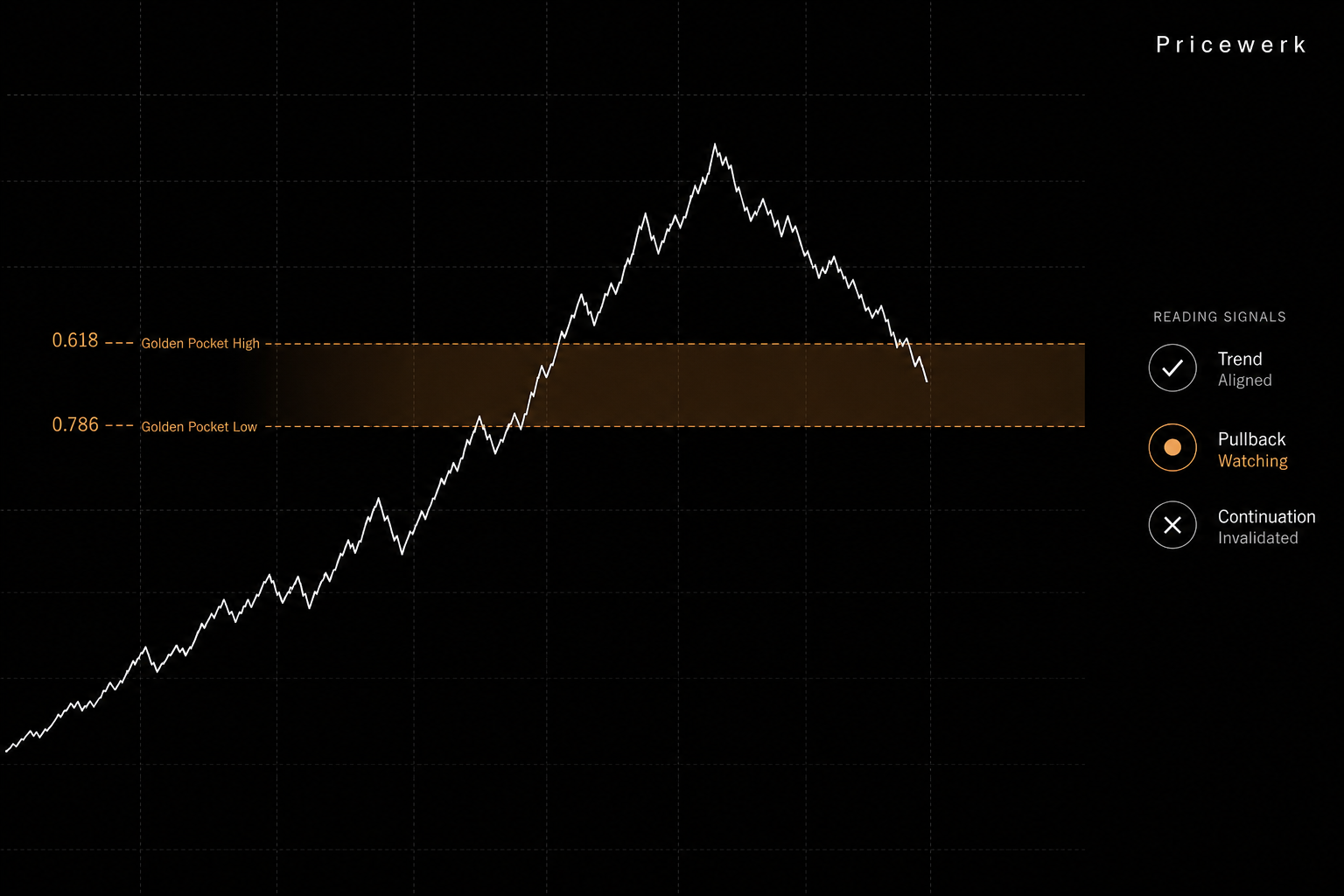
In the dynamic model, the 0.618-0.786 area still represents the Golden Pocket.
The difference is how the zone is generated. Instead of drawing it between two manually selected points, the zone is part of the envelope structure.
The interpretation remains familiar:
- in a bullish context, price pulling down into the zone may create a continuation area
- in a bearish context, price retracing upward into the zone may create a continuation area
- the zone is still not a signal by itself
- reaction, confirmation, invalidation and risk-reward still matter
This is important. A dynamic zone does not remove the need for trading discipline. It only gives the trader a cleaner structure to evaluate.
6. The 1.000 Band and Deeper Risk
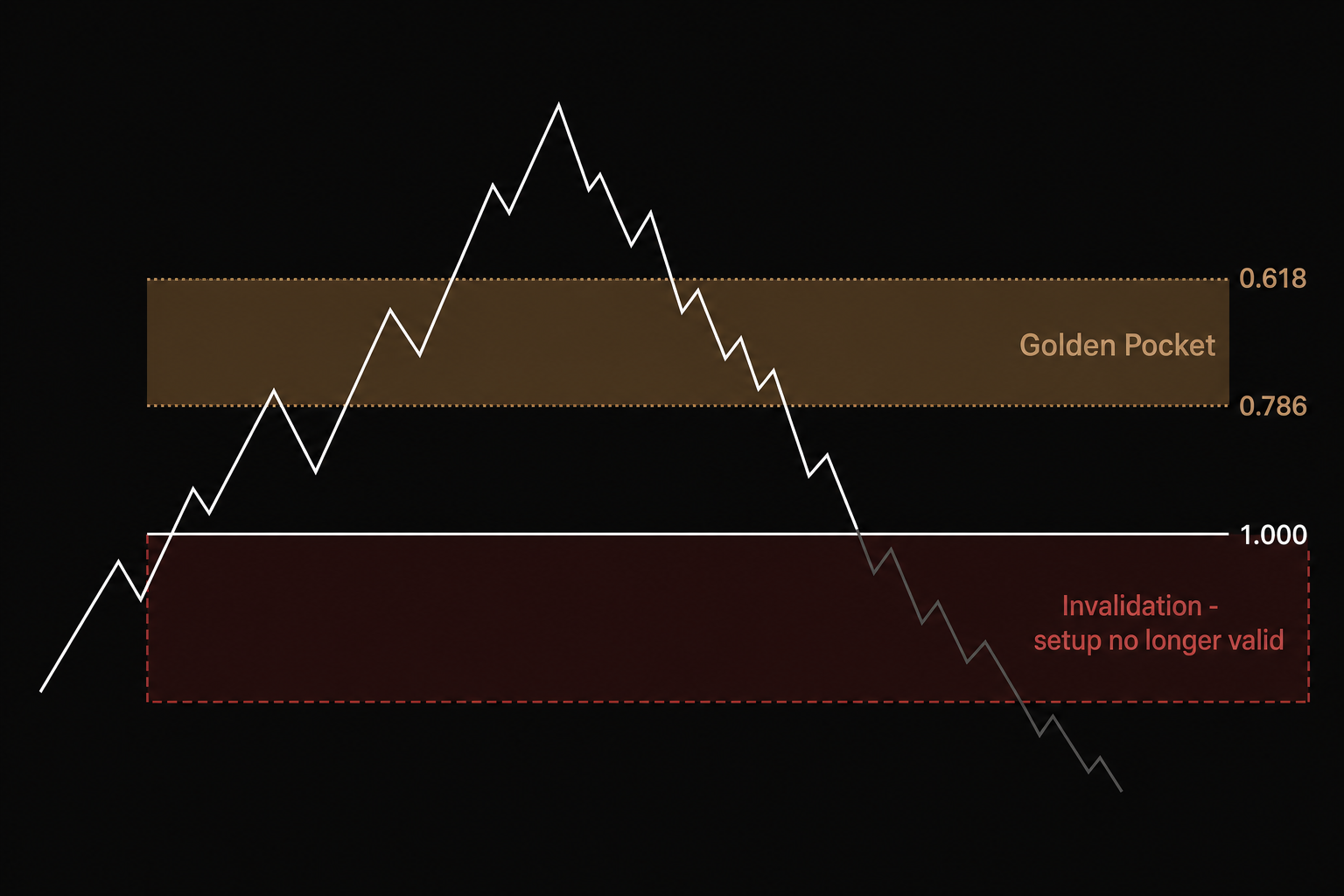
The 1.000 band can help frame deeper invalidation or trend-change risk.
If price reaches the Golden Pocket but holds the deeper structure, the continuation idea may remain valid. If price pushes through the zone and into or beyond the 1.000 area, the prior trend logic may be weakening.
The 1.000 band should not be interpreted mechanically. It is not a universal stop-loss price. It is a structural warning area.
A useful reading is:
- Golden Pocket zone: area of interest
- price reaction: first evidence
- confirmation: decision filter
- 1.000 band: deeper invalidation reference
- target distance: opportunity check
This keeps the model practical. The trader is not just watching colored bands. The trader is reading whether the whole structure still supports the setup.
7. Practical Use in MetaTrader 5
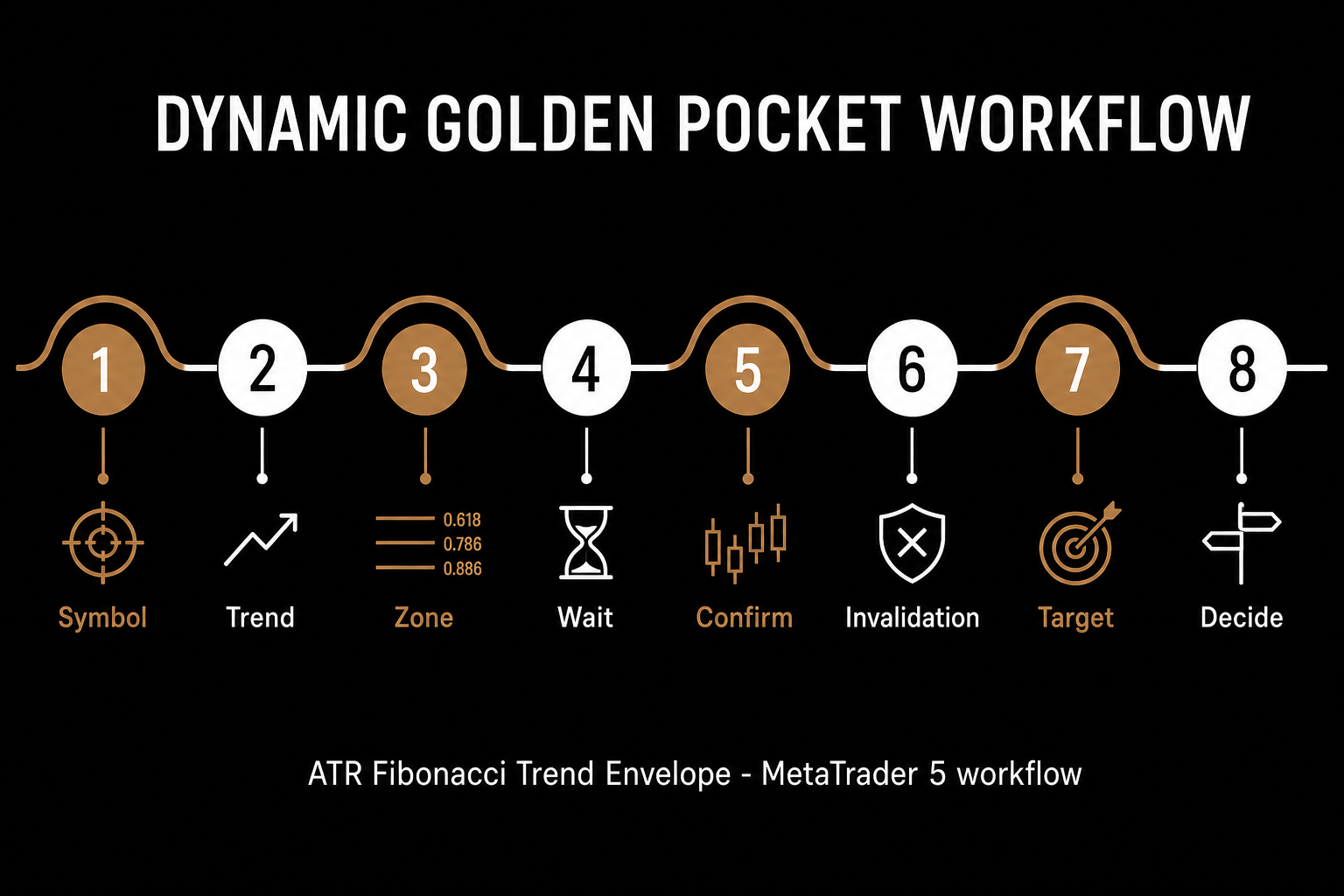
The Pricewerk Golden Pocket Indicator uses this kind of dynamic thinking to support Golden Pocket analysis inside MetaTrader 5.
A practical workflow can be:
- open a symbol and timeframe that has enough clean movement
- identify whether price is trending or ranging
- watch how price behaves around the dynamic Golden Pocket zone
- avoid entries when price slices through the zone without reaction
- wait for confirmation before treating the zone as a setup
- use the deeper band as an invalidation reference
- compare risk distance with realistic target distance
- review past examples to understand when the model works best
This workflow is most useful in markets with directional structure. It is less useful when the market is noisy, flat or constantly reversing without follow-through.
8. Final Thoughts
ATR Fibonacci Trend Envelopes offer a dynamic approach to Golden Pocket analysis.
They keep the familiar 0.618-0.786 concept but place it inside a volatility-adjusted framework. This can reduce the subjectivity of manual swing selection and make the chart easier to review consistently.
The benefit is not prediction.
The benefit is structure.
A useful Golden Pocket workflow still requires:
- clear market context
- controlled pullback
- reaction from the zone
- confirmation
- logical invalidation
- realistic target distance
- disciplined risk management
In Part 3, the series moves from zone structure to trade planning: common mistakes, entry logic, stop-loss placement, take-profit logic and risk-reward.
Risk Notice
Trading foreign exchange, CFDs and other leveraged products involves significant risk and may not be suitable for every trader. Fibonacci concepts, ATR-based zones, Golden Pocket areas, indicator signals and strategy examples do not guarantee future results. An indicator is a decision-support tool and does not guarantee profitable trades. Always test trading tools carefully in a demo environment before considering live use. Use risk settings that match your personal risk tolerance.