Daily Sweep PropTrading Indicator
- Индикаторы
- Версия: 2.0
- Активации: 10

Daily Sweep PropTrading Indicator
The top-down sweep scanner built for traders who want to pass prop firm challenges with discipline, not guesswork.
By SaintEmma Fx Systems
Stop Chasing Charts. Start Trading One Clear Story.
Most challenge failures do not come from bad analysis. They come from too many trades, too little patience and entries taken on charts that were never aligned. The Daily Sweep PropTrading Indicator was built to fix exactly that. It watches your entire Market Watch, runs every pair through the same three-step top-down process, and shows you only the setups where the Daily, the H1 and the M5 all tell the same story.
No clutter. No guessing which pair deserves your attention. One ranked list of the best opportunities, each one drawn on the chart with entry, stop loss and two targets, so you can plan the trade, size it correctly and walk away from the screen.
The Idea Behind It
Big money does not enter at obvious levels. It hunts them first. Price runs into a pool of resting orders, takes them out, and only then does the real move begin. The Daily Sweep PropTrading Indicator reads that sequence across three timeframes and waits for every piece to appear before it speaks.
Step one, the Daily bias. The indicator reads the daily structure. Higher highs and higher lows point to a buy day. Lower highs and lower lows point to a sell day. When the market is a messy range, it simply stays silent. Silence is a feature. A tool that tells you when not to trade protects your account more than any signal ever will.
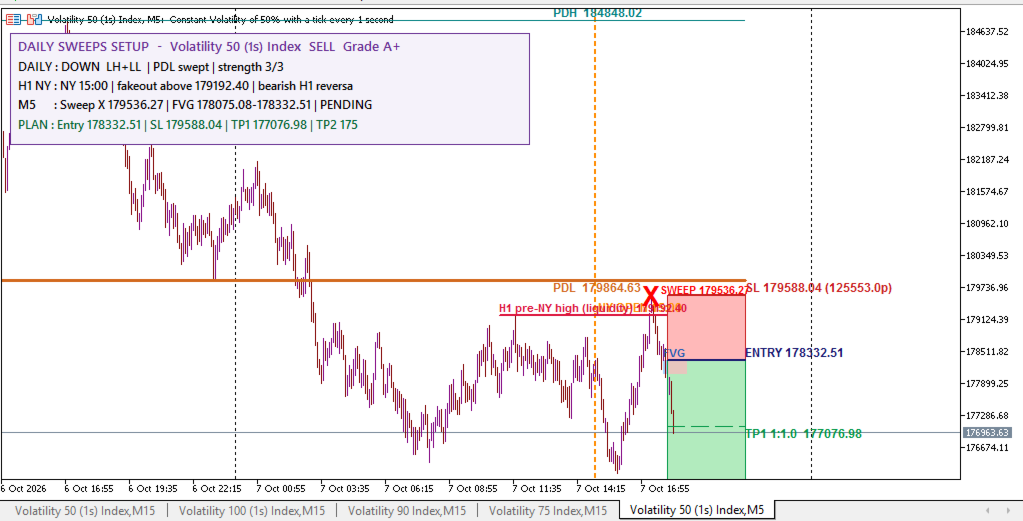
Step two, the H1 New York fakeout. Into the New York session, price often builds a run that traps traders on the wrong side. The indicator marks the pre-New York liquidity level, then watches for the fakeout through it after the open, followed by an H1 reversal candle in the direction of the daily trend. This is the moment the market shows its hand.
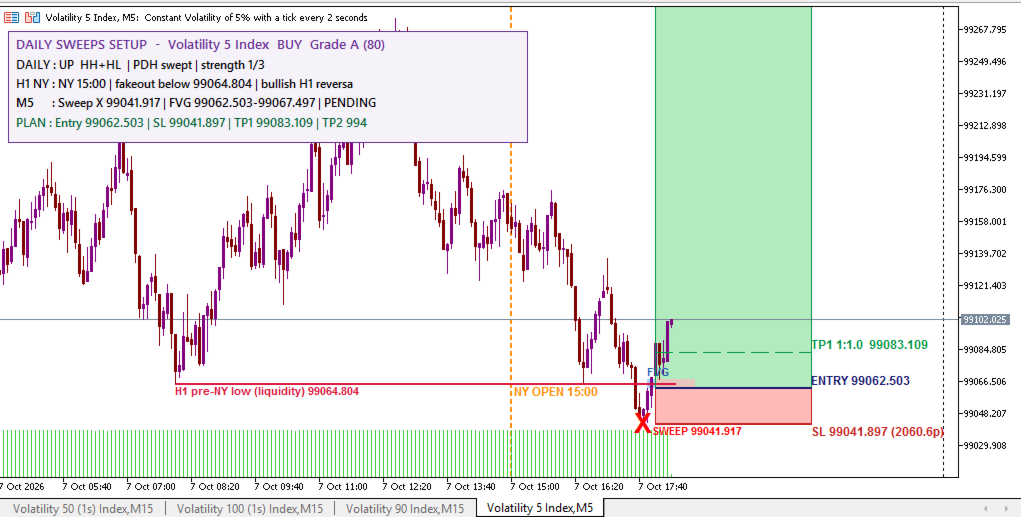
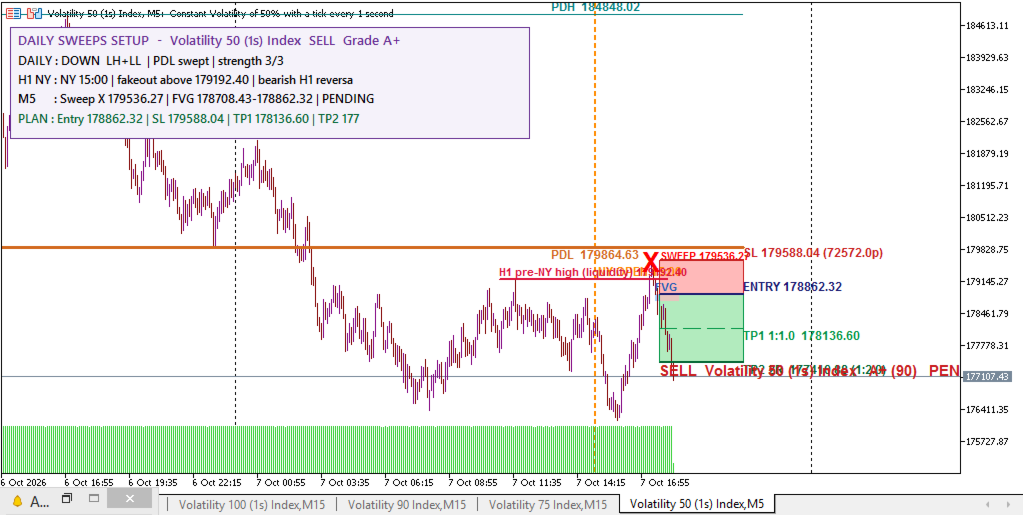
Step three, the M5 entry. After the sweep, the indicator marks the sweep point with a clear X, finds the fair value gap created by the reversal, and plans the entry on the retest. Your stop loss sits beyond the sweep. Your first target is a clean 1:1. Your second target is the previous day zone, the level the market is naturally drawn to.
Three timeframes. One story. Only when everything agrees do you see a signal.
What You Get On Your Chart
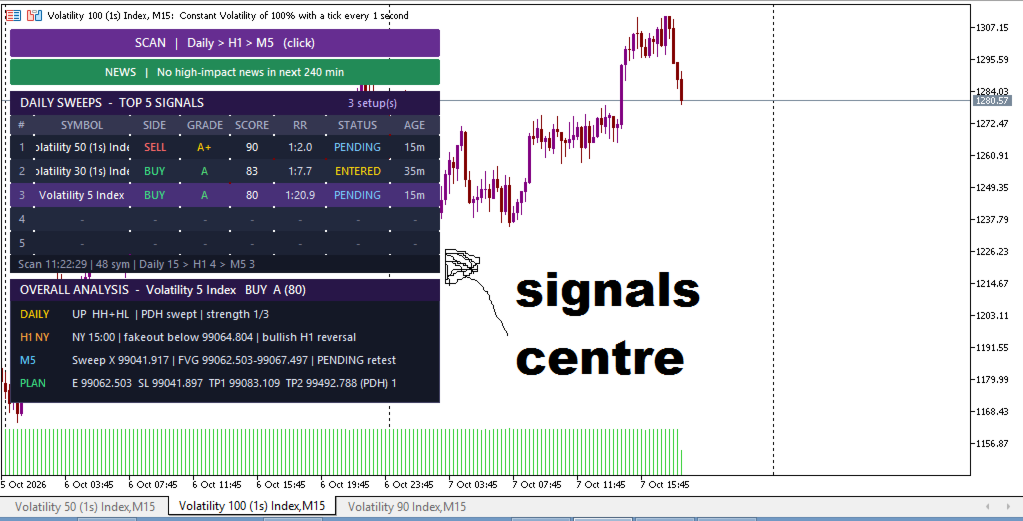
A one-click scanner. A scan button sits in the top left corner of your chart. Press it and the indicator works through every symbol in your Market Watch, from the Daily down to the H1 and finally the M5. It also re-scans automatically, so new setups appear while you focus on your plan.
A Top 5 signal dashboard. The best opportunities from the scan are ranked and displayed with direction, grade, score, reward to risk, status and age. Grades run from A+ to C, so you can see at a glance which setups deserve your risk and which deserve to be skipped.
An Overall Analysis panel. Below the dashboard, a live breakdown tells you the Daily trend, the H1 New York story and the M5 status for the selected symbol. Instead of wondering why a pair is or is not on the list, you can read exactly where it stands in the process.
A built-in news guard. A news button sits directly under the scan button. It warns you of high impact news arriving within the next 240 minutes, lists the events with countdowns, and flags any signal on a currency affected by the release. Prop firm accounts are lost to news spikes every single day. This keeps you informed before you click buy or sell.
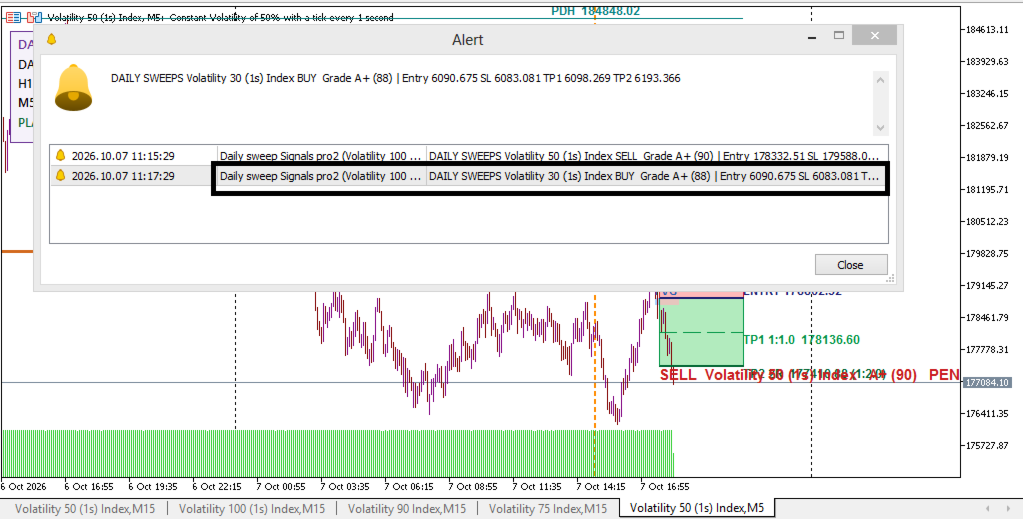
Signal boxes you can read in a second. A green box runs from entry to target. A red box runs from entry to stop loss. The sweep X, the pre-New York liquidity level, the New York open line, the fair value gap, the previous day high and low, and every price level are labelled and clearly visible. You never have to wonder what the indicator is seeing.
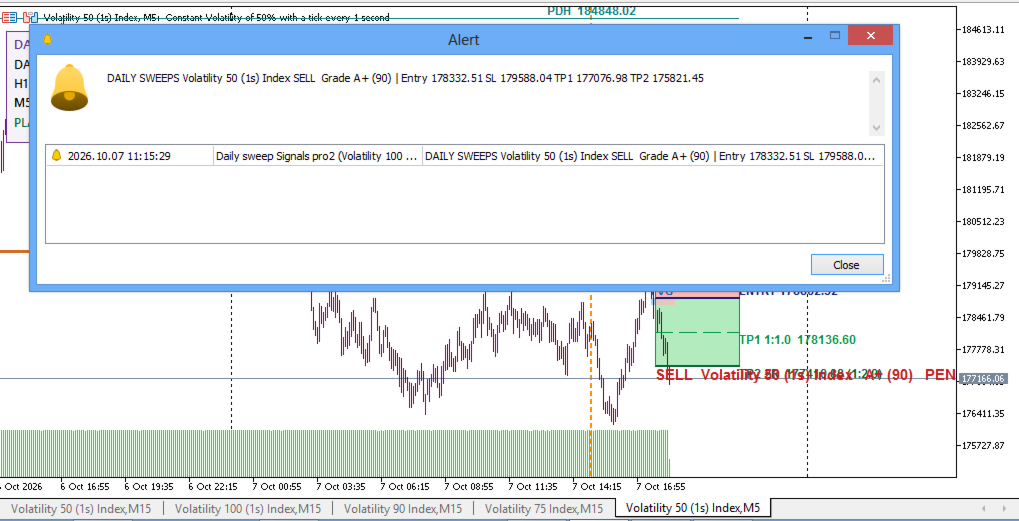
A dedicated signal window. Click any signal in the dashboard and a fresh M5 chart opens with every drawing and label for that setup, plus a summary panel. Review it calmly, plan it properly, and take only what you understand.
A clean, professional chart. The indicator applies a white background, no grid, purple bullish candles, maroon bearish candles and period separators on every timeframe below H4, so the sessions and days are easy to read at a glance.
Why This Approach Suits Prop Firm Challenges
A prop firm challenge is not a normal trading account. You are playing inside a rulebook: a daily loss limit, a maximum drawdown, often a profit target and sometimes a consistency rule or a minimum number of trading days. The traders who pass are rarely the ones with the most exciting wins. They are the ones who protect the rulebook above everything else.
This indicator fits that reality for three reasons.
First, it is selective. A strategy that produces a handful of high-quality setups across a whole watchlist keeps you out of overtrading, the number one account killer.
Second, every trade comes with a defined stop loss before you enter. You know your risk to the pip, so you can size every position to a fixed fraction of the account.
Third, it has a built-in structure for taking profit. A 1:1 first target lets you pay yourself early and remove risk, while the previous day zone gives you room to let a winner run.
The Prop Firm Playbook
The indicator finds the setup. Your rules keep you alive long enough to profit from it. Treat the following as your standard operating procedure.
Before the Challenge Starts
Read your firm's rules twice. Know whether the drawdown is static or trailing, whether the daily loss is measured from balance or equity, what the profit target is, whether news trading is restricted, whether weekend holding is allowed, and whether any consistency rule limits how much one day can contribute to your total profit.
Set the New York open time in the indicator to match your broker's server time. The default assumes a broker whose New York open falls at 15:00 server time. If your server runs on a different offset, adjust it once and verify that the New York line on the chart sits at the real session open.
Forward-test on a demo account for at least two to four weeks before you pay for a challenge. Take every A and A+ signal, record it, and learn how the setups behave on your pairs and your broker. A challenge fee is a poor place to discover how a strategy feels.
Risk Per Trade
This is the single most important decision you will make. Most successful challenge traders risk a small fixed fraction of the account on each trade, commonly between 0.25 and 0.5 percent. With a 1:1 first target and a larger second target, you do not need to risk big to reach a profit target. You need to survive long enough for the edge to play out.
Calculate your lot size from the distance between entry and stop loss shown on the chart. Never widen a stop because a trade is going against you. Never remove it.
Your Daily Loss Rule
Your firm gives you a daily loss limit. Do not treat that number as your limit. Treat it as the wall you never go near. Set a personal daily stop at roughly half of the firm's limit. When you hit it, you are done for the day. Close the platform and come back tomorrow with a clear head.
The same applies to maximum drawdown. Set an internal warning level well before the firm's line. If you approach it, cut your risk in half until you recover.
Which Signals to Take
Focus on A and A+ graded setups. A lower grade means one or more parts of the story are weak, and weak stories belong on the watchlist, not in your account.
Prefer setups where the status is pending, meaning price has not yet retraced into the entry zone. These give you the full planned risk to reward. Be cautious with setups that are already entered and have moved significantly, since you may be chasing.
Check the news flag. If a signal carries the news warning, either skip it or wait until the release has passed and the setup is still valid.
Execution
When a qualifying signal appears, open its signal window and read the Overall Analysis. Confirm the Daily trend makes sense on a quick look at the chart, confirm the H1 fakeout is visible, and confirm the entry, stop and targets match what you planned.
Place your entry at the planned level, your stop loss beyond the sweep, and your targets at TP1 and TP2. A common approach is to close a portion at TP1, move the stop to break even, and let the remainder run toward the previous day zone. Choose your split in advance and follow it every time. The point is consistency, not perfection.
Trade Frequency
Limit yourself to one or two trades per day, and a maximum number of open trades at one time. If several signals appear on correlated pairs, such as multiple dollar pairs moving on the same story, treat them as one idea and risk accordingly. Three correlated trades are not diversification. They are one trade with triple the risk.
The Do's
Do read your prop firm's rules in full and build your risk plan around them.
Do forward-test on a demo account before starting any paid challenge.
Do risk a small, fixed percentage on every trade and size from the stop distance.
Do prioritise A and A+ setups and let the rest pass.
Do set a personal daily loss limit well inside the firm's limit.
Do check the news button before entering and respect the flagged currencies.
Do take partial profit at the first target and protect the rest.
Do respect the New York window. The setup is built around the session, so trade it when the story is live.
Do keep a journal with screenshots of every signal, the grade, your decision and the outcome.
Do review your results weekly and look for patterns in what you take and what you skip.
Do treat a missed trade as a non-event. Another setup will come.
Do protect your first profits. A challenge is passed by staying in the game, not by one big week.
The Don'ts
Don't increase your risk after a loss to win it back. Revenge trading is how accounts end.
Don't increase your risk after a win because you feel invincible. Overconfidence is just revenge trading wearing a smile.
Don't trade a pair the indicator is not showing a setup for. If it is not on the list, it is not part of the plan.
Don't move or remove your stop loss.
Don't stack correlated trades and call it diversification.
Don't hold trades through high impact news unless your plan explicitly allows it and your firm permits it.
Don't overtrade because you have a large watchlist. Forty-eight pairs does not mean forty-eight trades.
Don't switch strategies mid-challenge because of a bad week.
Don't trade when tired, distracted, angry or rushed.
Don't chase a signal that has already run most of the way to its target.
Don't rush the profit target. Pace yourself within the time limit and let the trades come to you.
Don't ignore the grade and the analysis panel just because a chart looks tempting.
Trading Discipline: The Real Edge
An indicator can give you structure. It cannot give you discipline. That part is yours, and it is what separates traders who pass from traders who keep paying for resets.
Think in batches, not in trades. Any single trade is a coin with a slight edge. Your plan only works across twenty, fifty, a hundred trades. When you accept that any one outcome is meaningless, a loss stops feeling personal and a win stops feeling like proof. You simply execute the next one.
Define your day before the session opens. Before New York begins, decide your maximum trades, your risk per trade and your daily stop. Write it down. When the market gets exciting, your rules have already been made by the calm version of you.
Protect your mental capital. Two stop losses in a row is a signal to slow down, not to speed up. If you have taken two losses, review the setups honestly. If both were valid, they were simply part of the distribution, and you continue at normal risk or take the rest of the day off. If either was a rule break, close the platform and fix the process.
Respect the consistency rule. Many firms look for steady performance rather than one explosive day. Aim for repeatable, moderate days. If you reach a strong daily result, consider stopping. Taking a good day and keeping it is a skill.
Do not trade to hit the target faster. The challenge timeline feels like pressure, but the account does not care about your calendar. Forcing trades to meet a deadline is the quickest way to end up with neither the profit nor the account.
Treat the funded account differently from the challenge. Passing is the beginning. Funded accounts reward the same habits: small risk, strict loss limits, selective entries and regular payouts withdrawn rather than left to be lost. Build the routine now and it carries over.
Review like a professional. Every weekend, go through your journal. How many A and A+ signals did you take? How many lower grades did you take, and how did they perform? Did you break any rule? Your biggest improvement will usually come from removing one bad habit, not from adding one more indicator.
A Sample Day With the Indicator
Before the New York session, you check the news button and note which currencies have high impact releases in the next four hours. You confirm your daily loss limit and risk per trade. You press scan.
By the time New York is moving, the dashboard shows the best setups. Perhaps two pairs rank A or higher. One carries a news flag, so you leave it. The other shows a pending status with a healthy reward to risk. You click it, the signal window opens, and you read the analysis: the Daily is trending up and has swept the previous high, the H1 has faked out below the pre-New York low and printed a bullish reversal, and the M5 has formed a fair value gap after the sweep.
You calculate your position from the stop distance, place your order at the planned entry, set your stop beyond the sweep and set your two targets. Price retraces, you are filled, and it moves to the first target. You take your planned partial profit, move your stop to break even and let the rest work toward the previous day zone. You log the trade, close the platform and keep your day clean.
That is the entire game. Not more trades. Better ones, handled the same way every time.
Who This Indicator Is For
The Daily Sweep PropTrading Indicator is for traders who want structure, who want fewer and better setups, and who are serious about passing and keeping funded accounts. It works best for traders who can commit to the New York session, who are willing to follow a risk plan, and who understand that consistency beats intensity.
It is not for anyone looking for a magic button. No indicator removes risk, and none can promise results. What this one does is organise the market into a clear, repeatable process, so that your decisions are driven by a plan instead of by emotion.
Get Started
Add the indicator to a chart, make sure the symbols you want to scan are in your Market Watch, confirm the New York open time for your broker, and press scan. Take your first week on demo, follow the playbook above to the letter, and judge the process on how well you follow your rules, not on any single trade.
Trade the sweep. Respect the rules. Protect the account.
Important Risk Disclosure
Trading foreign exchange, metals, indices and other leveraged products carries a high level of risk and may not be suitable for everyone. You can lose some or all of your capital. The Daily Sweep PropTrading Indicator is an analytical tool and does not provide financial advice or guarantee profits, signals or the passing of any prop firm challenge. Past or illustrative performance does not guarantee future results. Always test on a demo account first, confirm the rules of your chosen prop firm, including its policies on news trading and tools, and only risk what you can afford to lose.