Election night is a gap, not a news release: what a stop can and cannot do overnight

The US midterm elections are on Tuesday 3 November. This post will not tell you who wins or what any market does next. Nobody can, and a robot cannot either. It is about something you can check before the night, on every robot you run: whether it is holding a position when the result arrives, and what its stop can actually do if the price jumps.
Two kinds of event
Most market-moving news is scheduled. An interest rate decision or a jobs report comes out at a minute that was published days ahead. You know when it lands, so you can decide in advance to stand aside around it, and many robots have a setting for exactly that.
An election result is a different kind of event. There is no single minute. Results are counted through the US evening and night, which for a European trader is the small hours, and the picture can change in stages over many hours. Whoever holds a position through that period holds it through all of it. There is no release time to step around.

A stop is an order, not a guarantee
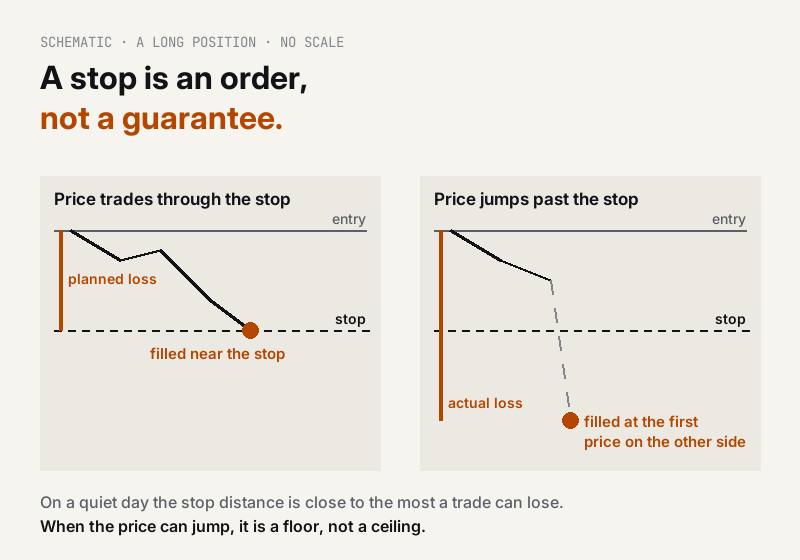
This is the part that surprises people. A stop-loss is an instruction to close at the market once the price reaches a level. If the price trades through that level step by step, the position closes close to it. If the price jumps from one side of it to the other, with little or no trading in between, the stop is filled at the first price on the other side. That price can be far from the level you set.
So on a quiet day, the stop distance is a good estimate of the most a trade can lose. On a night when the price can jump, it is a floor, not a ceiling. The jump decides the loss, not the line on your chart.
A worked example: a robot that is flat by the close
Our index robot, Index Cadence, trades the US tech index intraday. Its rules close every position before the end of the trading day. No overnight, no weekend. Every position carries a hard broker-side stop from the moment it opens.
For a night like election night that design does one simple thing: when the counting starts, the robot is not holding anything. It cannot be on the wrong side of an overnight jump because it has no overnight position. The same rule is why prop firms are comfortable with it: it never carries the overnight exposure most firms restrict.
Two honest limits come with that. First, being flat at night does not protect against a jump during the session. Scheduled releases fall inside trading hours, and the robot has a news filter for those, off by default. Switched on, it pauses new entries around high-impact releases. The MetaTrader tester has no economic calendar (the call returns error 4014), so no test can show its effect, and every published figure was measured with it off. Second, flat by the close has a price of its own. A stop caps what a loss can become, and nothing caps a winner except the end of the day. The robot gives up the overnight moves that would have paid, in exchange for never holding the ones that would have hurt.
Your check, robot by robot
1. Does it hold positions past its session? Read the listing for "flat before the close", a holding time, or a weekend rule. If it does not say, assume it holds.
2. Where does its stop live? A stop on the broker's server works while your terminal is off. A stop kept only inside the EA needs the terminal running and the price to trade through it.
3. What does it do around news? A news filter usually pauses new entries only. Check whether it is on, and remember that its effect is in no backtest.
4. Size for the jump, not for the stop. If a position will be open through the night, the stop distance is not its worst case. Ask what the account looks like if every open position is filled well past its stop at once.
5. Decide before, not during. A risk change made at three in the morning with the result half counted is a mood, not a rule. If you want less exposure on event nights, write down which robots and by how much while the market is quiet, and do exactly that.
What this does not mean
It does not mean every robot that holds overnight is wrong. Plenty of good systems hold positions for days, and their tests include nights like this one. It means the stop distance on those systems is an estimate, and an election night is when the estimate is weakest. Robots that are flat at the close and robots that hold are different bets. Know which ones you own before Tuesday.
Index Cadence on the MQL5 Market, 149 USD, with the free demo to run on your own broker's data: https://www.mql5.com/en/market/product/190845