Temporal Microstructure of Financial Markets: from Empirical Cycles to the iVISTscalp5 Temporal Framework

Temporal Microstructure of Financial Markets:
From Empirical Cycles to the iVISTscalp5 Framework (VISTmany Research)
Part I
Introduction: A Paradigm Shift from Price to Time
For more than a century, quantitative finance has been built upon a single fundamental assumption: price contains the primary information about future market behavior.
From classical moving averages and Elliott Wave Theory to modern Smart Money Concepts
(SMC), Order Flow analysis, and institutional liquidity models, nearly every analytical framework has focused on identifying price imbalances, support and resistance levels, or liquidity zones.
Within these models, time has traditionally been treated as nothing more than a passive coordinate—a horizontal axis along which price evolves.
The VISTmany Research initiative proposes a fundamentally different perspective.
Rather than asking:
Where will price move?
we begin with another question:
When does the market become capable of moving at all?
This distinction may appear subtle, yet it represents a profound conceptual shift.
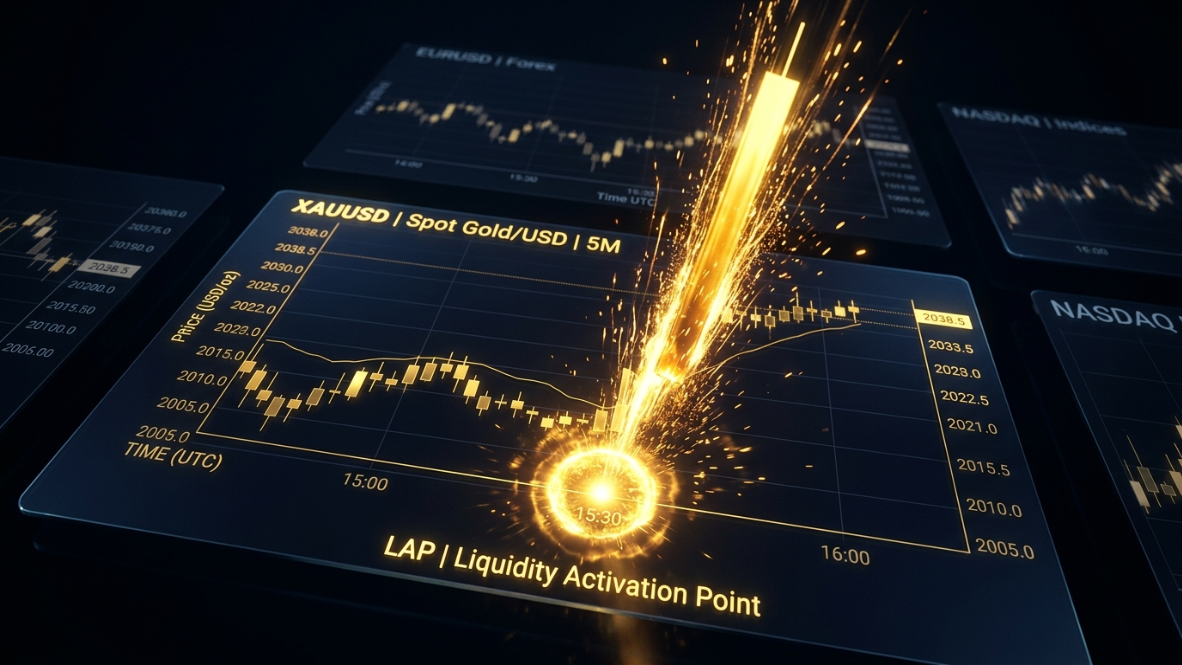
Instead of treating price as the independent variable and time as its background, the VISTmany framework investigates whether time itself contains measurable, structured information that governs liquidity activation before observable price movement occurs.
Within this framework, market dynamics emerge when temporal structures activate liquidity. Price becomes a consequence of temporal organization rather than its primary cause.
This approach forms the scientific foundation of the iVISTscalp5 Temporal Framework.
Historical Development of Time-Based Market Research
The idea that markets possess an internal temporal structure is not new.
However, previous generations of researchers lacked the computational tools necessary to investigate time as an independent quantitative variable.
W.D. Gann (1878–1955)
William Delbert Gann was among the first market researchers to argue that time may be more important than price.
His analytical methods incorporated astronomical cycles, geometric constructions, and temporal proportions in an attempt to forecast market turning points.
Although many of Gann’s concepts were remarkably innovative for their time, they relied heavily on manual interpretation and often lacked objective mathematical verification.
Nevertheless, Gann introduced one revolutionary principle:
Financial markets may possess an internal temporal order.
J. M. Hurst
During the 1970s, engineer J. M. Hurst approached market timing from an entirely different perspective.
Applying spectral analysis and Fourier-based decomposition, Hurst demonstrated that financial markets consist of multiple interacting cyclic components.
His work transformed market cycles from philosophical observations into measurable mathematical objects.
However, Hurst’s methodology remained fundamentally retrospective.
It identified previously existing cycles rather than predicting future temporal activation.
John Ehlers
The introduction of Digital Signal Processing (DSP) into financial analysis by John Ehlers represented another major milestone.
Using adaptive filters and spectral estimation techniques such as MESA (Maximum Entropy Spectral Analysis), Ehlers developed indicators capable of estimating the dominant market cycle in real time.
These algorithms significantly improved the precision of cycle detection.
Yet they still shared one important limitation:
they measured current oscillatory behavior, rather than forecasting future moments when liquidity would become active.
The full article can be read on our website in the "BLOG" section. Welcome!
© VISTmany Research Journal
Exploring the architecture of Temporal Space in financial markets.