Six engines that rarely lose together: correlation as the quiet edge on gold

Here is a statement that sounds wrong the first time you hear it: two mediocre strategies can be safer than one good strategy.
Not more profitable. Safer. The difference matters, and it is the reason we trade gold with six engines instead of one.
The math nobody advertises
Imagine strategy A and strategy B. Each one, alone, has a backtest drawdown of 500 USD. Neither is impressive.
Now run them together on the same account. If they lose at the same time, the combined drawdown can approach 1000 USD. But if they lose at different times, one strategy is often flat or winning while the other struggles. The combined drawdown can end up well below 500 USD, lower than either strategy alone.
The variable that decides which scenario you get is correlation. Not the win rate, not the profit factor of each strategy. Correlation between their losing periods.
How we measure it: drawdowns, not returns
Most people who check correlation compare daily returns between two strategies. That is a start, but it misses the point. What hurts a trader is not a mildly negative day. It is a deep drawdown, the kind that makes you switch the EA off at the worst moment.
So when we built our gold portfolio, we looked at the drawdown windows of each candidate engine across the backtest period. For every pair of engines we asked one question: when engine A is inside its worst stretch, what is engine B doing?
If B tends to be in its own worst stretch at the same time, the pair is toxic, even if both look fine individually. If B is usually flat or recovering while A suffers, the pair is worth keeping. We repeated this across thousands of generated candidates and kept only combinations where the losing periods rarely overlapped.
Why different timeframes and logics lower correlation
Two engines that both trade H1 breakouts on gold will lose together almost by definition. When gold stops trending on H1, both starve at the same time. Same signal family, same failure mode.
So we forced diversity on two axes:
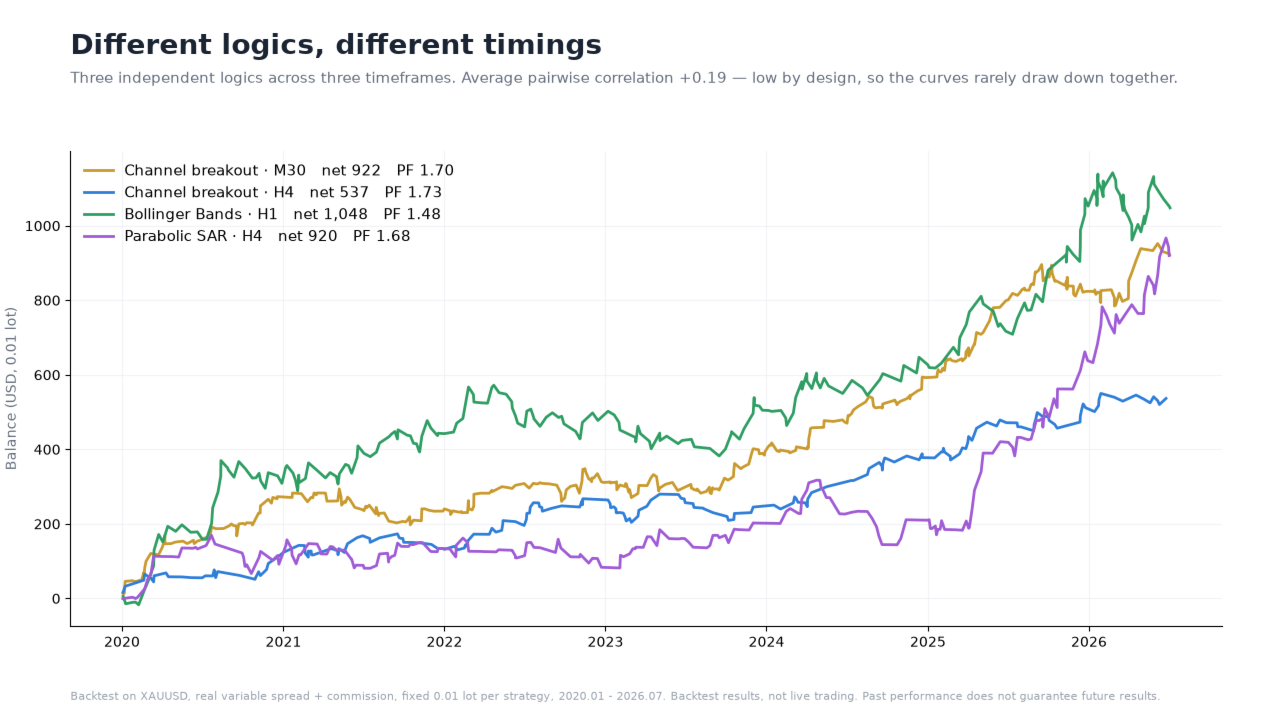
- Timeframe: the engines run on M30, H1 and H4. A choppy week on M30 can still contain a clean H4 trend, and a quiet H4 month can still offer M30 setups.
- Logic: the engines use different signal families, including breakout, volatility bands, parabolic SAR and momentum. Each family fails in a different market regime, so their bad periods land in different places on the calendar.
The result is what you see in the chart above: six equity lines that dip at different moments. In our MT5 backtest of the combined portfolio (1,425 trades over 2020 to 2026), the maximum drawdown of the whole portfolio was 326 USD with 0.01 lots per engine, lower than what the raw sum of individual drawdowns would suggest. These figures are backtest results, and past performance does not guarantee future results.
What this does not mean
Low correlation is not magic, and we want to be precise about its limits:
- Correlations measured in a backtest can change. A shock event can make everything fall together for a day.
- Six engines still trade one market. A long dead period on gold affects all of them, even if not equally.
- Diversification reduces the depth of drawdowns in the tested period. It does not remove risk, and it does not promise profit.
Every engine in the portfolio still opens each position with a fixed stop loss and take profit, no grid, no martingale, no averaging down. Correlation work sits on top of that discipline, not instead of it.
The quiet part of the edge
Most EA marketing focuses on entries: the clever indicator, the secret pattern. In our experience the entry logic is the least durable part of a system. What lasted across seven years of test data was the structural choice: several modest, honest engines whose bad weeks rarely coincide.
That is not exciting to advertise. It is just the thing that kept the tested equity curve from having a cliff in it.
If you want to see how we apply the same design rules in a simple, single-engine EA, Wonder 8 is free on MT5 (also on MT4) and runs on USDJPY H1 with a fixed 0.01 lot. Test it on a demo account and watch how it behaves through a losing week: that tells you more than any equity screenshot.
All numbers in this article come from backtests. Backtest results are hypothetical, and past performance does not guarantee future results. Trading involves risk of loss.