TEST #002 - Inside Bar / EURUSD, XAUUSD, SP500 — there is a pattern, but not where I expected

Testing the Inside Bar continuation hypothesis.
The idea is straightforward: after a strong directional Main Bar, the market pauses with a Signal Bar forming inside its range, then resumes movement in the direction of the Main Bar.
Detailed logic and testing rules are available in the research announcement on Telegram.
Test Conditions
- Markets: EURUSD, XAUUSD, SP500
- Timeframe: H1
- Period: 2020–2026
- Entry: breakout of the Main Bar in the direction of its close
- Filters: ATR, Main Bar body size, Signal Bar size
- Exit: Stop Loss and Take Profit calculated as fixed fractions of the Main Bar range
XAUUSD

Figure 1. Initial XAUUSD H1 test with baseline settings
The baseline version produced a reasonably stable result.
- Profit Factor: 1.43
- Recovery Factor: 1.51
The most interesting finding was related to the Main Bar body size.
The more directional the Main Bar was, the better the strategy performed. The best results were achieved when the candle body accounted for roughly 80% of the total range, leaving no more than 20% for the combined upper and lower shadows.
Another consistent finding was related to the size of the Signal Bar. The optimal value was around 50% of the Main Bar range.
The ATR filter showed a similar pattern as well, although its impact on profitability was much smaller. A value around 0.6 ATR effectively filtered out very small candles without significantly affecting the number of quality setups.
Increasing the filter further reduced the trade count without producing any meaningful improvement in performance.

Figure 2. Optimized XAUUSD H1 result
EURUSD

Figure 3. Optimized EURUSD H1 result
The settings that worked on Gold did not produce comparable results on EURUSD.
I then tried a different approach: extending the pending order lifetime to 15 bars and allowing the filters to eliminate a portion of losing setups.
Although the result became profitable, I would not consider this a confirmation of the hypothesis.
For two reasons.
- The Stop Loss was approximately 1.2 times the Main Bar range. In practice, this places the stop beyond the pattern itself, which conflicts with the continuation logic behind the setup.
- The pending order remained active for 15 bars. At that point, the result is likely influenced more by random market movement than by the Inside Bar pattern.
For EURUSD H1, I would say no reliable edge was found.
SP500
The settings that worked on Gold produced a negative result on SP500.
I still wanted to understand how the parameters behaved in a different market environment, so the testing continued.
The relationship between profitability and Main Bar body size remained visible, although it was less pronounced than on Gold.
An unexpected pattern emerged during optimization.
The best results were achieved with the Signal Bar size filter almost disabled and the pending order lifetime reduced to a single bar.
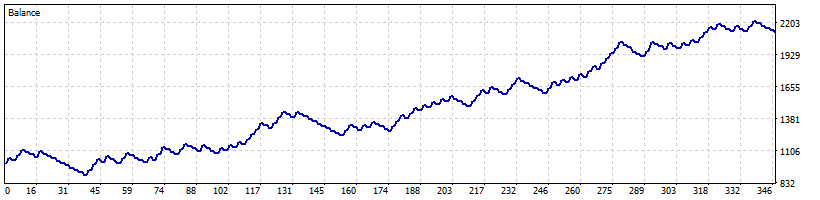
Figure 4. Optimized SP500 H1 result
In practice, this means the Signal Bar almost fully retraces the Main Bar, but the market quickly resumes the original move during the next candle.
It almost behaves like a different pattern altogether: impulse, pullback, continuation.
This variation delivered the best results on SP500.
M15
H4 testing was abandoned due to insufficient trade count. Instead, the hypothesis was evaluated on M15.
- SP500 did not show any stable patterns.
- XAUUSD continued to produce reasonably strong results.
- EURUSD M15 turned out to be the most interesting case.
EURUSD M15 was the only setup that remained stable in both backtesting and forward testing.

Figure 5. EURUSD M15 backtest

Figure 6. EURUSD M15 forward test
Conclusion
The most consistent finding of the entire research was the relationship between performance and the Main Bar body size.
Across all markets and timeframes, stronger directional Main Bars consistently led to better results.
This parameter appears to be a meaningful building block when designing price action systems.
The strategy produced encouraging results on XAUUSD, although additional forward-testing data is still required.
No convincing edge was found on EURUSD H1.
The most interesting outcome came from EURUSD M15. The parameters remain consistent with the underlying logic of the setup, and the performance held up in both backtesting and forward testing.
At this stage, EURUSD M15 is the only variation I would seriously consider for further research.
Expert Advisor source code: https://www.mql5.com/en/code/73884
Full report and additional charts: https://c.mql5.com/6/1011/002_-_Inside_Bar_-_Report.zip