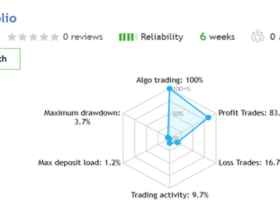
Why I Chose a Cent Account for the Devils Contract Signal Account

Why I Chose a Cent Account for the Devils Contract Signal Account
View Devils Contract on Ultimate Extractor
I want to show people that a proper risk management is possible even with only 100$ capital. To demonstrate my point about how positive a cent account can be I will show you an example down below.
When people first see a cent account with a balance of 500,000 USC, they may assume that it is a much larger account than a standard account with a balance of $5,000.
In reality, both accounts contain exactly the same amount of capital:
- Standard account: $5,000
- Cent account: 500,000 USC = $5,000
The larger displayed number does not create additional capital. The real advantage of the cent account is that it allows much more precise position sizing.
A cent account does not automatically make a trading strategy safer or more profitable. Its main advantage is that the economic position size can be adjusted in much smaller increments.
Why Position-Sizing Precision Matters Below $10,000
On many standard trading accounts, the minimum position size is 0.01 standard lot.
For a smaller trading account, this minimum step can be relatively large. Increasing a position from 0.01 lot to 0.02 lot immediately doubles the exposure.
An automated risk model may calculate that the correct position should be 0.0069, 0.0074 or 0.0082 standard lot. However, when the broker only allows steps of 0.01 standard lot, the position must be rounded.
This can produce one of two problems:
- The position is rounded down and the account is underexposed.
- The position is rounded up and the account takes more risk than intended.
The smaller the account balance, the more significant this rounding effect becomes.
A cent account solves much of this problem by using smaller economic contract sizes. The trading platform still displays lot sizes such as 0.01, 0.10 or 1.00 lot, but the real monetary exposure is much smaller than on a standard account.
According to VT Markets, one cent lot of XAUUSD represents 0.01 of a standard XAUUSD lot. This allows an automated strategy to increase or reduce its exposure much more gradually.
Source: VT Markets – What Is a Trading Cent Account?
Comparing the Two Backtests
To demonstrate the difference, I tested the same strategy using two different account structures.
Both tests used:
- 100% history quality
- 549,757 bars
- 191,576,743 ticks
- 2,524 trades
- The same trading logic
- The same historical testing period
Standard Account Backtest
The first test used a standard account with an initial deposit of $5,000.

Figure 1: Standard account backtest with an initial deposit of $5,000.
| Metric | Standard Account Result |
|---|---|
| Initial deposit | $5,000.00 |
| Total net profit | $3,448.20 |
| Profit factor | 3.38 |
| Relative equity drawdown | 2.83% |
| Total trades | 2,524 |
| Profitable trades | 1,972 / 78.13% |
| Expected payoff | $1.37 per trade |
Cent Account Backtest
The second test used a cent account with an initial deposit of 500,000 USC.
Because 100 USC equals $1, this is also an initial capital of exactly $5,000.

Figure 2: Cent account backtest with an initial deposit of 500,000 USC, equal to $5,000.
| Metric | Cent Account Result |
|---|---|
| Initial deposit | 500,000 USC = $5,000.00 |
| Total net profit | 493,452.58 USC = $4,934.53 |
| Profit factor | 3.46 |
| Relative equity drawdown | 3.05% |
| Total trades | 2,524 |
| Profitable trades | 1,972 / 78.13% |
| Expected payoff | 195.50 USC = $1.955 per trade |
Direct Comparison
| Metric | Standard Account | Cent Account |
|---|---|---|
| Real starting capital | $5,000.00 | $5,000.00 |
| Displayed balance | 5,000 USD | 500,000 USC |
| Total trades | 2,524 | 2,524 |
| Winning trades | 78.13% | 78.13% |
| Net profit | $3,448.20 | $4,934.53 |
| Profit factor | 3.38 | 3.46 |
| Relative equity drawdown | 2.83% | 3.05% |
The number of trades and the winning-trade percentage are identical. This shows that the underlying strategy signals remained consistent.
The main difference is the position-sizing resolution. The cent account was able to adjust its exposure in smaller increments as the balance increased.
This resulted in smoother and more efficient compounding in the tested configuration.
Original Position-Sizing Model
The original cent-account money-management setting was:
0.01 lot per 5,000 USC
With a starting balance of 500,000 USC, the calculated starting position is:
500,000 ÷ 5,000 × 0.01 = 1.00 cent-account lot
For the VT Markets XAUUSD cent specification, 1.00 cent-account lot represents approximately 0.01 standard lot of economic exposure.
The position size increases by 0.01 cent-account lot whenever the balance increases by another complete 5,000 USC.
Growth Model: Standard Account
For the simplified comparison, the following assumptions are used:
- Starting balance: $5,000
- Position size: 0.01 standard lot per $5,000
- Profit at 0.01 lot: exactly $1 per profitable trade
The account must generate another $5,000 to reach $10,000.
$5,000 ÷ $1 per trade = 5,000 trades
The standard account therefore requires exactly 5,000 profitable trades to double under these simplified assumptions.
Growth Model: Original Cent-Account Size
For the cent account, the assumptions are:
- Starting balance: 500,000 USC
- Target balance: 1,000,000 USC
- Position size: 0.01 lot per 5,000 USC
- Profit at 0.01 cent-account lot: exactly 1 USC per profitable trade
- The position increases by 0.01 lot after every additional complete 5,000 USC
At the beginning:
500,000 ÷ 5,000 × 0.01 = 1.00 lot
A position of 1.00 cent-account lot therefore generates 100 USC per successful trade in this simplified model.
As the account grows, the position size increases gradually:
- 500,000 USC: 1.00 lot
- 505,000 USC: 1.01 lots
- 510,000 USC: 1.02 lots
- 750,000 USC: 1.50 lots
- 995,000 USC: 1.99 lots
With this compounding method, the account reaches 1,000,000 USC after approximately:
3,479 profitable trades
This is significantly faster than the 5,000 trades required by the standard-account example.
Reducing the Cent-Account Position Size
The cent account does not necessarily need to use the additional compounding efficiency to maximize profit.
Instead, the position size can be reduced so that the cent account targets approximately the same doubling speed as the standard account.
The calculated adjusted setting is:
0.01 lot per 7,184 USC
At a starting balance of 500,000 USC:
500,000 ÷ 7,184 × 0.01 = approximately 0.696 lot
Compared with the original starting size of 1.00 lot:
0.696 ÷ 1.00 = 69.6% of the original position
The position-size reduction is therefore:
100% − 69.6% = approximately 30.4%
| Setting | Original Cent Model | Adjusted Cent Model |
|---|---|---|
| Position-sizing formula | 0.01 lot per 5,000 USC | 0.01 lot per 7,184 USC |
| Calculated starting size | 1.00 lot | Approximately 0.696 lot |
| Normalized practical size | 1.00 lot | Approximately 0.69 or 0.70 lot |
| Position-size reduction | 0% | Approximately 30.4% |
| Trades required to double | Approximately 3,479 | Approximately 5,006 |
With the reduced setting, the cent account reaches 1,000,000 USC after approximately 5,006 trades.
This is almost identical to the 5,000 trades required by the standard-account example.
Control Calculation Using the Actual Backtest Profits
The two backtest reports provide a second independent calculation.
The standard account generated:
$3,448.20
The cent account generated:
493,452.58 USC = $4,934.53
To estimate the cent-account position size required to produce the same profit as the standard account:
$3,448.20 ÷ $4,934.5258 = 0.69879
The cent-account exposure could therefore theoretically be reduced to approximately 69.879% of the tested size.
The corresponding reduction is:
100% − 69.879% = approximately 30.12%
Converted into the same position-sizing format:
5,000 USC ÷ 0.69879 = approximately 7,155 USC
The backtest-implied setting is therefore approximately:
0.01 lot per 7,155 USC
This result is very close to the theoretical value of 0.01 lot per 7,184 USC.
| Calculation Method | Suggested Setting | Estimated Reduction |
|---|---|---|
| Simplified 5,000-trade growth model | 0.01 lot per 7,184 USC | Approximately 30.4% |
| Actual backtest profit comparison | 0.01 lot per 7,155 USC | Approximately 30.12% |
Two independent calculations therefore produce almost the same conclusion:
The cent account can potentially use approximately 30% less position size while targeting a profit comparable to the standard-account test.
Does 30% Less Position Size Mean Exactly 30% Less Risk?
Position size, margin usage and the monetary value of each price movement normally scale with exposure. Therefore, reducing the position by approximately 30% should also reduce the immediate monetary exposure of each trade by approximately 30%.
However, this does not guarantee that every final risk metric will be exactly 30% lower.
The final drawdown can also be influenced by:
- The sequence of winning and losing trades
- Compounding
- Minimum lot-size normalization
- Spread
- Commission
- Slippage
- Swap costs
- Different margin requirements
- Broker-specific contract specifications
An exact drawdown comparison should therefore be confirmed with a separate backtest using the reduced position-sizing setting.
Advantages of a Cent Account for Smaller Capital
1. More Accurate Position Sizing
The Expert Advisor can remain much closer to the position size calculated by its risk model.
2. Smaller Changes in Exposure
The system does not need to double its position from 0.01 to 0.02 standard lot simply because the broker does not support an intermediate size.
3. Smoother Compounding
As the account grows, the position can increase gradually instead of making large jumps.
4. Real-Money Trading Conditions
A cent account is still a live trading account. It is exposed to real spreads, market execution, slippage and trading costs.
5. More Conservative Signal-Account Exposure
The sizing advantage can be used to reduce risk instead of simply maximizing profit.
6. Better Representation of the Strategy
For a signal account, accurate execution of the strategy's risk model is more important than displaying a large nominal dollar balance.
Why the Advantage Becomes Smaller as Capital Increases
The $10,000 threshold is not an absolute rule.
As the account balance increases, a 0.01-standard-lot increment represents a smaller percentage of the total equity.
For example, a 0.01-lot rounding difference is proportionally much more important on a $1,000 or $5,000 account than on a $50,000 account.
The higher the capital, the less significant the minimum lot increment becomes.
For capital below approximately $10,000, however, the additional position-sizing precision of a cent account can materially improve how accurately an automated strategy follows its intended exposure.
Why Devils Contract Uses a Cent Signal Account
For the Devils Contract signal account, I wanted to combine three important characteristics:
- Real-money execution
- Precise position sizing
- Conservative and scalable exposure
A cent account provides this combination more effectively than a standard account with the same sub-$10,000 capital.
The 500,000 USC balance does not represent $500,000. It represents $5,000.
The reason for using the cent account is not to make the account look larger. It is to make the position sizing more precise.
This precision allows the signal account to reduce its position size by approximately 30% while still targeting a profit comparable to the standard-account configuration in the calculations shown above.
Conclusion
A cent account is not automatically better for every trader and every strategy.
However, for an automated trading system with less than $10,000 in capital, it can provide an important technical advantage: much finer control over the real economic position size.
In the comparison presented here:
- Both accounts started with the same real capital of $5,000.
- Both backtests executed 2,524 trades.
- Both achieved the same 78.13% profitable-trade rate.
- The cent account benefited from more granular position-size adjustments.
- The calculations indicate that the cent-account size can be reduced by approximately 30% while targeting a comparable profit.
For this reason, I selected a cent account as the Devils Contract signal account.
It allows the system to trade in a real-money environment while keeping the position sizing more precise, scalable and conservative.
Risk Warning
Trading forex, gold and CFDs involves significant risk and may not be suitable for every investor. A cent account improves position-size granularity, but it does not eliminate market risk, leverage risk, execution risk or the possibility of losing capital.
Backtest results and past performance do not guarantee future performance. The calculations in this article are based on the stated assumptions and may differ under live market conditions, different broker specifications, spreads, commissions, slippage and execution conditions.