
The 4-Filter Reversal Blueprint using Acceleration, Money-Flow and Higher-Timeframe Trend
Every trader has felt it: you spot a beautiful top, hesitate, and watch price reverse without you. Or you finally short - right before the market rips higher. Picking swing tops and bottoms is where most accounts are made or broken, because it is where emotion is loudest and information is thinnest.
This guide shares the exact framework I use to trade reversals with a clear head, powered by Accelerator Signal Pro. You will learn why acceleration leads price, how four independent filters stack into high-quality signals, and three concrete setups you can apply this week.
1. Why Catching Tops and Bottoms Is So Hard
A trend looks obvious in hindsight, but the turn never announces itself in real time. The three classic traps:
• Too early: you sell strength because it looks high, and momentum keeps running.
• Too late: you wait for certainty, and by the time it is obvious the move is half over.
• Too noisy: every small wiggle looks like a reversal, so you over-trade and bleed on chop.
The fix is not a magic line. It is a process that measures momentum objectively, filters out noise, and only acts when several independent signals agree.
2. The Core Idea: Acceleration Comes Before Price
Bill Williams Accelerator/Decelerator (AC) does not measure price - it measures the acceleration of momentum. Think of a car approaching a red light: the brakes engage (deceleration) well before the car actually stops. In markets, momentum decelerates before price turns.
That is why AC is such a powerful early-warning tool. The challenge with the raw indicator is interpretation - a histogram flipping colour every few bars gives too many false alarms. Accelerator Signal Pro solves this by turning acceleration into a disciplined swing-detection engine and confirming it three more ways.
3. The 4-Filter Confirmation Stack
A signal only prints when the setup survives all active filters. You can enable or disable each one to match your style.
Filter 1 - The Swing Engine (core)
An adaptive, ATR-based model isolates only significant swings and marks the precise high or low. Because it scales with volatility, the same settings behave sensibly on EURUSD and on Gold, on M15 and on H4.
Filter 2 - Accelerator Momentum
Confirms that momentum was genuinely accelerating into the top (or decelerating into the bottom) - not just drifting sideways.
Filter 3 - Money-Flow (A/D)
A built-in Accumulation/Distribution engine checks whether volume flow agrees, including price/flow divergence - price makes a higher high while money flow makes a lower high, the classic footprint of distribution before a top (and the mirror image before a bottom).
Filter 4 - Higher-Timeframe Trend
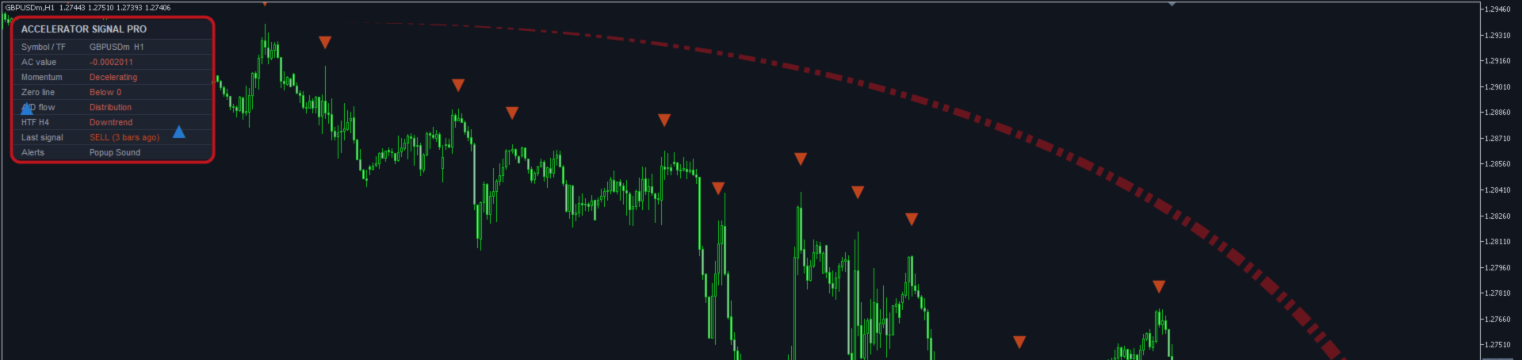
Aligns every signal with the bigger picture, so you buy dips in an uptrend and sell rallies in a downtrend instead of fighting it. It reads only the last closed higher-timeframe bar, so there is no look-ahead.
A quick word on trust: signals are calculated on closed bars only, they never read future data, and once an arrow is printed it never moves. What you see in the backtest is what you get live.
4. Strategy 1 - The Trend-Aligned Pullback
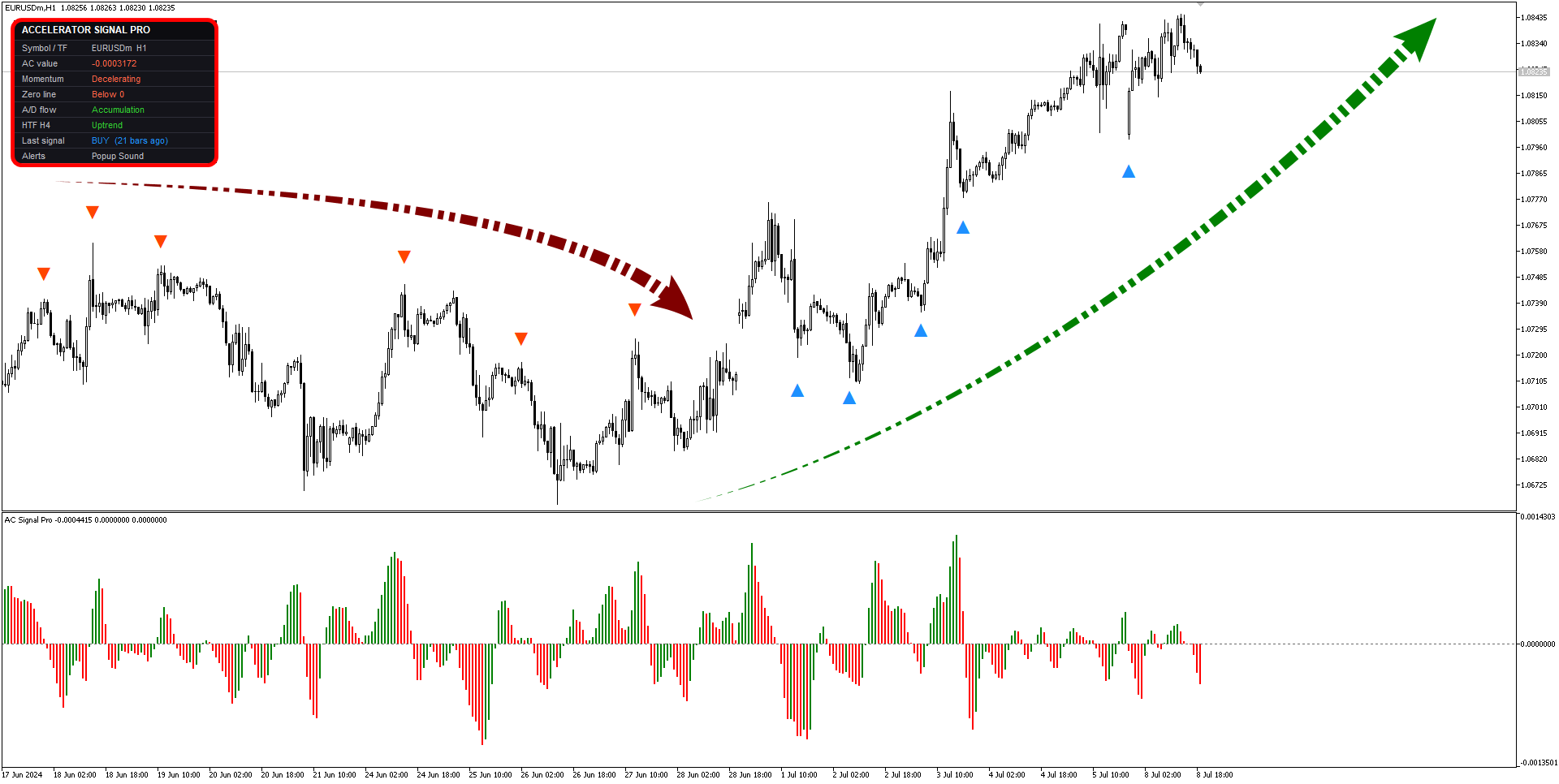
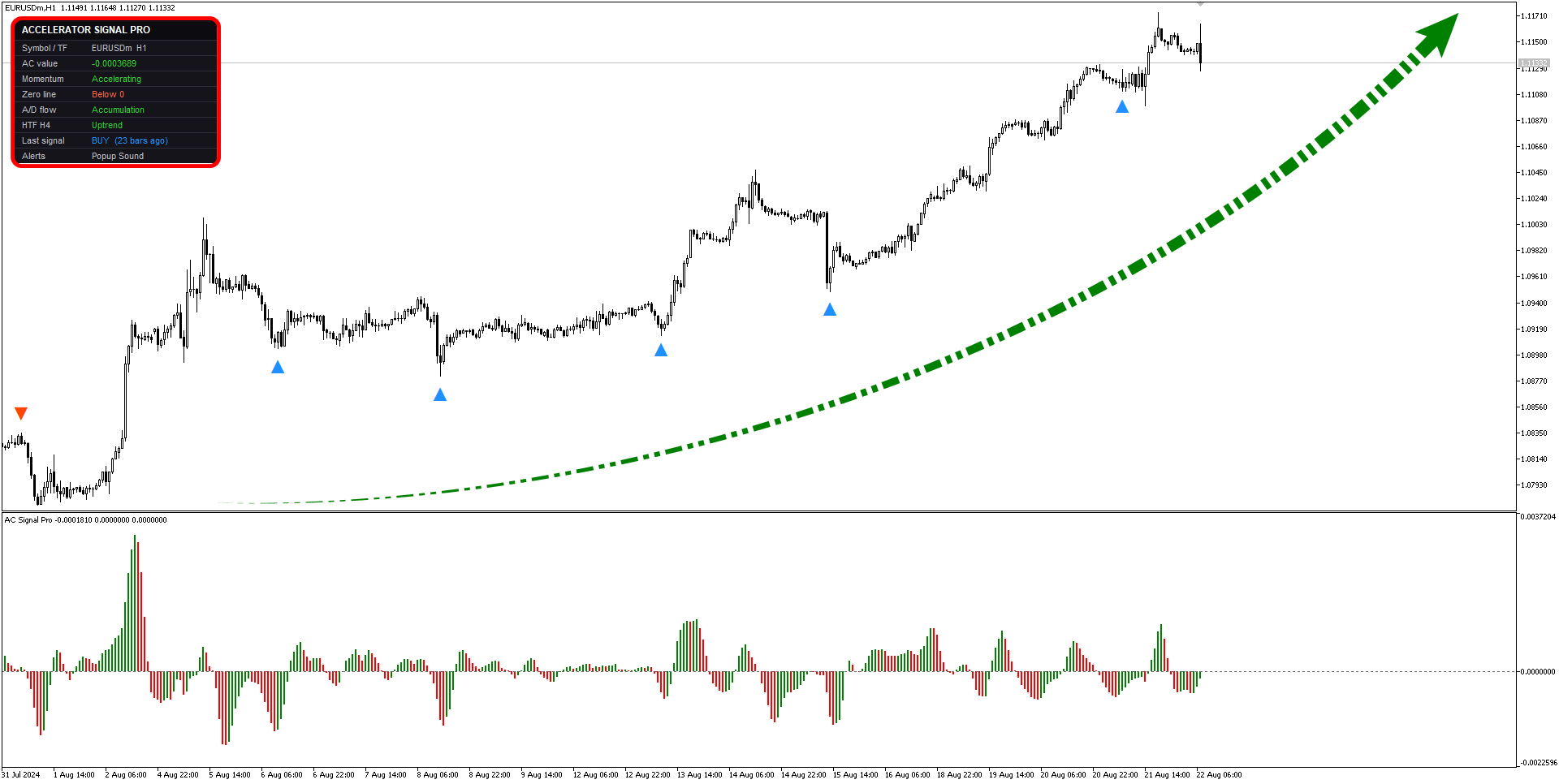
This is my bread-and-butter setup and the best starting point for most traders. The idea is simple: trade reversals of the small pullback, in the direction of the larger trend.
The setup
1. The dashboard shows the higher-timeframe trend as Uptrend (for buys) or Downtrend (for sells).
2. Wait for price to pull back against that trend.
3. Take the BUY at the swing low in an uptrend, or the SELL at the swing high in a downtrend, printed on a closed bar.
4. Skip any signal that fights the higher-timeframe trend - the filter already removes most of them for you.
Why it works: you are entering with the dominant order flow while getting a low-risk price at the end of a counter-trend pullback.
5. Strategy 2 - The Momentum-Divergence Reversal
For traders who want to catch major turning points, enable the A/D money-flow filter in Divergence mode. Now a signal only fires when price pushes to a new extreme but money flow refuses to follow.
• SELL: price prints a higher high, A/D prints a lower high - buyers are exhausting.
• BUY: price prints a lower low, A/D prints a higher low - sellers are exhausting.
These are rarer but often mark the strongest reversals. Pair them with the higher-timeframe filter for the most selective, sniper version of the strategy.
6. Strategy 3 - Intraday Sniper on M15
Prefer faster action? Drop to M15 with the higher-timeframe filter set to auto (it will use H1). Lower the reversal-to-confirm value so signals arrive sooner, and switch the marker to Confirmation bar so the arrow appears exactly on the candle you act on.
This version fits the London and New York sessions, where Gold and index CFDs offer clean, tradable swings.
7. Trade Management: Entry, Stop, Targets
The indicator tells you where and when; your risk plan does the rest. A simple, robust routine:
• Entry: on the close of the signal bar, or the open of the next bar.
• Stop: just beyond the marked swing high/low - the level that would invalidate the reversal.
• Targets: scale out at the previous swing, then trail the rest while the higher-timeframe trend stays in your favour.
• Risk: keep risk per trade small and consistent. Survival first, then compounding.
8. Settings Presets
Start with Balanced, then adjust one dial at a time. The two inputs that change everything are the swing size and the reversal-to-confirm value.
| Setting | Conservative | Balanced (default) | Aggressive |
| Significant swing size (xATR) | 4.0 | 3.0 | 2.0 |
| Reversal to confirm (xATR) | 2.0 | 1.5 | 1.0 |
| Marker mode | Confirmation bar | Pivot | Pivot |
| HTF trend filter | On | On | Off |
| A/D money-flow filter | Divergence | Off | Off |
| Typical result | Few, high-grade | Clean swings | More, faster |
Tip: bigger swing size = fewer, larger swings. Smaller reversal-to-confirm = faster signals with a little more noise.
9. Best Pairs, Timeframes and Sessions
• Pairs: EURUSD, GBPUSD, XAUUSD (Gold), US30 and NAS100 give the cleanest swings.
• Timeframes: M15 to H4; H1 is the best all-round balance of quality and frequency.
• Sessions: London and New York, when volatility and follow-through are highest.
10. Five Mistakes That Ruin Reversal Trading
1. Trading against the higher-timeframe trend because it looks extended.
2. Moving the stop further away to avoid being wrong.
3. Over-trading every small wiggle instead of waiting for a filtered signal.
4. Ignoring risk sizing after a couple of winners.
5. Abandoning the plan after one loss - edges play out over many trades, not one.
Final Thoughts
You do not need to predict the market - you need a repeatable process that stacks the odds and keeps you disciplined. Objective acceleration, confirmed by momentum, money flow and the higher-timeframe trend, is exactly that kind of process.
Trade tops and bottoms with clarity.
Get Accelerator Signal Pro and let acceleration, money-flow and trend agree before you click - so you enter with confidence, not hope. Explore it and my other tools here:
https://www.mql5.com/en/market/product/187419/
Disclaimer: Trading involves risk. This material is educational and does not constitute financial advice. Past performance does not guarantee future results. Always use sound risk management.