The Best of Both Worlds — Building a Hybrid Scalper That Can Catch Big Moves on Gold

Gold has been relentless lately. If you have been trading XAUUSD over the last few months you already know what I mean — violent intraday swings, sharp reversals, news-driven spikes that erase hours of movement in minutes. The kind of price action that punishes traders who hold too long and also punishes traders who exit too early.
That tension is exactly what led me to build a hybrid approach.
Where It Started
My original concept was a straightforward London session breakout strategy. The logic is clean — gold tends to consolidate during the Asian session, and when London opens, institutional order flow breaks price decisively out of that range. The strategy was initially designed to wait for the break, a retracement back toward the range, and then a confirmed continuation in either direction before entering. Capture the move, hold for a defined target, exit. Simple.
And it works. The London breakout on gold is one of the most consistent patterns I have found on this instrument. Price respects the Asian session range more often than most traders realize, and the breakout move that follows is frequently sharp and directional.
The problem was the holding strategy. A fixed take profit worked well in trending conditions, but in the kind of erratic, whipsaw environment gold has been trading in recently, price would hit a target and immediately reverse — or worse, reverse before hitting the target at all, stopping out a trade that was well in profit.
I needed something more adaptive.
The Shift to a Hybrid Approach
The turning point was accepting that gold right now does not behave like gold did two years ago. Volatility has expanded significantly. Geopolitical drivers, shifting rate expectations, and macro uncertainty have all contributed to a market that moves fast, moves far, and reverses without warning.
A pure scalp approach — tight entry, tight target, get out quickly — handles the erratic conditions well. You are not exposed long enough for a reversal to hurt you. But you also leave significant money on the table when gold decides to trend hard out of the London open, which it still does regularly.
A pure swing approach gives you the upside on trending days but bleeds you on the choppy ones.
The hybrid solves both problems.
How the System Works
The EA enters at the London breakout using a tight, scalp-style entry — precise timing, controlled risk, a stop loss sized to the immediate breakout structure rather than a wide swing stop. The entry is the scalp component.
From there the trade management shifts to swing logic. Rather than exiting at a fixed take profit, a trailing stop activates once the trade is in profit and follows price as it moves. On a clean trending day, the trade can ride a significant move. On a choppy day where price breaks out and immediately stalls, the trail keeps the loss minimal or locks in a small gain before price reverses.
The result is an asymmetric system — losses are controlled and consistent, wins vary based on what the market gives. Some days it is a small scalp. Some days it catches a $50–$100 trend move on gold — the kind of run that a pure scalper would have exited long before it finished.
The system does not care which — it manages both outcomes automatically.
Finding a Second Edge
Once the London breakout logic was dialed in, a natural question emerged — where else on the chart could the same logic be applied?
The London breakout gives one trade opportunity per day. That is intentional and disciplined, but it also means the system sits idle for large portions of the trading day. The question became whether there was another area on the gold chart where price consistently respects a defined level, breaks cleanly, and follows through — the same conditions that make the London breakout work.
The answer was the previous day's high and low.
Gold respects prior day structure consistently. These levels act as magnets and barriers — price tests them, breaks them, and when it does, the move is frequently decisive. The same pending order logic used on the London range breakout translates directly to these levels, with the same hybrid scalp entry and adaptive trail management.
The result is a second independent trade opportunity each day that runs entirely separately from the London breakout system. Two systems, two entry opportunities, one EA — each managing its own risk without interfering with the other.
Backtest Results
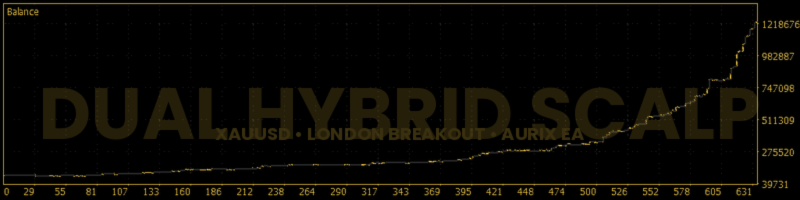
I backtested the system on XAUUSD across a 14-month period using real tick data with variable spreads across two account sizes:
$1,000 starting balance — ending balance $12,704 (1,170% return) $100,000 starting balance — ending balance $1,349,181 (1,249% return)
Maximum drawdown stayed under 5% across both tests. Profit factor above 6.5.
These are backtest results. I want to be straightforward about that — live trading will always produce different numbers. Forward testing is underway and I will update this post as live results come in.
Why This Approach Makes Sense Right Now
Gold is not going to calm down anytime soon. The macro environment driving this volatility — rate uncertainty, geopolitical tension, dollar instability — is not resolving in the near term. A system that adapts to both trending and choppy conditions is not just a nice feature right now, it is a necessity.
The hybrid scalp/swing approach is the answer I landed on after working through the alternatives. It is not perfect — no system is — but it handles the current gold environment better than anything else I have tested.
If you want to look at the EA, it is available on the MQL5 marketplace here: https://www.mql5.com/en/market/product/168975
Questions and feedback welcome in the comments. I will continue posting updates as the forward test progresses.