
THE LAST HUMAN STARING AT THE CHART
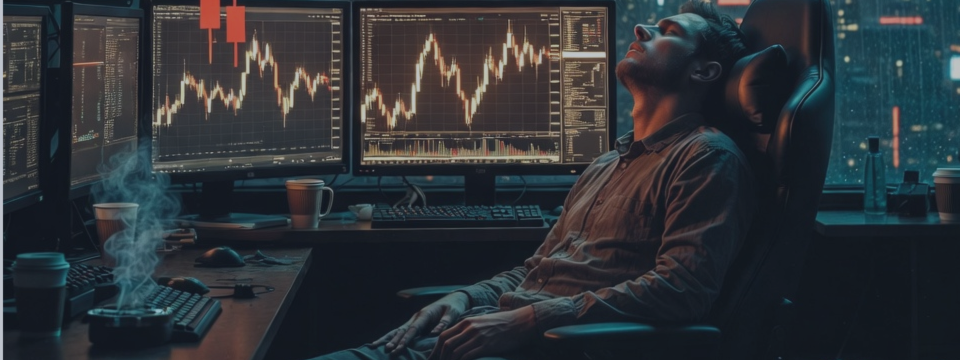
February 2026. Four in the morning. You're staring at the chart for the fifth straight day. Bags under your eyes, cold coffee in your mug, thousands of dollars in your head—"it'll just sit in a little drawdown for a while."
Your stop was hit an hour before the news. The move you'd waited two days for happened twenty minutes after you fell asleep.
You didn't lose to the market. You lost to your own physiology.
I. THE ILLUSION OF CONTROL: WHY TWENTY YEARS OF EXPERIENCE BECAME A LIABILITY
We've entered an era when decision-making speed has finally detached itself from human capability.
Look at your trading day. You're looking for an entry—algorithms have already executed it. You're analyzing news—the position was opened a minute before the release. You place a stop—liquidity was swept three ticks higher.
The market no longer punishes ignorance. It punishes inertia.
Those who learned to trade in 2018 learned to read candlestick patterns and wait for confirmation. But 2026 doesn't forgive waiting. While you wait for the candle to close, price moves a hundred pips. While you hesitate, the algorithm enters with the fourth volume.
Your experience is no longer an advantage. It has become the speed of your delay.
II. THE SILENCE THAT KILLS: WHAT'S WRONG WITH THE HUMAN BRAIN
Neuroscientists have long known what traders refuse to accept: humans are not designed for decision-making under uncertainty.
Your brain is evolutionarily wired for two things: - Fleeing from danger (close a position in loss on the first pullback); - Getting dopamine pleasure (lock in profit too early).
The 2026 market exploits this with sadistic pleasure.
The first trap: the dopamine needle.
You closed a trade with a 20-pip profit. Feel satisfied? Don't. The move continued another 200 without you. But your brain already received its hit of happiness hormone for the "correct decision." You'll remember this moment as a success, when in reality you lost 90% of potential profit.
The second trap: mirror neurons.
You see others blowing up accounts. You read chats where everyone's panicking. Your brain synchronizes with the crowd on a chemical level. You start feeling their fear as your own. And you make the decision the crowd makes—close at a loss, even though your analysis says otherwise.
The third trap: the anchor effect.
You remember that last month price reversed from the 1950 level. Now it's there again. Your hand reaches for the "Sell" key. But the market no longer remembers last month. It only remembers the liquidity you're about to place above that level.
III. THE ECONOMICS OF PRESENCE: WHY YOU PAY FOR WHAT YOU SHOULD BE PAID FOR
Let's calculate your trading day not in pips, but in resources.
Eight hours at the screen. Four hours of analysis. Forty minutes on calls with your broker. Two sleepless nights because of open positions.
What's the hourly rate for this torment?
Now look at your monthly statement. How much did you earn per hour spent in front of the monitor?
I'll bet: a waiter at a roadside cafe earns more per unit of time, counting your losses and missed profits.
The scariest thing about manual trading in 2026 isn't the losses. It's the illusion of busyness. You think you're working. In reality, you're just present. Observing. Suffering.
The market doesn't need your suffering. The market needs liquidity.
IV. THE QUIET CAPITULATION: WHY THE ALGORITHM NEVER GETS TIRED
Imagine the perfect trader.
He doesn't sleep. News from Washington doesn't infuriate him. He's not afraid price will hit his stop. He doesn't rejoice when a trade goes positive. He doesn't get upset when it goes negative.
He simply opens and closes positions exactly as you programmed him.
This isn't science fiction. This is your computer, sitting idle 23 hours a day while you torture yourself in front of the monitor.
You bought hardware that can calculate millions of iterations per second. And you use it to watch YouTube between market entries.
You don't need a more powerful processor. You need a processor that will work instead of you.
Systems like GOLD QUEEN aren't just algorithms—they're the digitization of discipline. They don't get tired at 3 AM. They don't hesitate after three losses. They don't get greedy after three wins. They just execute.
V. THE FINAL ILLUSION: "I'LL DO IT MYSELF"
Professional traders with decade-long histories often display the exact same reaction to automation.
"I need to feel the market." "I need to see orders being placed." "I make my own decisions."
Translate this into human language: "I need to suffer."
Because feeling the market means feeling the pain of drawdown. Seeing orders means watching your stop get taken out a second before the reversal. Making decisions means deciding not to sleep while normal people are sleeping.
The airplane syndrome.
When you're on a plane, you don't run to the cockpit screaming: "I feel like we should go left! I'll land it myself!"
You trust the autopilot and the professionals. Because you know: in a critical situation, a human will make mistakes faster than a machine.
Trading is the only field where grown adults with money refuse the autopilot, preferring to crash with their own hands.
VI. THE IMPERCEPTIBLE TRANSITION: HOW TO STOP BEING AN OPERATOR
Those who've already walked this path know one pattern.
The transition to automated trading never happens through "bought-it-turned-it-on-got-rich." It always looks like gradual capitulation.
First, you test on demo. You just watch how the system works without your participation. Then you put it on a cent account. Micro-volumes, micro-risks. Then you forget to check the terminal for two days. Then you notice you haven't opened the terminal in a week—and the account is growing.
And at some point, you catch yourself thinking: "What was I even doing all these years?"
You weren't buying a robot. You were buying your time back.
Time that used to burn in front of the screen. Time you can't get back. Time the market stole from your children, your sleep, your health.
VII. THE CHOICE THAT WILL DEFINE YOUR 2026
February 2026. The chart has been ranging for three weeks.
Your EA isn't opening trades—you set the parameters yourself to wait for confirmation. But your hands are itching. "This is the perfect entry, I'll just take it myself, one lot, real quick."
What do you do?
If you enter—you've lost. Not because the trade will be unprofitable. But because you've just proven: your discipline is worth less than a single market impulse. Within a month, the EA will be disabled. A forum post will appear saying "robots don't work." You'll return to manual trading and blow accounts with deep satisfaction.
If you hold back—you've won. Because you just purchased freedom from your own impulses. A professional's most profitable trades are the ones they never took.
We live in an era when speed has finally detached itself from humanity.
Robots won't replace you. They'll replace the part of you that prevents you from earning. Your experience will remain with you—in the settings, in the strategies, in the risk management. Only the pain will disappear.
Test any advisory system. Put it on minimum settings. Don't touch it for two weeks. Record the results.
You'll likely discover two things: - The algorithm will make mistakes (no perfect systems exist). - Those mistakes will be fewer than yours.
The market doesn't forgive hesitation. Your main competitor is already sleeping while their EA counts profits.
The question isn't whether you'll start. The question is how much more you'll lose before you allow yourself to stop losing.