
How George Soros traded: the trades that made him $1 billion in a day

George Soros was not a trader who scalped on 5-minute candles.
He did not use RSI, MACD, or Bollinger Bands.
He did not trade stocks, NFTs, or even Bitcoin — he traded the macroeconomic imbalances behind currencies.
He traded currencies.
And he did so as a macro-arbitrageur—with billion-dollar positions—based on one clear principle:
“When the market is wrong—and knows it’s wrong—go all in.”
Here’s how he did it in practice.
1. Strategy: “Trading Imbalance”
Soros wasn’t looking for the “best stock.”
He looked for unstable currency pairs where:
- The central bank pegs the exchange rate (non-floating).
- The economy fundamentally does not support that rate (overvalued or undervalued).
- The market has already begun to doubt the peg—but the bank hasn’t yet surrendered.
This is the real entry signal.
Example: British Pound vs. German Mark, 1992
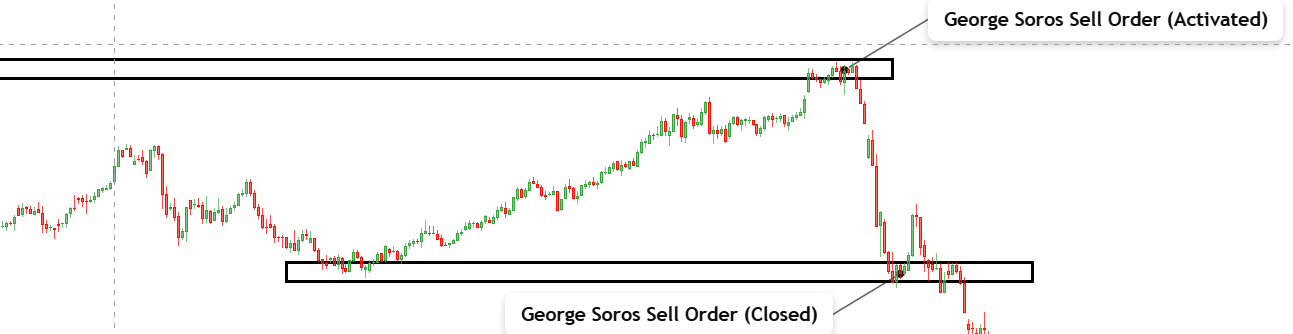
- Pegged rate: 2.95 DM/GBP
- Real market level (PPP): ~2.50 DM/GBP
- Bank of England reserves: $27 billion
- Demand to sell GBP: Rising for 3 consecutive months
- Bank of England monetary policy: High interest rates (15%) to defend the peg
Soros saw:
- The Bank of England was holding the pound above its true value.
- To do so, it was burning through reserves.
- The market knew it—but hadn’t yet acted en masse.
- Every day the pound didn’t fall meant additional debt for the central bank.
His decision:
Sell $10 billion in British pounds.
Buy $10 billion in German marks.
This was one position—not 100 trades.
It was 10 times larger than all other positions in the Quantum Fund combined.
2. How He Identified the Entry Point
Soros didn’t wait for a “breakout” or “reversal.”
He waited for a signal that the central bank was about to capitulate.
His three key indicators:
- Central bank reserves: Are gold and foreign exchange reserves declining?
→ If yes, the bank is losing strength. - Interest rates: Are they higher than those of competitors?
→ High rates = expensive to hold the currency. - Capital flows: Are foreign investors withdrawing?
→ Capital outflow = the market has already sold.
In 1992:
- Reserves were falling daily.
- UK rates: 15% | Germany: 8%.
- Foreign banks were moving money from GBP to DEM.
His signal:
“When the central bank starts spending reserves to defend a rate, it’s not protection—it’s suicide.”
He entered the position one week before the collapse.
3. Position Size: How He Used Leverage
Soros didn’t trade with his own money.
He used leverage through derivatives.
His trade structure:
- Sold GBP futures: $7 billion
- Sold GBP forwards: $2 billion
- Bought DEM spot: $1 billion
Total:
- $10 billion short GBP
- $1 billion long DEM
Leverage:
- The position was 10–12 times the total capital of the Quantum Fund.
- This wasn’t risky—because he was certain the central bank would break.
- He wasn’t guessing—he was calculating.
“I’m not betting on an outcome. I’m betting that the system cannot hold.”
4. Exit Strategy: When to Close
He didn’t wait for the “peak.”
The moment the Bank of England announced its exit from the ERM, he closed the position instantly.
- Short GBP → closed
- Long DEM → closed
Profit:
- Pound fell from 2.95 to 2.65 in two days — 10%
- Profit on $10 billion = $1 billion (before fees and taxes)
Trade timeline:
- Entry: September 10–15, 1992
- Exit: September 24, 1992 — 14 days
- Maximum drawdown: Zero. He held only when certain.
5. His Trading Discipline — 4 Rules
- Only one major trade at a time.
→ He didn’t diversify. He concentrated.
→ “If you’re not sure—don’t trade. If you’re sure—go all in.” - The position must be “unstoppable” by the market.
→ If the central bank can withstand it—don’t enter.
→ If it can’t—enter. - Never hold a position without fundamental justification.
→ He didn’t trade charts. Only economic imbalances. - Exit by event—not by price level.
→ He never set take-profit levels. He closed when the event happened—e.g., exit from ERM, devaluation, rate change.
6. What Else Did He Trade—Beyond the Pound?
- British Pound — 1992 — GBP vs DEM — Short — $1 billion
- Mexican Peso — 1994 — MXN — Short — $700 million
- Thai Baht — 1997 — THB — Short — $1.5 billion
- Asian Currencies — 1997–98 — IDR, KRW, PHP — Short — >$2 billion
All trades followed the same pattern:
- Currency is overvalued.
- Central bank is pegging it.
- Reserves are declining.
- Market is waiting for the moment.
- He enters—and waits for the official announcement.
7. Why He Never Lost
He didn’t trade every day.
He didn’t trade on news.
He didn’t trade using indicators.
He didn’t trade unless he was 90% certain.
His profits didn’t come from frequency.
They came from precision.
“I make 10 trades a year. Eight are losers. But one makes $2 billion. That’s the business.”
Conclusion: How to Trade Like Soros — No Philosophy, Just Actions
- Look for currencies with fixed exchange rates + declining reserves.
- Don’t trade based on charts.
- Compare central bank interest rates with neighboring countries.
- Never use leverage without fundamental justification.
- Wait until the market begins selling en masse.
- Don’t enter until the central bank starts losing reserves.
- Enter with maximum position size when confident.
- Don’t hold a position unless a clear event is pending.
- Close by event—not by price level.
- Never wait for the peak.
In 2025, this strategy still works.
Today: China is pegging the yuan. Saudi Arabia is pegging the riyal.
If you see:
- Declining reserves,
- High interest rates,
- Capital outflows,
- And central bank officials publicly declaring “the rate is stable”—
That’s your trade.
Soros wasn’t a genius.
He was a systematic thinker.
And his method works—so long as central banks try to “hold back” the market.
If you prefer ready-made technical solutions rather than manual analysis — in my channel I publish working indicators and advisors for MetaTrader that help automate trading based on proven market patterns:


![[iVISTscalp5]: XAUUSD. Forecast First. Market Reaction Afterwards](https://c.mql5.com/6/1035/splash-preview-777232.png "[iVISTscalp5]: XAUUSD. Forecast First. Market Reaction Afterwards")
