Articles on machine learning in trading

Creating AI-based trading robots: native integration with Python, matrices and vectors, math and statistics libraries and much more.
Find out how to use machine learning in trading. Neurons, perceptrons, convolutional and recurrent networks, predictive models — start with the basics and work your way up to developing your own AI. You will learn how to train and apply neural networks for algorithmic trading in financial markets.
Add a new article

You are missing trading opportunities:
- Free trading apps
- Over 8,000 signals for copying
- Economic news for exploring financial markets
Registration
Log in
You agree to website policy and terms of use
If you do not have an account, please register


Neural Network in Practice: Pseudoinverse (II)
Since these articles are educational in nature and are not intended to show the implementation of specific functionality, we will do things a little differently in this article. Instead of showing how to apply factorization to obtain the inverse of a matrix, we will focus on factorization of the pseudoinverse. The reason is that there is no point in showing how to get the general coefficient if we can do it in a special way. Even better, the reader can gain a deeper understanding of why things happen the way they do. So, let's now figure out why hardware is replacing software over time.


Neural Networks Made Easy (Part 90): Frequency Interpolation of Time Series (FITS)
By studying the FEDformer method, we opened the door to the frequency domain of time series representation. In this new article, we will continue the topic we started. We will consider a method with which we can not only conduct an analysis, but also predict subsequent states in a particular area.

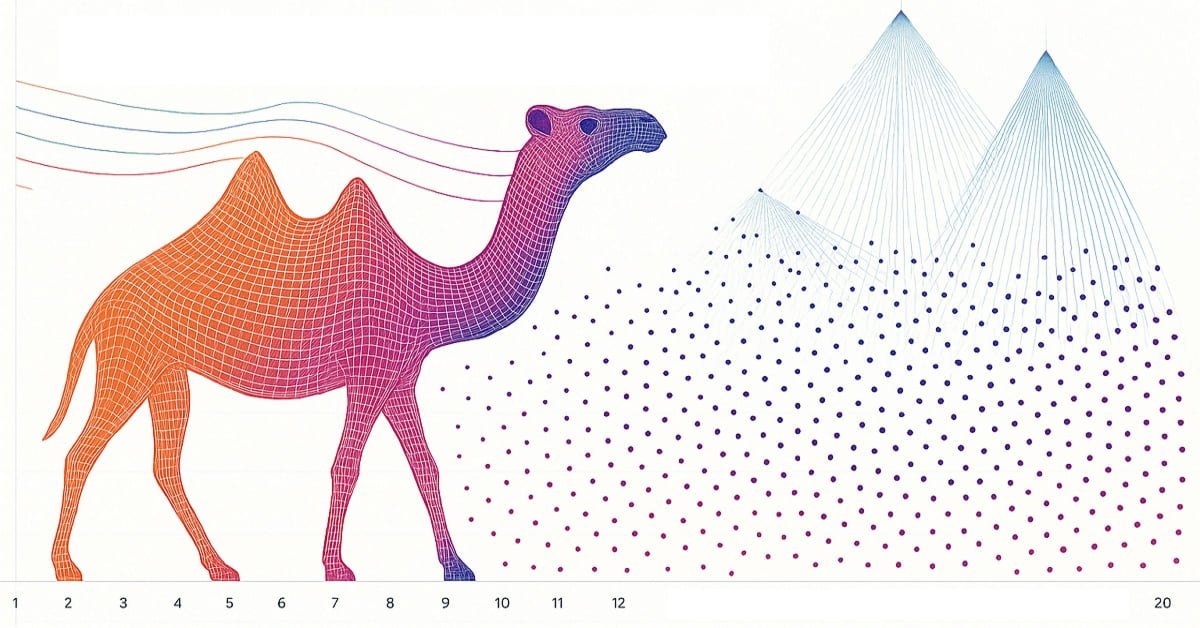
Camel Algorithm (CA)
The Camel Algorithm, developed in 2016, simulates the behavior of camels in the desert to solve optimization problems, taking into account temperature, supply, and endurance. This article also presents a modified version of the algorithm (CAm) with key improvements: the use of a Gaussian distribution in generating solutions and the optimization of the oasis effect parameters.


Self Optimizing Expert Advisor With MQL5 And Python (Part VI): Taking Advantage of Deep Double Descent
Traditional machine learning teaches practitioners to be vigilant not to overfit their models. However, this ideology is being challenged by new insights published by diligent researches from Harvard, who have discovered that what appears to be overfitting may in some circumstances be the results of terminating your training procedures prematurely. We will demonstrate how we can use the ideas published in the research paper, to improve our use of AI in forecasting market returns.


Population optimization algorithms: Whale Optimization Algorithm (WOA)
Whale Optimization Algorithm (WOA) is a metaheuristic algorithm inspired by the behavior and hunting strategies of humpback whales. The main idea of WOA is to mimic the so-called "bubble-net" feeding method, in which whales create bubbles around prey and then attack it in a spiral motion.


African Buffalo Optimization (ABO)
The article presents the African Buffalo Optimization (ABO) algorithm, a metaheuristic approach developed in 2015 based on the unique behavior of these animals. The article describes in detail the stages of the algorithm implementation and its efficiency in finding solutions to complex problems, which makes it a valuable tool in the field of optimization.


Neural Networks in Trading: Generalizing Time Series Without Data-Specific Dependence (Mamba4Cast)
In this article, we introduce the Mamba4Cast framework and take a closer look at one of its key components: timestamp-based positional encoding. The article shows shows how time embedding is formed taking into account the calendar structure of the data.


The Dragonfly Algorithm (DA)
In this article, we will examine the Dragonfly Algorithm (DA), inspired by the collective behavior of dragonflies in nature — their ability to coordinate flight in a swarm, avoid collisions, follow prey, and evade predators. Let's look at how five simple behavioral rules and an adaptive mechanism for transitioning from exploration to exploitation are implemented in MQL5, and test the algorithm on our test bench.


Overcoming The Limitation of Machine Learning (Part 2): Lack of Reproducibility
The article explores why trading results can differ significantly between brokers, even when using the same strategy and financial symbol, due to decentralized pricing and data discrepancies. The piece helps MQL5 developers understand why their products may receive mixed reviews on the MQL5 Marketplace, and urges developers to tailor their approaches to specific brokers to ensure transparent and reproducible outcomes. This could grow to become an important domain-bound best practice that will serve our community well if the practice were to be widely adopted.


An introduction to Receiver Operating Characteristic curves
ROC curves are graphical representations used to evaluate the performance of classifiers. Despite ROC graphs being relatively straightforward, there exist common misconceptions and pitfalls when using them in practice. This article aims to provide an introduction to ROC graphs as a tool for practitioners seeking to understand classifier performance evaluation.


Meta-Labeling the Classics (Part 3): Filtering and Sizing Bollinger Band Trades
Bollinger Band mean reversion degrades in trending regimes when ADX is high and bandwidth expands. We separate direction from trade selection with a two‑stage meta‑labeling pipeline: a gradient‑boosted secondary classifier trained with PurgedKFold on band‑specific features (BBP, BBB, bandwidth regime) outputs action probabilities that drive probability‑based bet sizing. The MQL5 implementation loads the ONNX model and applies position sizing within a two‑EA architecture to filter low‑quality band touches.


Neural Networks in Trading: Skill Hierarchy for Adaptive Agent Behavior (Final Part)
The article discusses the practical implementation of the HiSSD framework in algorithmic trading tasks. It explains how the skill hierarchy and adaptive architecture can be used to build sustainable trading strategies.


Battle Royale Optimizer (BRO)
The article explores the Battle Royale Optimizer algorithm — a metaheuristic in which solutions compete with their nearest neighbors, accumulate “damage,” are replaced when a threshold is exceeded, and periodically shrink the search space around the current best solution. It presents both pseudocode and an MQL5 implementation of the CAOBRO class, including neighbor search, movement toward the best solution, and an adaptive delta interval. Test results on the Hilly, Forest, and Megacity functions highlight the strengths and limitations of the approach. The reader is provided with a ready-to-use foundation for experimentation and tuning key parameters such as popSize and maxDamage.


Data Science and ML (Part 44): Forex OHLC Time series Forecasting using Vector Autoregression (VAR)
Explore how Vector Autoregression (VAR) models can forecast Forex OHLC (Open, High, Low, and Close) time series data. This article covers VAR implementation, model training, and real-time forecasting in MetaTrader 5, helping traders analyze interdependent currency movements and improve their trading strategies.


Neural Networks in Trading: Multi-Task Learning Based on the ResNeXt Model (Final Part)
We continue exploring a multi-task learning framework based on ResNeXt, which is characterized by modularity, high computational efficiency, and the ability to identify stable patterns in data. Using a single encoder and specialized "heads" reduces the risk of model overfitting and improves the quality of forecasts.


Digital Signal Processing for Traders: Building Ehlers' Filter Library in MQL5
We implement Ehlers-style DSP filters in a single reusable MQL5 library and use it to build two indicators. The Roofing Filter applies a 2‑pole high‑pass followed by a Super Smoother to isolate the tradeable 10–48‑bar band. The Even Better Sinewave normalizes the wave to about ±1, oscillating in cycle regimes and railing in trends, so you can read cycles and detect regime shifts in charts and EAs.


Neural networks made easy (Part 82): Ordinary Differential Equation models (NeuralODE)
In this article, we will discuss another type of models that are aimed at studying the dynamics of the environmental state.


Mutual information as criteria for Stepwise Feature Selection
In this article, we present an MQL5 implementation of Stepwise Feature Selection based on the mutual information between an optimal predictor set and a target variable.


Neural Networks in Trading: Generalized 3D Referring Expression Segmentation
While analyzing the market situation, we divide it into separate segments, identifying key trends. However, traditional analysis methods often focus on one aspect and thus limit the proper perception. In this article, we will learn about a method that enables the selection of multiple objects to ensure a more comprehensive and multi-layered understanding of the situation.

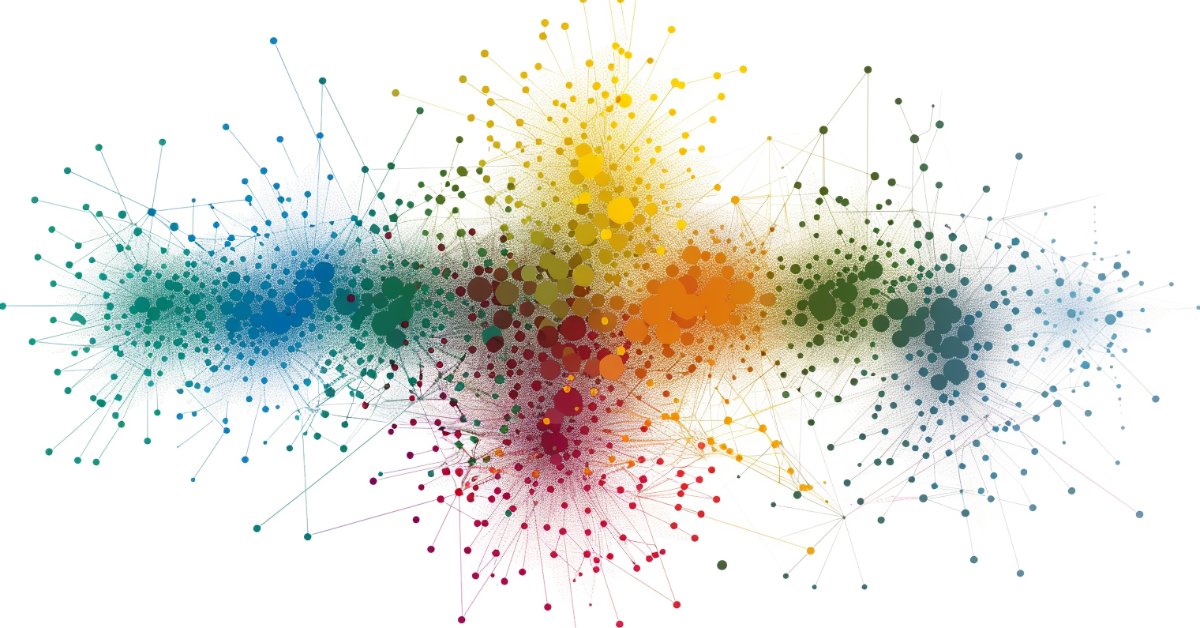
Brain Storm Optimization algorithm (Part I): Clustering
In this article, we will look at an innovative optimization method called BSO (Brain Storm Optimization) inspired by a natural phenomenon called "brainstorming". We will also discuss a new approach to solving multimodal optimization problems the BSO method applies. It allows finding multiple optimal solutions without the need to pre-determine the number of subpopulations. We will also consider the K-Means and K-Means++ clustering methods.


Deterministic Oscillatory Search (DOS)
Deterministic Oscillatory Search (DOS) algorithm is an innovative global optimization method that combines the advantages of gradient and swarm algorithms without the use of random numbers. The fitness oscillation and slope mechanism allows DOS to explore complex search spaces in a deterministic manner.


Integrating MQL5 with Data Processing Packages (Part 8): Using Graph Neural Networks for Liquidity Zone Recognition
This article shows how to represent market structure as a graph in MQL5, turning swing highs/lows into nodes with features and linking them by edges. It trains a Graph Neural Network to score potential liquidity zones, exports the model to ONNX, and runs real-time inference in an Expert Advisor. Readers learn how to build the data pipeline, integrate the model, visualize zones on the chart, and use the signals for rule-based execution.


MQL5 Wizard Techniques you should know (Part 87): Volatility-Scaled Money Management with Monotonic Queue in MQL5
This article presents a custom MQL5 money management class that adapts position sizing to real-time volatility using a monotonic queue for O(N) sliding-window extremes. The class applies inverse volatility scaling and optionally validates risk with an RBF network. We show implementation details in the Optimize method and compare results with the inbuilt Size-Optimized class to assess latency and risk control benefits.


Neural Networks in Trading: Disentangling Structured Components (SCNN)
We invite you to explore the innovative SCNN framework, which takes time series analysis to a new level by clearly separating data into long-term, seasonal, short-term, and residual components. This approach significantly improves forecasting accuracy by allowing the model to adapt to complex and changing market dynamics.


Chemical reaction optimization (CRO) algorithm (Part I): Process chemistry in optimization
In the first part of this article, we will dive into the world of chemical reactions and discover a new approach to optimization! Chemical reaction optimization (CRO) uses principles derived from the laws of thermodynamics to achieve efficient results. We will reveal the secrets of decomposition, synthesis and other chemical processes that became the basis of this innovative method.


Most notable Artificial Cooperative Search algorithm modifications (ACSm)
Here we will consider the evolution of the ACS algorithm: three modifications aimed at improving the convergence characteristics and the algorithm efficiency. Transformation of one of the leading optimization algorithms. From matrix modifications to revolutionary approaches regarding population formation.


Neural Network in Practice: Least Squares
In this article, we'll look at a few ideas, including how mathematical formulas are more complex in appearance than when implemented in code. In addition, we will consider how to set up a chart quadrant, as well as one interesting problem that may arise in your MQL5 code. Although, to be honest, I still don't quite understand how to explain it. Anyway, I'll show you how to fix it in code.


A Team of AI Agents with Profit-Based Rotation: The Evolution of a Living Trading System in MQL5
Financial management as an ecosystem: Seven AI traders with different personalities and strategies instead of a single algorithm. They compete for capital, learn from their mistakes, and make decisions collectively. The article explains the principles behind the Modern RL Trader system, in which the code possesses consciousness and emotions, creating a living, evolving trading mind.


Generative Adversarial Networks (GANs) for Synthetic Data in Financial Modeling (Part 2): Creating Synthetic Symbol for Testing
In this article we are creating a synthetic symbol using a Generative Adversarial Network (GAN) involves generating realistic Financial data that mimics the behavior of actual market instruments, such as EURUSD. The GAN model learns patterns and volatility from historical market data and creates synthetic price data with similar characteristics.


Category Theory in MQL5 (Part 17): Functors and Monoids
This article, the final in our series to tackle functors as a subject, revisits monoids as a category. Monoids which we have already introduced in these series are used here to aid in position sizing, together with multi-layer perceptrons.


Hybridization of population algorithms. Sequential and parallel structures
Here we will dive into the world of hybridization of optimization algorithms by looking at three key types: strategy mixing, sequential and parallel hybridization. We will conduct a series of experiments combining and testing relevant optimization algorithms.


MQL5 Wizard Techniques You Should Know (Part 15): Support Vector Machines with Newton's Polynomial
Support Vector Machines classify data based on predefined classes by exploring the effects of increasing its dimensionality. It is a supervised learning method that is fairly complex given its potential to deal with multi-dimensioned data. For this article we consider how it’s very basic implementation of 2-dimensioned data can be done more efficiently with Newton’s Polynomial when classifying price-action.


Ensemble methods to enhance classification tasks in MQL5
In this article, we present the implementation of several ensemble classifiers in MQL5 and discuss their efficacy in varying situations.


Central Force Optimization (CFO) algorithm
The article presents the Central Force Optimization (CFO) algorithm inspired by the laws of gravity. It explores how principles of physical attraction can solve optimization problems where "heavier" solutions attract less successful counterparts.


MQL5 Wizard Techniques you should know (Part 68): Using Patterns of TRIX and the Williams Percent Range with a Cosine Kernel Network
We follow up our last article, where we introduced the indicator pair of TRIX and Williams Percent Range, by considering how this indicator pairing could be extended with Machine Learning. TRIX and William’s Percent are a trend and support/ resistance complimentary pairing. Our machine learning approach uses a convolution neural network that engages the cosine kernel in its architecture when fine-tuning the forecasts of this indicator pairing. As always, this is done in a custom signal class file that works with the MQL5 wizard to assemble an Expert Advisor.


Ordinal Encoding for Nominal Variables
In this article, we discuss and demonstrate how to convert nominal predictors into numerical formats that are suitable for machine learning algorithms, using both Python and MQL5.


Chaos optimization algorithm (COA): Continued
We continue studying the chaotic optimization algorithm. The second part of the article deals with the practical aspects of the algorithm implementation, its testing and conclusions.


Applying Localized Feature Selection in Python and MQL5
This article explores a feature selection algorithm introduced in the paper 'Local Feature Selection for Data Classification' by Narges Armanfard et al. The algorithm is implemented in Python to build binary classifier models that can be integrated with MetaTrader 5 applications for inference.


Artificial Tribe Algorithm (ATA)
The article provides a detailed discussion of the key components and innovations of the ATA optimization algorithm, which is an evolutionary method with a unique dual behavior system that adapts depending on the situation. ATA combines individual and social learning while using crossover for explorations and migration to find solutions when stuck in local optima.


Category Theory in MQL5 (Part 12): Orders
This article which is part of a series that follows Category Theory implementation of Graphs in MQL5, delves in Orders. We examine how concepts of Order-Theory can support monoid sets in informing trade decisions by considering two major ordering types.