The ICT Liquidity Matrix: Automating New York Session Sweeps & Market Structure Shifts on NAS100

By Ilias Saoudi | Quantitative Algorithmic Developer & Institutional Systems Architect
1. Introduction: The Pre-Market Liquidity Trap
Every day at 09:30 AM New York time (the US Equities Cash Open), millions of retail traders rush to trade the morning breakout on the Nasdaq 100 (NAS100 / USTEC). And every single day, the exact same story unfolds:
- Price violently surges above the pre-market high. Retail breakout buyers jump in with market orders.
- Within minutes, the rally stalls. Institutional market makers use that clustered retail buy liquidity to fill massive institutional sell orders.
- Price reverses sharply, plunges through the entire session range, and triggers all retail Stop Losses before running down to the pre-market low.
This pattern is neither random nor bad luck. It is the core mechanics of Smart Money Concepts (SMC) and Inner Circle Trader (ICT) theory: the market must seek liquidity before it can engineer true displacement.
In this comprehensive guide, we dissect the exact mathematical rules governing session liquidity sweeps, market structure shifts, and mitigation retests — and explain how we automated this entire framework into a high-performance MetaTrader 5 Expert Advisor: Apex Liquidity Matrix MT5.
2. Phase A: Session Liquidity Range Accumulation (02:00 – 09:30 AM NY)
Before any trade can be taken, the algorithm must define where smart money has engineered stop-loss pools. We define our accumulation window strictly from 02:00 AM NY (London Open) to 09:30 AM NY (New York Cash Open).
During this 7.5-hour accumulation window, three structural levels are established:
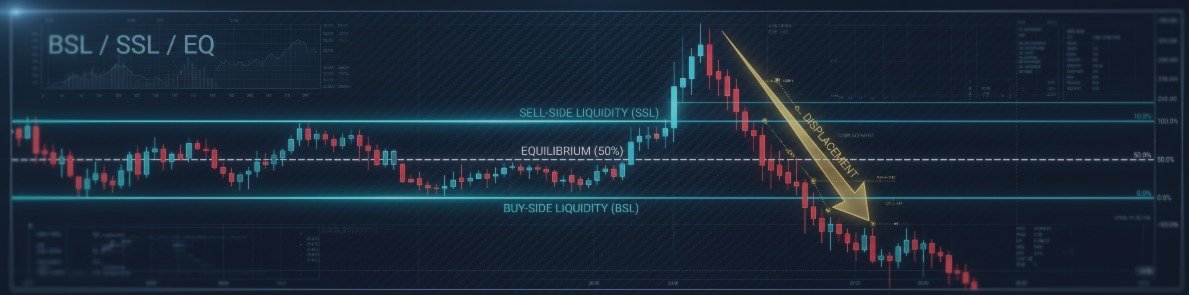
- Buy-Side Liquidity (BSL): The highest point reached during the session. Clustered above this level are retail breakout buy stops and short traders' protective stop losses.
- Sell-Side Liquidity (SSL): The lowest point reached during the session. Clustered below this level are retail breakdown sell stops and long traders' protective stop losses.
- Equilibrium (50% Fair Value): The exact arithmetic midpoint: $$\text{Equilibrium} = \frac{\text{BSL} + \text{SSL}}{2}$$ Prices above Equilibrium represent the Premium zone; prices below represent the Discount zone.
3. Phase B: The Two Institutional Execution Pathways
Once the opening bell rings at 09:30 AM NY, the range high and low are locked. The algorithm does not gamble on breakout direction; instead, it waits for market makers to reveal their intention through one of two distinct structural footprints:
Setup 1: The Turtle Soup Sweep & Market Structure Shift (MSS) Reversal
A high-probability reversal setup occurs when price wicks outside the session boundary but fails to establish candle body acceptance:
- The Sweep (Liquidity Grab): A candle wicks above Buy-Side Liquidity (BSL) but closes inside the range (or fails to clear our displacement offset). This proves buyers lack institutional commitment.
- Market Structure Shift (MSS) Confirmation: The algorithm watches subsequent bars for a decisive candle close below the immediate swing low formed during the sweep. This confirms that smart money has absorbed liquidity and taken control of directional order flow.
- Execution & Targets: A Short order is executed at the close of the MSS candle. The Stop Loss is placed safely above the sweep wick high, targeting the Equilibrium Midline (TP1) and the opposing Sell-Side Liquidity pool (TP2).
Setup 2: Institutional Displacement Expansion & Mitigation Retest
When major macroeconomic drivers are present, smart money does not reverse; it displaces aggressively:
- Displacement Confirmation: Rather than just wicking, an institutional bar completes a full candle body close decisively past the range extreme plus an expansion buffer threshold.
- The Mitigation Retest: Instead of chasing the move (retail FOMO), the algorithm waits for a healthy retracement back to the broken liquidity level (the Mitigation Order Block retest).
- Execution & Targets: A continuation trade is entered upon touch of the retest level, with Stop Loss set at the Equilibrium Midline and Take Profit targeting the 1.0x to 2.0x measured range expansion.
- Bar-Timeout Circuit Breaker: If the market fails to retest within a configurable window (e.g., 30 bars), the setup expires to prevent late, momentum-depleted entries.
4. The Profit Engine: Dual-Target Runner Architecture
One of the greatest flaws in algorithmic trading is the all-or-nothing exit. Exiting an entire position at 1.5R leaves massive macro runners on the table, while holding for 5.0R often allows winning trades to reverse back into full losses.
Apex Liquidity Matrix solves this through a dual-stage execution matrix:
| Stage | Position Allocation | Target Level | Risk Management Action |
|---|---|---|---|
| TP1 (Bank Target) | 50% Volume | Equilibrium (50% Fair Value) or 1.0x Range Expansion | Locks in realized profit early in the move. |
| Automated Breakeven Guard | Remainder Position | Entry Price + Spread Buffer | Instantaneously advances Stop Loss to Breakeven the microsecond TP1 fills. Risk is completely neutralized (0.0R risk). |
| TP2 (Macro Trend Runner) | 50% Volume | Opposite Liquidity Pool (SSL) or 2.0x/3.0x Measured Move | Rides the macro trend expansion 100% risk-free, with optional trailing stop. |
5. Prop-Firm Capital Protection Suite
Designed specifically for funded evaluation rules (FTMO, FundedNext, Topstep, etc.):
- Daily Drawdown Circuit Breaker: Dynamically monitors day-start equity. If the customizable daily loss threshold (e.g. 4.0%) is reached, all open positions and pending orders are instantly closed and trading is halted until the next calendar day.
- Strict 1-Trade-Per-Day Discipline: Eliminates overtrading, revenge trading, and emotional tilting.
- Server-Side Hard Stops: Every order is transmitted with hard Stop Loss and Take Profit levels that are fully compliant with broker StopLevel rules and MQL5 Market validation.
- Zero Toxic Mechanics: NO Martingale, NO Grid, NO Cost-Averaging, NO Arbitrage.
6. Empirical Performance Profile (NAS100 • 2-Minute Timeframe)
Why the M2 (2-Minute) timeframe? Through extensive quantitative backtesting, M2 emerged as the institutional sweet spot on NAS100: it confirms Market Structure Shifts faster than M5, while filtering out the erratic false-tick noise common on M1.
Verified MetaTrader 5 Strategy Tester report on NAS100 M2 (100% Real Tick History Quality):
- Initial Deposit: $10,000.00
- Net Profit: +$1,363.82 (+13.64%) in 30 Days
- Profit Factor: 3.88 | Recovery Factor: 5.90 | Sharpe Ratio: 27.89
- Maximal Equity Drawdown: Only 2.25% ($231.01) — flawlessly complies with strict 4%–5% prop-firm daily drawdown constraints.
- Win Rate: 77.08% across 48 setups (Long: 81.25% | Short: 75.00%).
- Session Concentration: Over 90% of all executions triggered between 09:30 and 11:00 AM NY time, eliminating exposure to stagnant midday chop.
7. Setup & Backtesting Recommendations
- Attach the EA to a NAS100 / USTEC / US100 chart on the M2 (or M5) timeframe.
- Ensure your broker time corresponds to GMT+3 (Vantage Auto mode handles this automatically, or enter your broker's GMT offset).
- For backtesting in the MT5 Strategy Tester, select:
- Symbol: NAS100 / USTEC
- Period: M2
- Modeling: "Every tick based on real ticks"
- Press 'R' on your keyboard at any time on a live chart to instantly recalculate and display historical setups on the on-chart HUD.
8. Try Apex Liquidity Matrix MT5 on MQL5 Market
Experience the power of automated institutional ICT order flow directly on your charts. Download the free Strategy Tester demo today on the official MQL5 Market:
👉 Download Apex Liquidity Matrix MT5 on MQL5 Market
🚀 Introductory Launch Promotion: For the first 10 copies, Apex Liquidity Matrix MT5 is available at a special introductory price before stepping up to its full commercial tier. Test the demo on your broker feed and see the institutional difference.
Conclusion
Market makers do not trade based on moving average crossovers or lagging indicators; they trade based on liquidity pools, session timing, and order book imbalances. By aligning your automated trading with these fundamental institutional mechanics, you transition from being the retail liquidity that gets hunted to trading alongside the smart money that hunts it.