Why AI Coding Agents Fail at Quantitative Finance: Look-Ahead Bias, Repainting, and the QF-Bench Study

An AI that can write clean Python or MQL5 syntax is not the same thing as an AI that understands market math.
A new October 2026 benchmark study (QuantitativeFinance-Bench) tested 47 frontier AI coding configurations across 86 real-world practitioner quantitative finance problems. The results expose a massive blind spot that every EA and indicator developer needs to know:
📉 The QF-Bench Findings: General Coding vs. Quant Math
- While top AI coding agents now pass 63% of general software engineering benchmarks, they failed more than half of the real-world quantitative finance tasks.
- The #1 failure mode? Letting future data leak into historical calculations (look-ahead bias / repainting), violating no-arbitrage bounds, and ignoring volatility non-stationarity.
Why Language Models Love to "Repaint" the Past
Every indicator on the MQL5 Market carrying my name follows one non-negotiable rule: closed-bar values are final, and the indicator does not repaint.
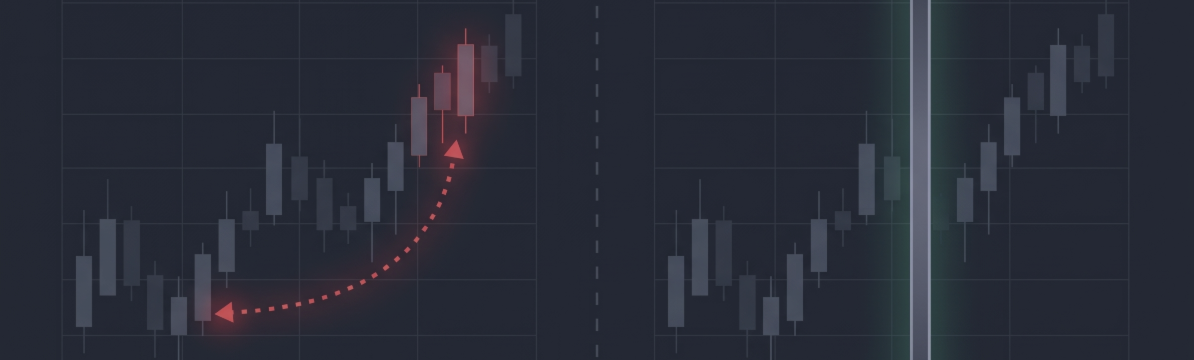
General-purpose AI models don't think like market practitioners. When you prompt an LLM to write a smoothing filter, a swing detector, or a multi-timeframe signal, its primary goal is to make the output look clean. To a language model, indexing i-1 instead of i+1 —or recalculating past bars using future highs and lows—is just a convenient shortcut to produce a pretty curve.
In a Strategy Tester visual run or a static screenshot, that look-ahead leak looks like the Holy Grail. On a live XAUUSD or FX chart, that "shortcut" destroys accounts.
Where to Draw the Line in Your MQL5 Stack
Does this mean you shouldn't use AI coding assistants in MetaEditor or VS Code? Not at all. They are phenomenal for:
- UI & Dashboard Panels: Building on-chart buttons, canvas graphics, and alert wrappers in minutes.
- Boilerplate & Data Parsing: Writing file exports, SQLite database connectors, and array sorting utilities.
- Refactoring & Diagnostics: Cleaning up legacy code and hunting down memory leaks.
However, when it comes to closed-bar indexing, multi-timeframe bar alignment, and indicator integrity, you shouldn't take anyone's word for it—whether the code was written by a human or an AI. Measure what the indicator actually does on the chart.
🔬 MEASUREMENT — Point it at any indicator and read what it actually does
Instead of guessing whether an indicator repaints, leaks future data, or shifts closed-bar values, run an automated diagnostic audit directly in your terminal:
- ▸ Indicator Test Report (MT5) · 🆓 · Twelve automated checks with a plain-language report
- ▸ Indicator Test Report MT4 (MT4) · 🆓 · Full diagnostic suite for MetaTrader 4
👉 Explore all of my non-repainting indicators and quantitative tools on my MQL5 profile: mql5.com/en/users/naamo (@naamo)
💬 When you audit someone else's indicator or EA code, what is the first mathematical flaw or look-ahead trap you usually check for?
📚 References & Further Reading:
- QuantitativeFinance-Bench: Benchmarking AI Agents on Real-World Quantitative Finance Tasks (OpenReview, Oct 2026): https://openreview.net/pdf?id=kmcjWuFo39