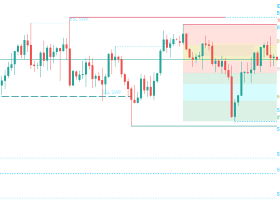
PO3 and SMT from the New York open: when to trade and what to expect

Trading time often matters more than the signal itself. The same pattern behaves differently in a quiet hour and in the first minutes of the US session. Here is how I look at the New York open through the PO3 model and SMT divergence. This describes a model. It is not a signal and not a guarantee.
What PO3 (Power of 3) is. Three phases of the day:
- Accumulation. A calm range, most often the Asian session. The market collects stops on both sides.
- Manipulation. A sharp move beyond the range edge, usually at the London or New York open. This is a liquidity sweep, a false breakout.
- Distribution. The real move, most often in the direction opposite to the false one.
Times worth remembering (New York time, ET; Bulgarian summer time in brackets):
- 07:00-10:00 ET (14:00-17:00): the most active morning window.
- 09:30 ET (16:30): the US stock market opens, the main moment of the day.
- 10:00-11:00 ET (17:00-18:00): the hour after the open, where the range edge is most often swept.
The US and Europe change their clocks on different dates. In late October and in March, for a couple of weeks, the gap to Bulgaria is 6 hours, not 7, and the open falls at 15:30. Check before the session.
How I put it together:
- Mark the range before 09:30 ET: the high and low of the Asian session and premarket.
- Wait for one edge to be swept in the first 30-60 minutes after the open. That is the manipulation.
- Check SMT: did the second index (S&P 500 and Nasdaq) sweep the same edge? If one made the extreme and the other did not, the move looks false. More here: SMT divergence.
- Wait for a structure shift on M1-M5 (CHoCH) and an entry from an imbalance or an Order Block: IDM, CHoCH, BOS in plain words.
- Put the stop beyond the swept extreme and take the target at the opposite edge of the range.
What breaks the scheme:
- Trading after 11:00 ET, when the opening impulse is over.
- Entering on the first move, with no sweep and no structure shift.
- News releases (CPI, a Fed decision): at those minutes a divergence is random.
- A day with no sweep of the edge: that is not a setup, skipping is a decision too.
To be honest, no model works every day. Test it on history and in a journal, count the stop in advance, and what to look at in a report I covered here: how to read an EA backtest.
Want an indicator that draws the range before 09:30 ET, the time windows and the SMT between indices by itself? Let us discuss the task: kovalev.trade/development
Not investment advice.
Full article with a diagram: https://kovalev.trade/en/post?slug=po3-smt-new-york-open