
Aggressive Pyramiding: How to Grow Positions Using Profits and Automated Lot Management


You want to aim for large profits in a high-leverage trading environment.
In that situation, you do not necessarily need to take excessive risk by starting with a huge position size.
Instead, one approach is to start with a smaller position, and once the trade becomes profitable, use those profits to increase the position size.
This is known as pyramiding.
Practice Simulator includes automated lot calculation that works particularly well with this approach.
AI-powered practice scoring and trade analysis with MT5 AI Assistant.
English | Русский | 中文 | Espanol | Portugues | 日本語 | Deutsch | 한국어 | Francais | Italiano | TurkceIt Is Slightly Different from a Standard “10% Risk” Calculation
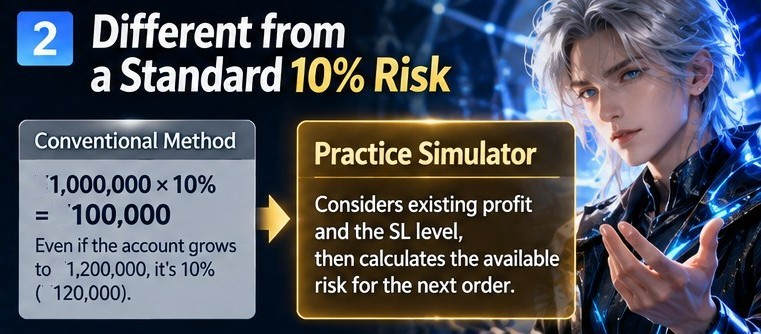
For example, suppose you have a trading account with ¥1,000,000 and set the risk level to 10%.
With a conventional approach, the calculation would be:
10,000 × 10% = 1,000
The position size is calculated so that the potential loss is 10,000.
Even if you make a 2,000 profit and your account grows to 12,000, the calculation would simply become:
12,000 × 10% = 12,000
Practice Simulator's lot calculation works somewhat differently.
It takes into account the profit of existing positions and the location of their SL levels, then calculates how much risk capacity remains available for the next order.
For example:
- Account balance: 10,000
- Unrealized profit: 2,000
- Risk setting: 10%
If you move the SL into profitable territory, the risk of the existing position becomes smaller.
As a result, more risk capacity can become available for an additional entry.
This is the major difference.
The “10% Risk” Setting Has Not Changed
This point is important.
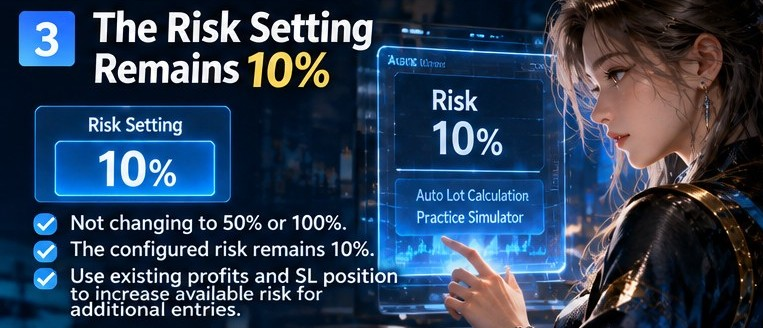
You are not changing the risk setting from 10% to 50% or 100%.
The configured risk percentage remains 10%.
The difference is that existing profits and the position of the SL are taken into account, allowing the available risk capacity for an additional entry to increase.
In other words:
- The original capital is managed with a 10% risk setting.
- Profits are protected with the SL and can then be utilized for the next position.
The Difference Becomes Clear with Numbers
Suppose you have a 10,000 account with 2,000 in unrealized profit.
When considering the next order, there are several different approaches:
- 10% of the original capital: 1,000
- 10% of the entire account: 1,200
- Practice Simulator approach: Automatically calculate the additional lot size by considering the existing position, its SL, and current profit
Practice Simulator does not simply look at the account balance.
It also considers the current position and the distance to the SL when calculating the next lot size.
As profits accumulate and the SL moves further into profitable territory, the additional position size can become larger.
When leverage is combined with this approach, a relatively small amount of capital can control a much larger position.
The process can therefore look like this:
Start small
↓
The position becomes profitable
↓
Use the profit to add another position
↓
The position becomes more profitable
↓
Add an even larger position
This allows profits to be progressively reinvested into the position.
Adding to a Winning Position: Pyramiding
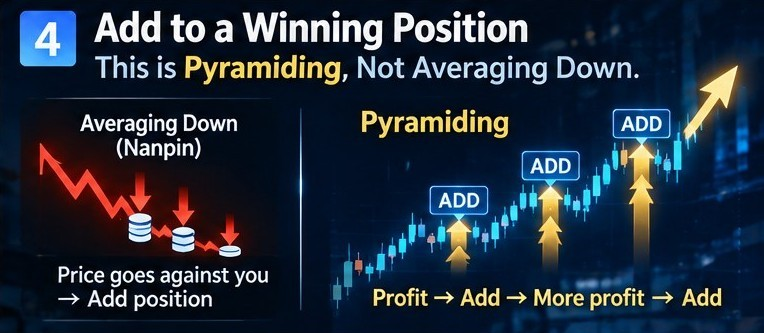
This is different from averaging down.
Averaging down means:
Price moves against you → Add another position
With this approach, it becomes:
Profit → Add → More profit → Add
In other words, you use a winning position to increase the size of the position further.
This effect can become particularly significant in a high-leverage environment.
Instead of starting with a large position, you increase the position after the trade has already moved in your favor.
For this reason, this type of automated lot calculation can work well with pyramiding.
AI-powered practice scoring and trade analysis with MT5 AI Assistant.
English | Русский | 中文 | Espanol | Portugues | 日本語 | Deutsch | 한국어 | Francais | Italiano | TurkceNo Need to Perform the Calculations Manually
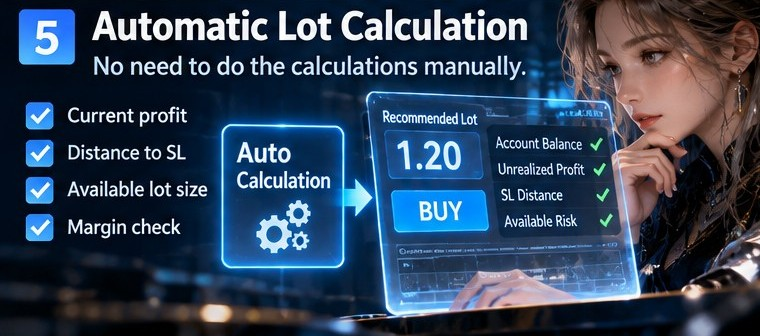
Normally, you would need to calculate things such as:
- How much profit is currently available?
- How many pips remain before the current SL?
- How many lots can be added?
- Will the new order pass the margin requirements?
Practice Simulator automatically calculates the lot size while taking these factors into account.
This means you do not need to recalculate the appropriate lot size every time.
The basic setting is the risk percentage.
Then, when the position becomes profitable and you add another entry, the lot size can be automatically calculated based on the current positions and the location of their SL levels.

However, Profits Can Disappear
Of course, this does not mean that profits will increase safely or automatically.
Once profits are reinvested into additional positions, a subsequent reversal can cause those profits to decline significantly as well.
Also, because moving the SL into profitable territory can increase the available lot size, the overall position can become much larger during the later stages of the trade.
For example, an account might grow:
100,000 → 12,000 → 15,000 → 20,000
But if the market subsequently moves strongly against the accumulated positions, some or all of those profits can be lost.
This is why it is useful to understand this method as a form of lot management that emphasizes maximizing the potential growth of profits, rather than simply protecting profits.
Depending on the trading strategy, partial closing and trailing stops can also be combined with the approach to determine how far profits should be allowed to compound.

Start Small, Then Increase the Position
If you want to take advantage of leverage and aim for larger profits, you do not necessarily need to start with the maximum position size.
Start small.
If the position becomes profitable, use that profit to add another position. If the trade continues in your favor, add again.
Repeating this process can gradually increase the overall position size.
Practice Simulator can automatically perform this lot calculation. Without changing the risk setting, profits and SL levels can be taken into account when determining the next entry.
This is more than simple automated lot calculation.
It can be viewed as a form of automated lot management designed to progressively increase position size by utilizing accumulated profits.
For traders looking to maximize profit growth in a leveraged environment, this type of automated lot calculation can be particularly compatible with pyramiding.
And because the additional position size can become larger as profits accumulate, this approach could be described as a more aggressive form of pyramiding:
Aggressive Pyramiding.