Your EA Can Open the Trade. But Who Is Protecting the Account?

Automated trading has changed the way traders interact with the markets. An Expert Advisor can analyse conditions, calculate entries, place orders, manage positions and even operate continuously without human intervention. But there is an important question that often gets overlooked:
Your EA can open the trade. But who is protecting the account?
That distinction becomes increasingly important as trading systems become more sophisticated. A strategy may be profitable. An entry may be technically correct. An order may be executed exactly as programmed. And yet, the account can still be exposed to unnecessary risk.
Execution Is Not the Same as Protection
An EA is generally designed around a specific trading objective. For example:
- Identify a trading opportunity
- Calculate position size
- Open a position
- Set Stop Loss and Take Profit
- Manage the position
- Close the trade according to the strategy
These are execution and strategy functions.
But account-level protection requires looking at the bigger picture.
What happens if several positions are already open?
What happens when multiple trades begin losing at the same time?
What happens when margin utilization increases?
What happens when a trader is approaching a daily loss limit?
What happens when a profitable strategy encounters an unusual market environment?
These are not necessarily questions that the trading strategy itself was designed to answer. This is where a separate layer of risk management can become valuable.
A Profitable Strategy Can Still Have a Bad DayNo trading strategy wins every trade. Even systems with a positive long-term expectancy will experience losing streaks, unexpected volatility and periods where market conditions behave differently from historical conditions.
The problem is not necessarily the losing trade. The problem is allowing a series of individually acceptable decisions to create unacceptable account-level exposure. Consider a simple example.
A trader decides to risk 1% on each trade.
One trade risks 1%.
Another trade risks 1%.
A third trade risks another 1%.
Individually, each position may appear reasonable. But if the positions are highly correlated, the account may effectively be exposed to the same market movement several times. The trader may believe they have three independent opportunities.
The account may experience them as one large risk event. This is why risk management needs to look beyond the individual order.
The Risk Layer Around Your Trading StrategyA useful way to think about automated trading is as a series of layers.
Strategy
What should I trade?
Execution
When and how should the order be placed?
Position Management
How should the open trade be managed?
Account Protection
How much risk can the account safely tolerate?
The first three layers may be handled by an EA. The fourth deserves independent attention. Account protection can involve monitoring things such as:
- Equity
- Balance
- Floating profit and loss
- Margin
- Margin level
- Drawdown
- Daily losses
- Position exposure
- Risk per trade
- Overall account limits
The objective isn't to interfere with every trading decision. It is to create boundaries around the decisions that the trading system is allowed to make.
Automation Doesn't Remove the Need for Risk ManagementThere is sometimes a misconception that automated trading automatically means controlled risk. It doesn't. Automation removes certain forms of human intervention, but it also means that an error can potentially be repeated automatically.
A human trader might make one mistake. An incorrectly configured EA could potentially make the same mistake repeatedly. That is why automated trading systems should be treated like any other automated process:
The process needs safeguards.
A good risk-management framework should answer questions such as:
How much can this account lose?
How much exposure is currently open?
How close is the account to its risk limits?
Is there sufficient margin available?
Is the current trading activity still within the intended risk parameters?
These questions are about the health of the account, not simply the quality of the next trade.
The Prop Trading ChallengeThe distinction becomes even more important in the prop trading environment. A trader can have a profitable strategy and still fail a challenge.
Why? Because prop trading introduces another layer of constraints. A trader may need to operate within rules involving:
- Maximum daily loss
- Maximum overall drawdown
- Profit targets
- Minimum trading days
- Position restrictions
- Risk limits
- Other firm-specific requirements
A strategy only needs to identify and execute trades. A prop trader also needs to remain compliant. That creates a fundamentally different problem. Making money and protecting the account are not always the same objective.
What Happens When the Trader Isn't Watching?Markets don't operate according to our schedules. A position can remain open while the trader is:
- Sleeping
- Working
- Travelling
- Away from the computer
- Managing another account
This is one of the major advantages of automation. But it also creates a question: Who is monitoring the account while the trader is away?
A dedicated risk-management layer can continuously monitor the account and provide visibility into what is happening. Instead of relying entirely on memory, manual calculations or occasional checks, the trader can have a structured view of account-level risk.
That can be particularly useful when multiple automated systems are operating simultaneously.
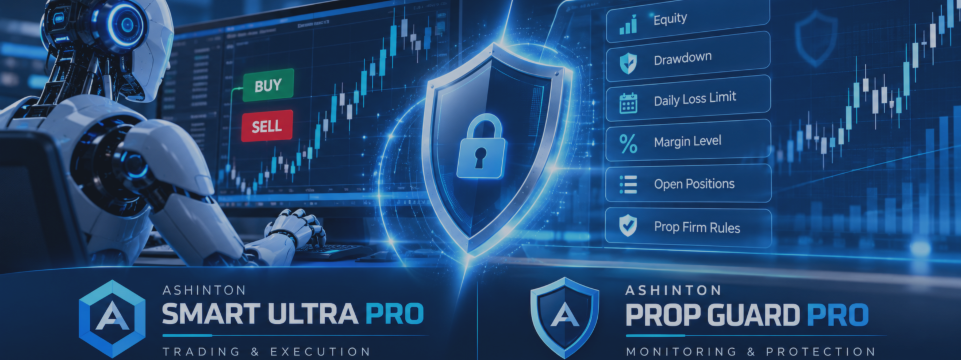
Smart Ultra Pro + Prop Guard ProThis is where the Ashinton approach becomes interesting. Rather than treating automated trading and account protection as the same problem, the two can work as complementary layers.
Ashinton Smart Ultra Pro
Smart Ultra Pro is focused on the trading and execution side. The EA can handle the mechanics of automated trading according to its strategy and configuration. Its job is to identify and execute trading opportunities.
Ashinton Prop Guard Pro
Prop Guard Pro focuses on the account protection and monitoring side. Instead of asking only: “Should this trade be opened?”
the risk layer asks: “What is happening to the account as a whole?” This creates a more complete architecture:
Smart Ultra Pro - Trading & Execution
Prop Guard Pro - Monitoring & Protection
The two functions are different, but complementary.
Think of It Like a CarThere is a simple analogy. A powerful engine can make a car move quickly. But the engine isn't responsible for the brakes.
You wouldn't remove the brakes because the engine is working perfectly. In the same way, a sophisticated EA doesn't eliminate the need for account-level risk controls. The trading engine and the protection layer have different jobs.
One drives the strategy. The other helps protect the account.
Check out the Ashinton product lounge, or visit AshintonForex.com