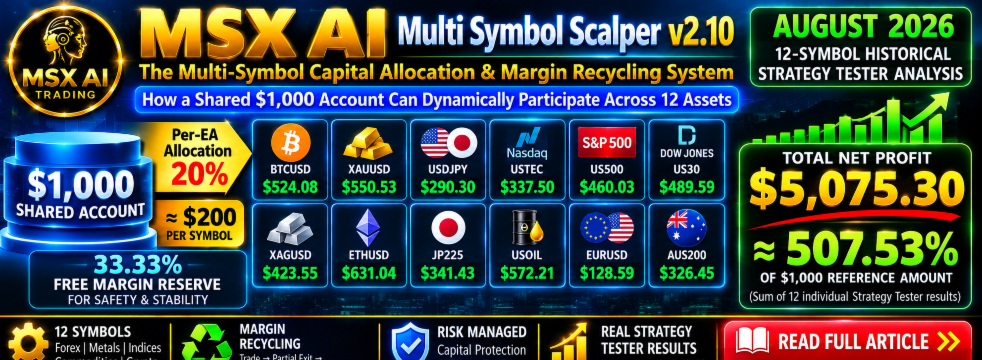
MSX AI Multi Symbol Scalper v2.10 The Multi-Symbol Capital Allocation & Margin Recycling System

MSX AI Multi Symbol Scalper v2.10 The Multi-Symbol Capital Allocation & Margin Recycling System — Article #38
How a Shared $1,000 Account Can Dynamically Participate Across 12 Assets
August 2026 — 12-Symbol Historical Strategy Tester Analysis
There is an important point behind the MSX AI Multi Symbol Scalper v2.10 12-Symbol Strategy Tester Series that can be missed when looking only at the final profit figures.
Each symbol-level Strategy Tester study uses a $1,000 initial account balance, but the EA is not designed to treat the entire $1,000 as the maximum capital allocation for one EA instance.
With the published architecture using:
Per-EA Capital Allocation = 20%
the corresponding allocation reference on a $1,000 initial balance is:
$1,000 × 20% = $200
Therefore:
-
$1,000 = Strategy Tester initial account balance
-
$200 = 20% Per-EA capital-allocation reference
This distinction is central to understanding the system.
1. August 2026 — Twelve-Symbol Historical Results| # | Asset / Symbol | Net Tester Profit |
|---|---|---|
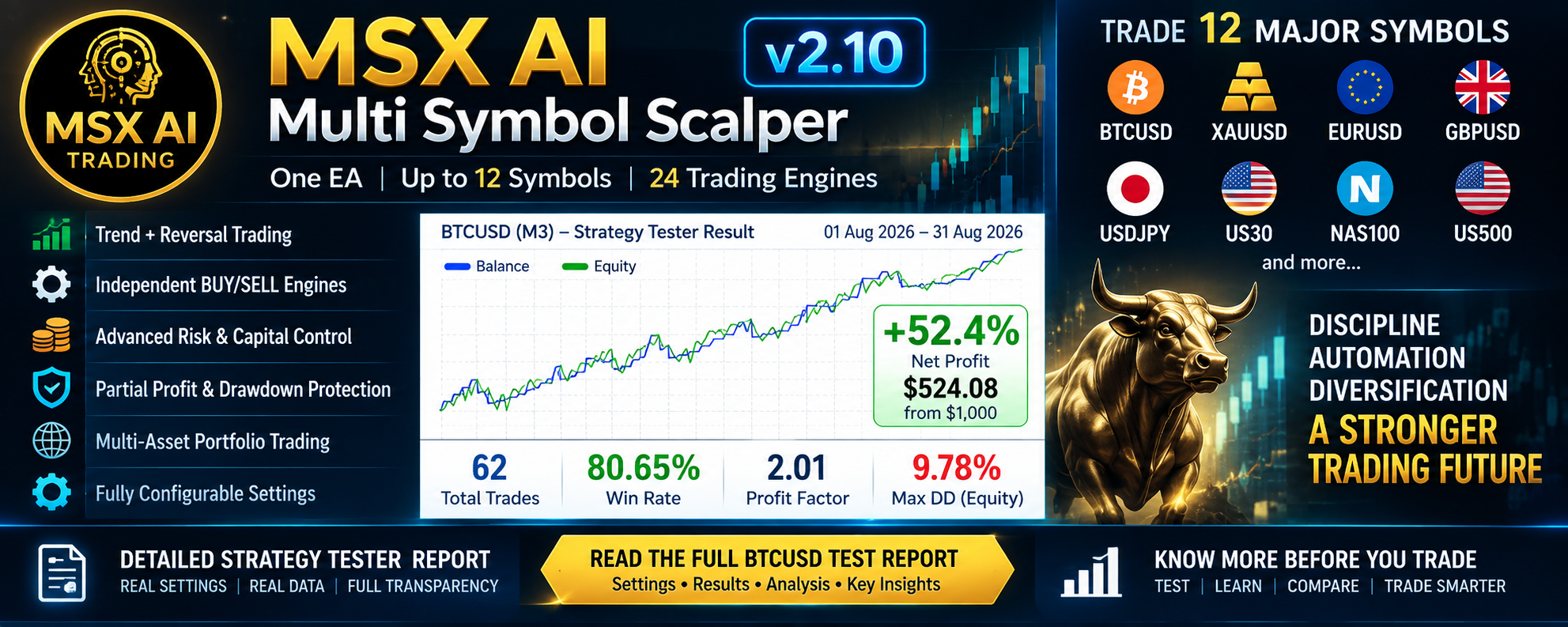
| 1 | BTCUSD | $524.08 |
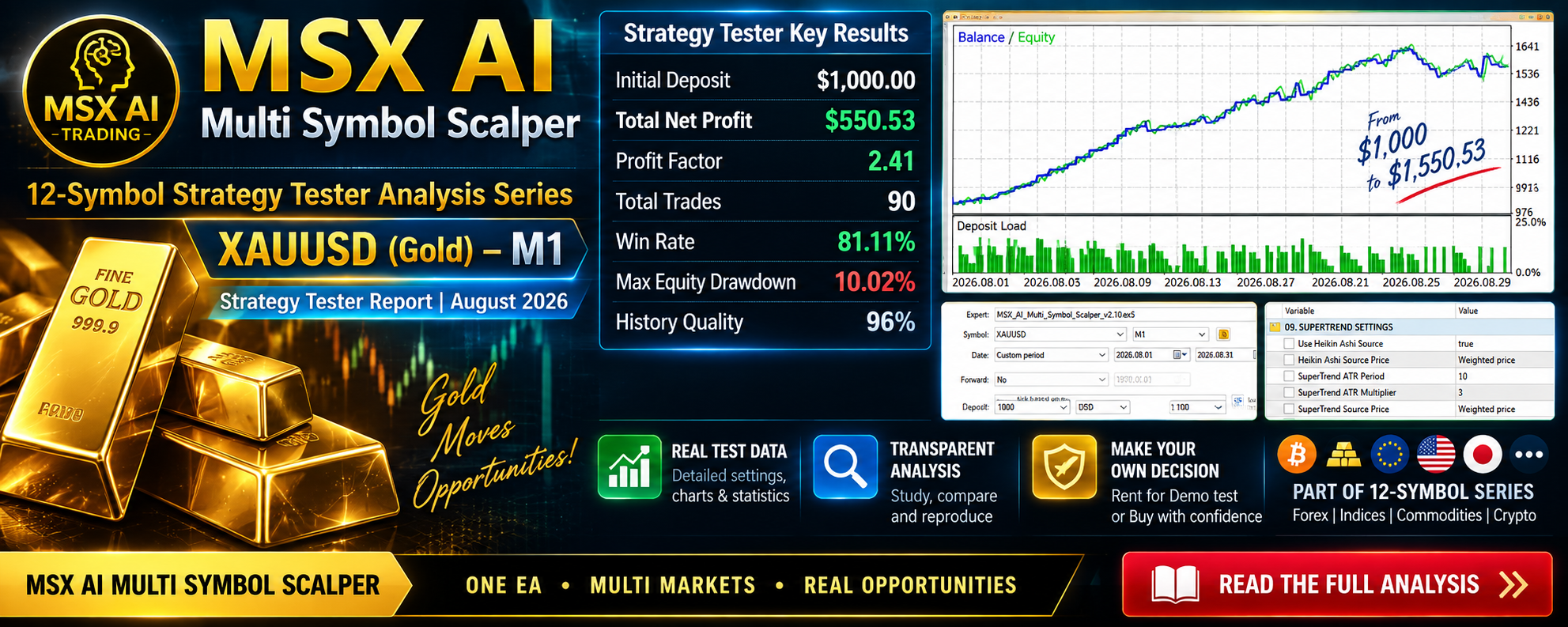
| 2 | XAUUSD | $550.53 |
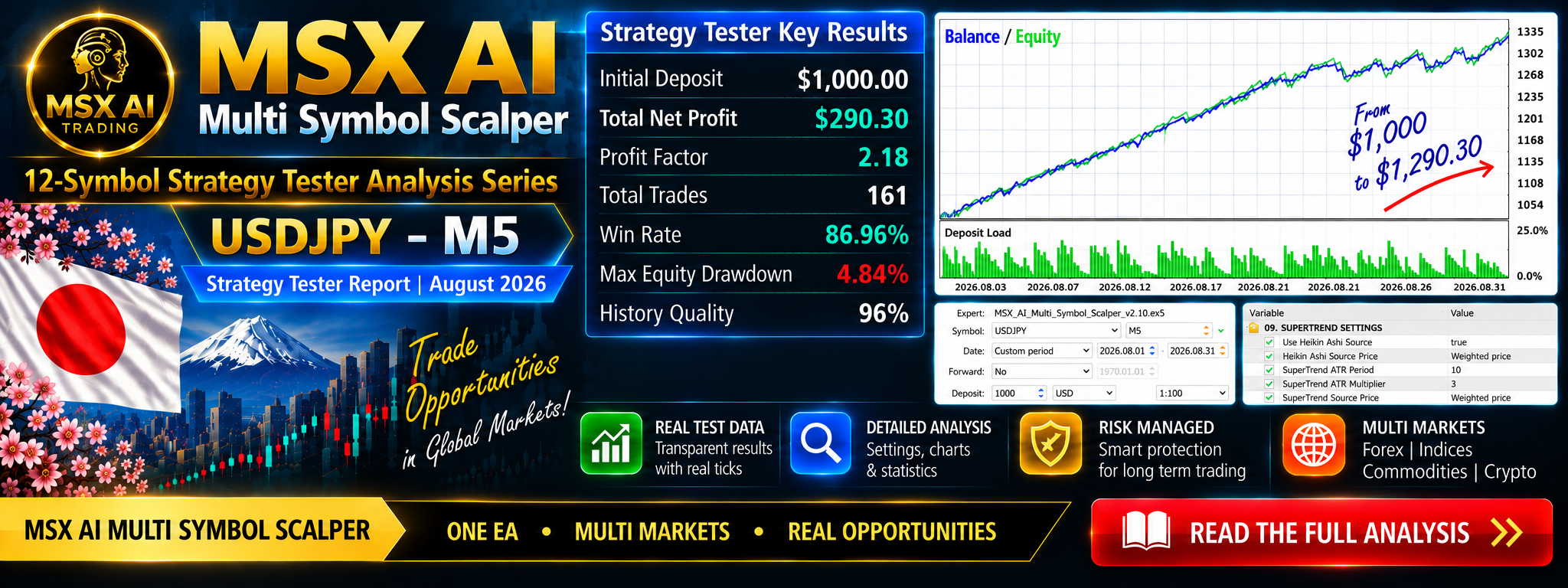
| 3 | USDJPY | $290.30 |
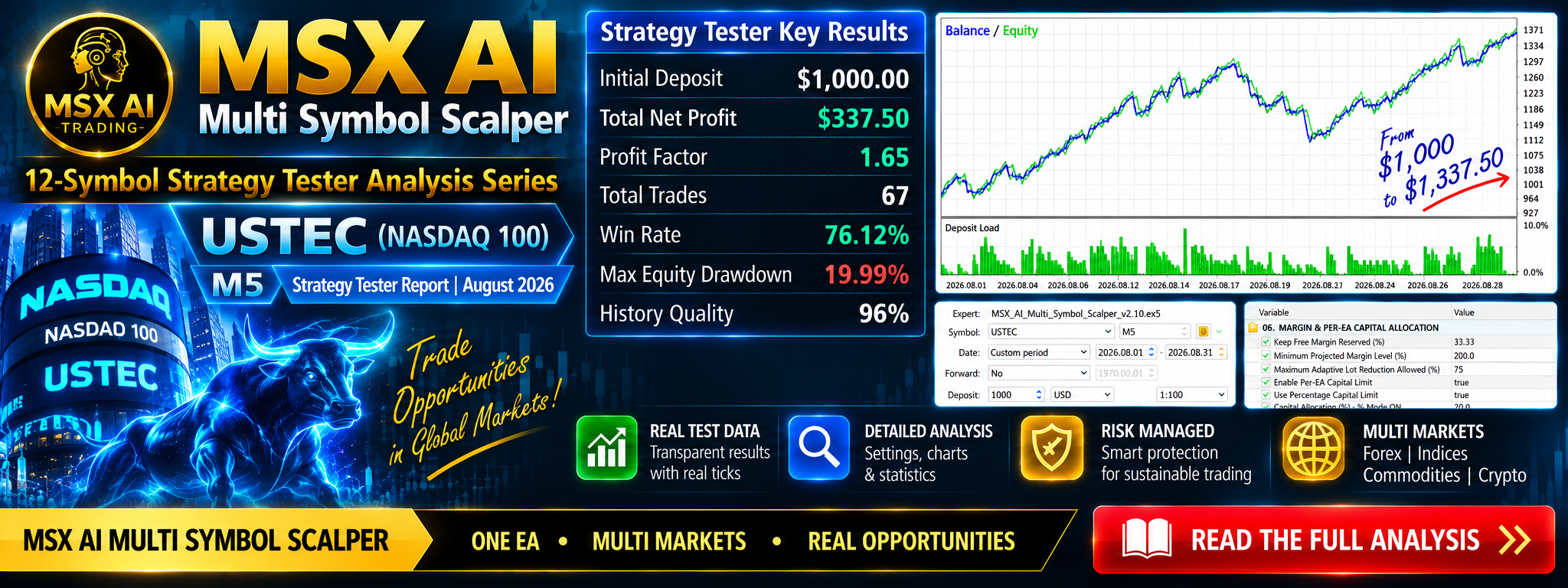
| 4 | USTEC / NAS100 | $337.50 |
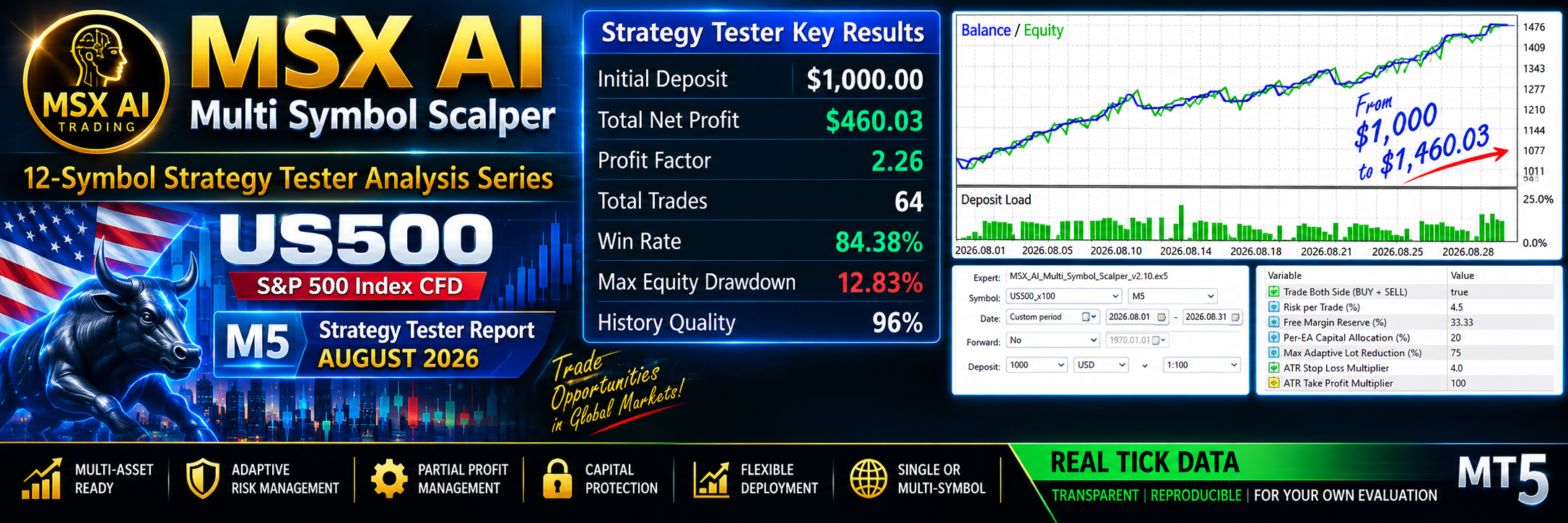
| 5 | US500 / S&P 500 | $460.03 |
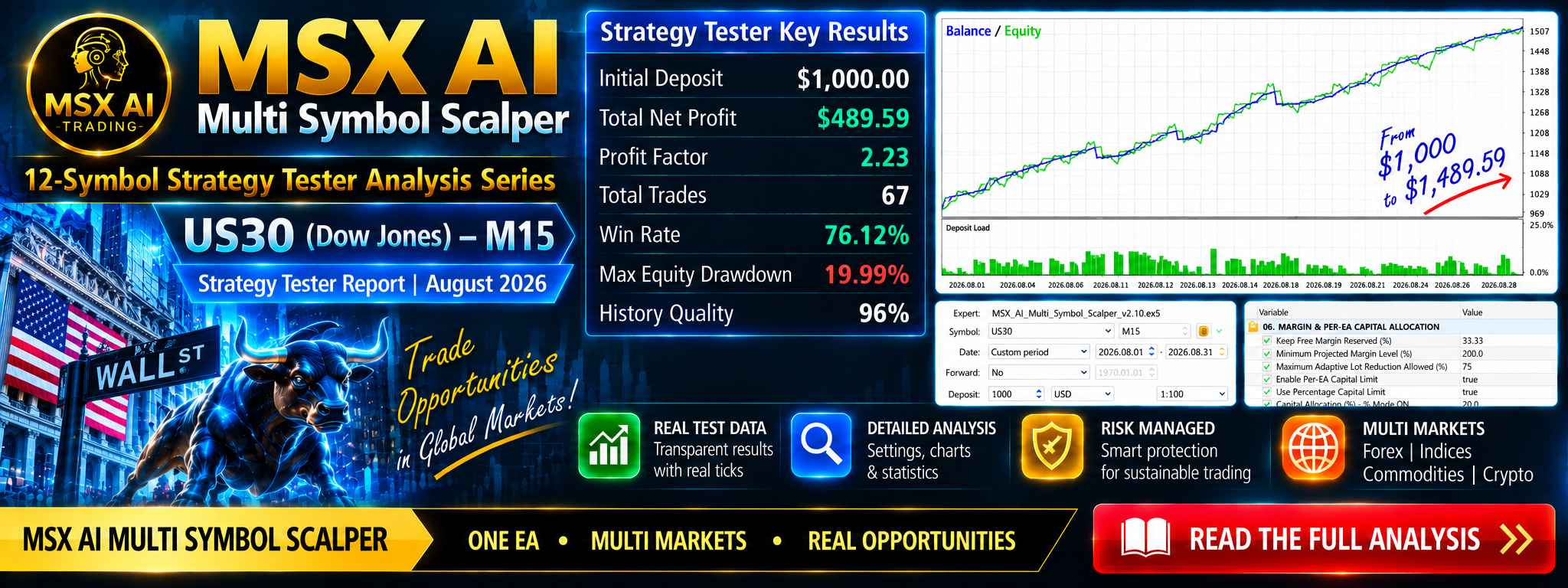
| 6 | US30 / DOW JONES | $489.59 |
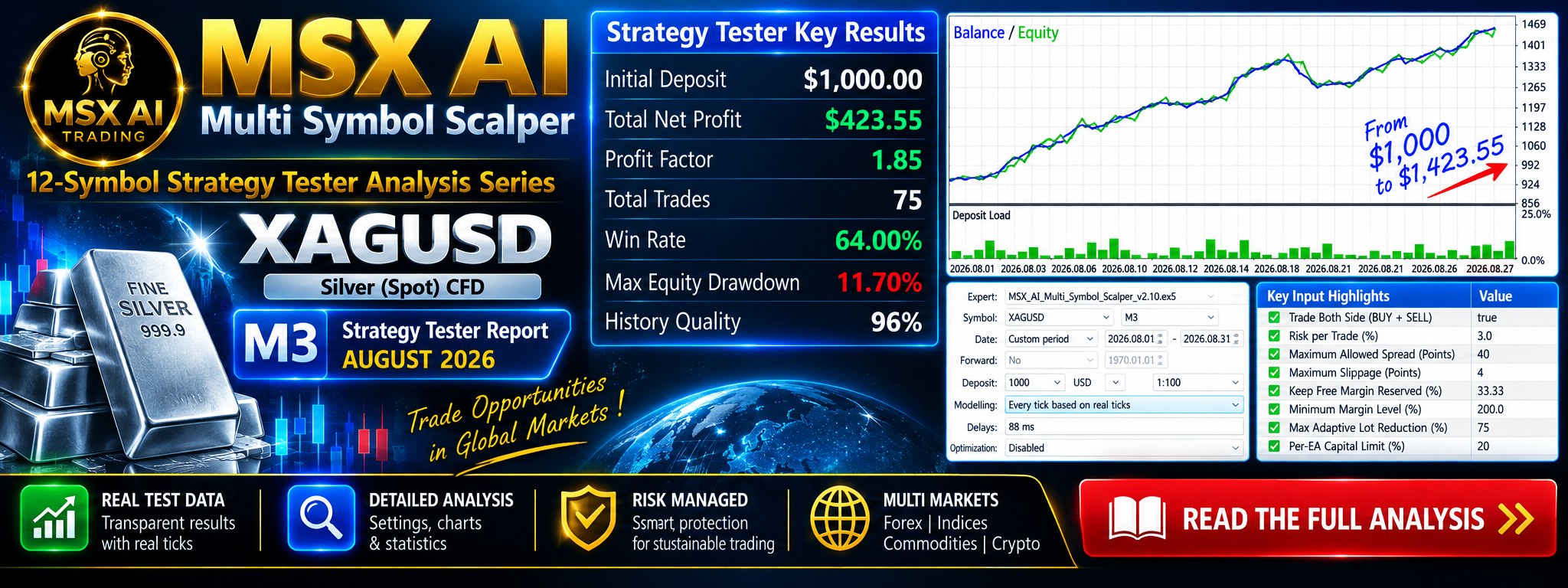
| 7 | XAGUSD | $423.55 |
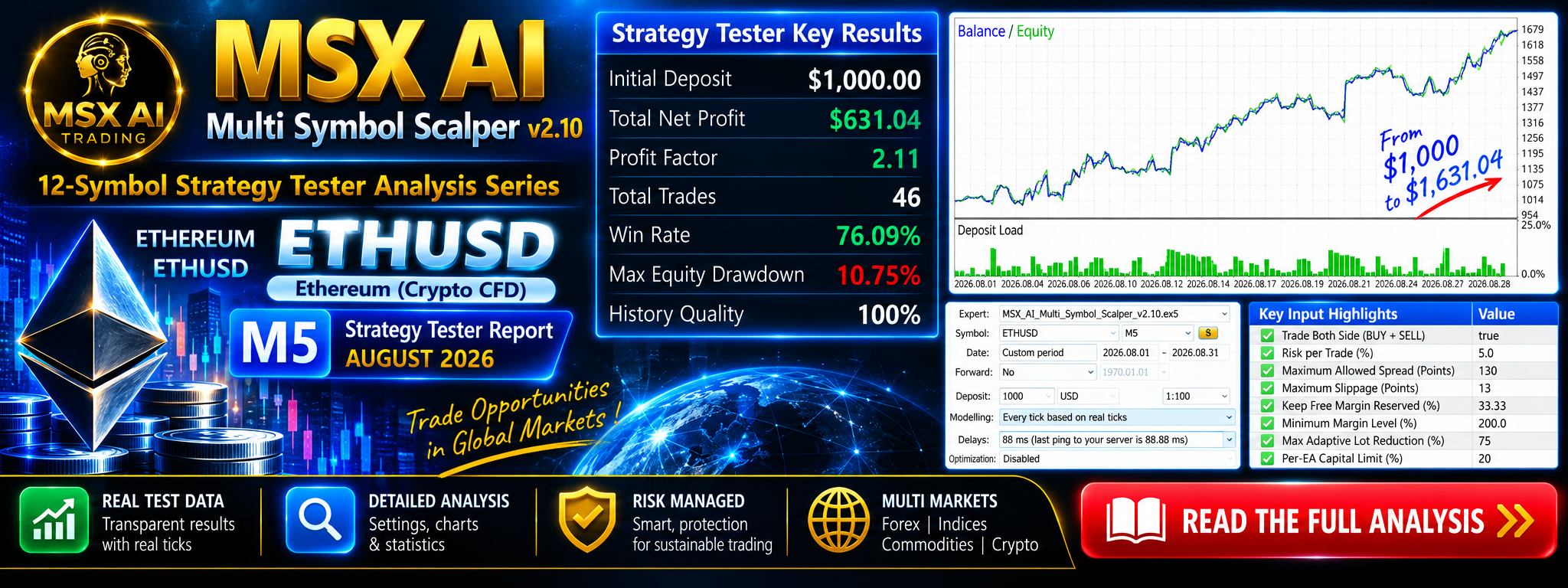
| 8 | ETHUSD | $631.04 |
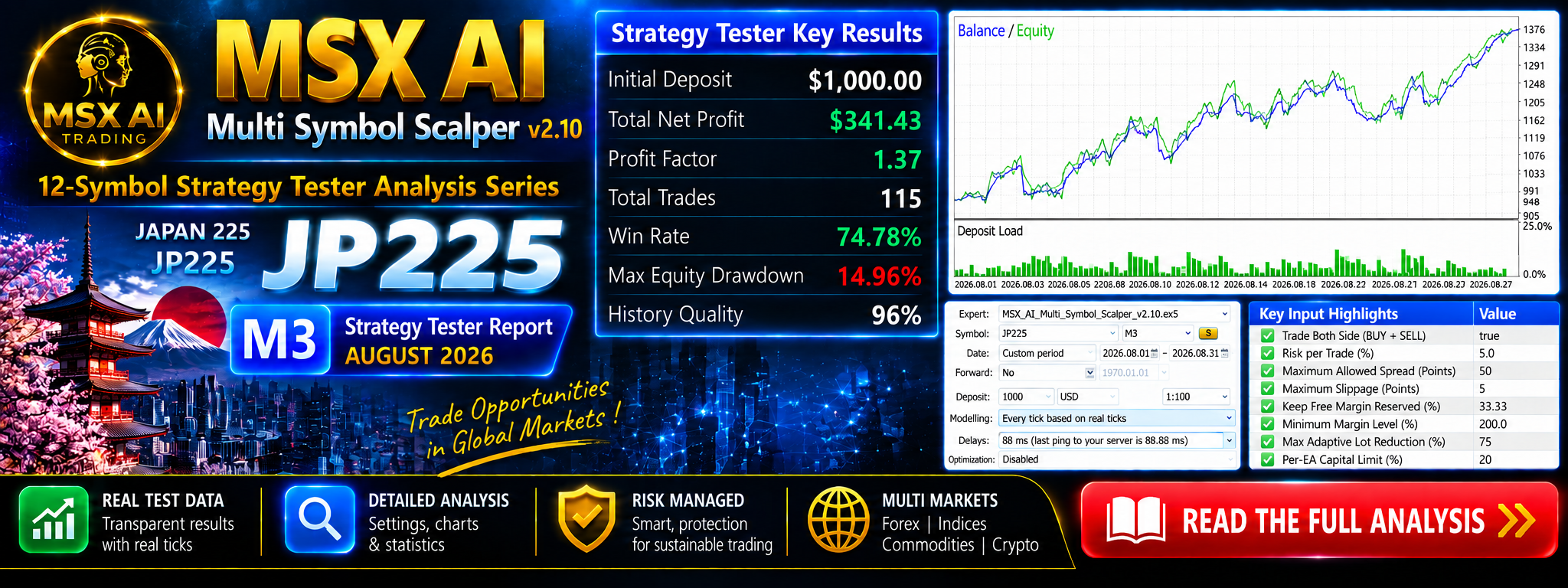
| 9 | JP225 | $341.43 |
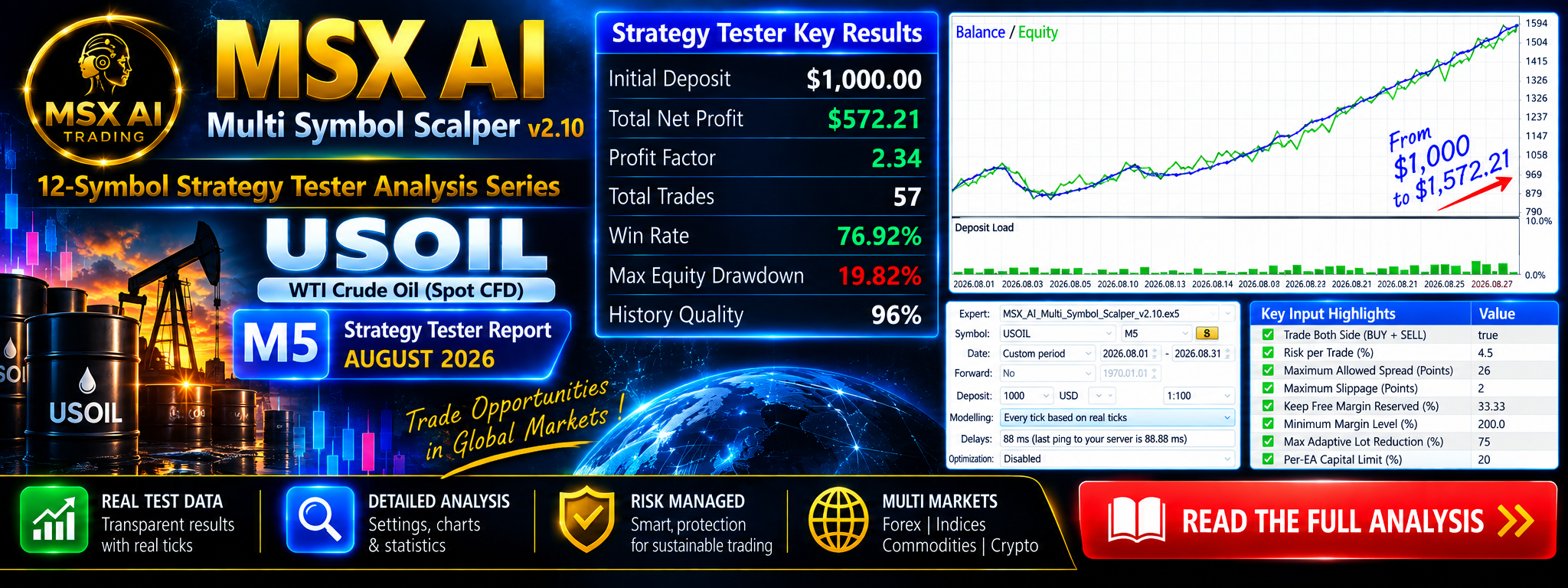
| 10 | USOIL | $572.21 |
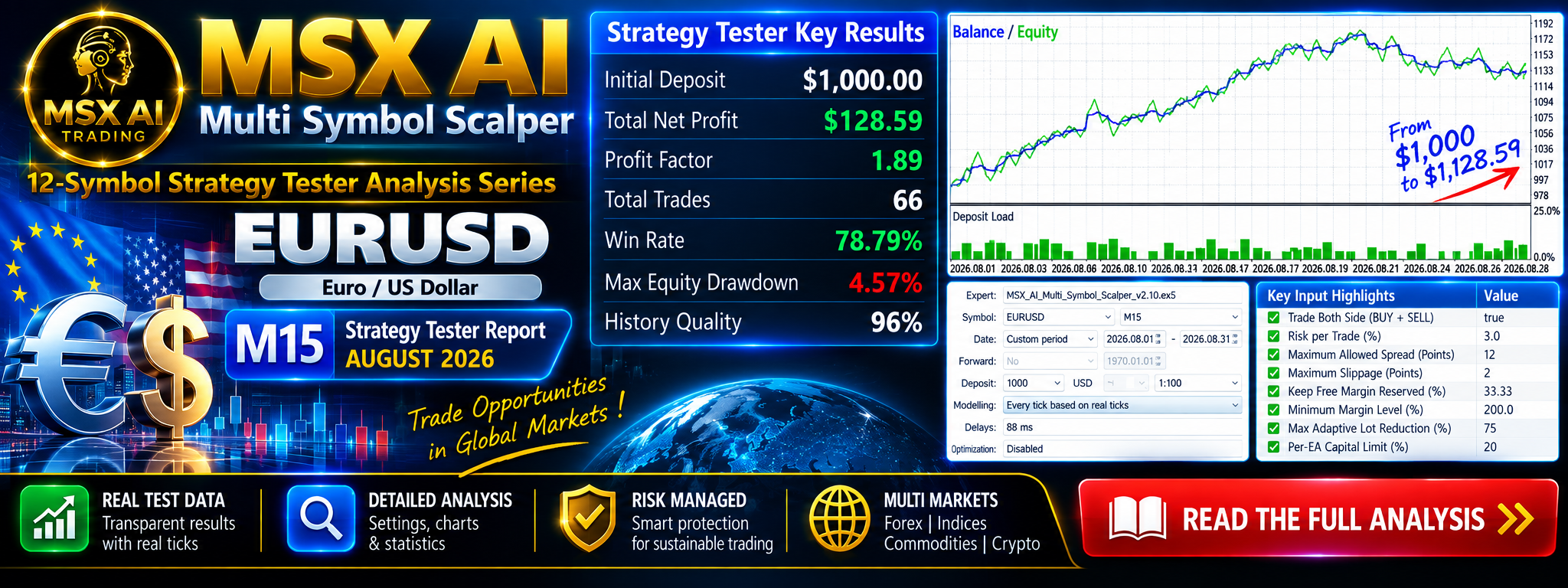
| 11 | EURUSD | $128.59 |
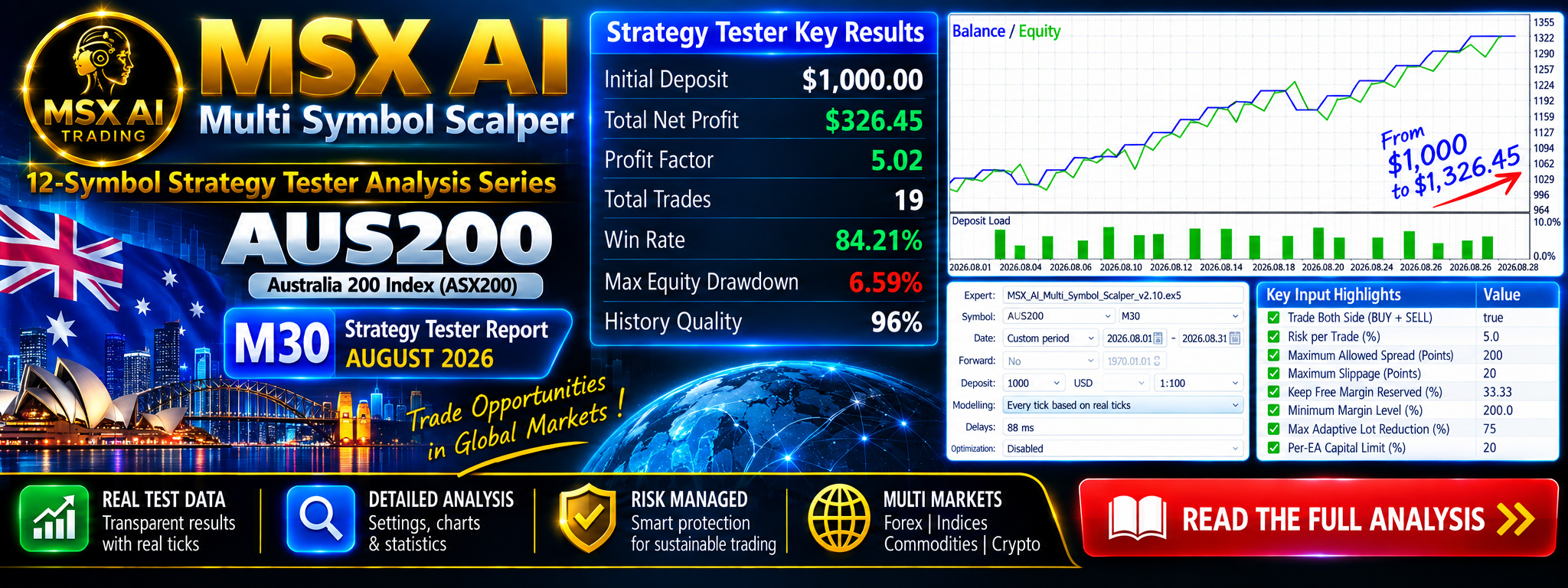
| 12 | AUS200 | $326.45 |
| Aggregate of 12 individual studies | $5,075.30 |
The mathematical sum of the twelve individual historical tester profits is:
$5,075.30
The $1,000 initial deposit shown in each Strategy Tester report is the account balance used by MetaTrader 5 for that historical simulation.
It does not mean:
“This EA was allowed to use the entire $1,000 as its own trading-capital allocation.”
The configured Per-EA Capital Allocation establishes a separate capital-participation boundary.
With:
-
Initial Account = $1,000
-
Per-EA Capital Allocation = 20%
-
Allocation Reference ≈ $200
the simple conceptual structure is:
MT5 TEST ACCOUNT $1,000 │ ▼ PER-EA CAPITAL ALLOCATION 20% │ ▼ ≈ $200 REFERENCE
This is why simply comparing a symbol's profit with the full $1,000 does not fully explain how the EA's configured capital allocation operates.
The $200 should not be interpreted as a separate $200 account that remains permanently locked for the entire month.
The system is dynamic.
An EA can use its available capital/margin environment to open a position, manage it, partially close it, close it completely and release margin. The same allocation can therefore participate in multiple sequential trading opportunities during the historical period.
Allocation Reference │ ▼ Trade │ ▼ Partial / Full Exit │ ▼ Margin Released │ ▼ Next Valid Trade │ ▼ ...
Therefore, a monthly net tester result can be larger than the instantaneous capital-allocation reference. The $200 is not a maximum cumulative capital-turnover amount for the entire month.
Margin recycling is an important part of the multi-symbol architecture.
When a position reaches a configured Partial Profit condition, part of the current volume can be closed.
POSITION ↓ PARTIAL PROFIT TRIGGER ↓ PART OF POSITION CLOSED ↓ OPEN VOLUME REDUCED ↓ MARGIN REQUIREMENT CAN REDUCE ↓ FREE MARGIN CAN BECOME AVAILABLE
The released margin can change the account's available trading environment.
A different EA instance with a valid setup can then be evaluated against the new account state.
The twelve EAs do not have to open trades simultaneously. One may be active, another waiting, another completed, and another in local daily sleep.
Conceptually:
Trade → Partial/Full Exit → Margin Released → Shared Free Margin → Next Valid EA Opportunity
The published configurations also use:
Free Margin Reserve = 33.33%
This is a separate safety mechanism designed to maintain a conservative liquidity buffer rather than treating all available free margin as immediately deployable.
The two controls have different purposes:
Per-EA Capital Allocation — 20%
Defines the EA's intended capital-participation boundary.
Free Margin Reserve — 33.33%
Provides additional account-level liquidity protection.
They should not be described as:
20% − 33.33% = 13.33%
That is not the intended architecture. They are separate controls performing different jobs.
For technical accuracy, the current implementation calculates the executable margin budget dynamically from current Free Margin and the configured reserve, then applies the percentage-based Per-EA limit to that available budget. It also checks required margin and projected margin level before accepting a trade.
Therefore, the $200 figure should be presented as:
The configured 20% Per-EA Capital Allocation reference calculated from a $1,000 initial balance.
It should not be described as a permanently fixed $200 margin budget for every trade.
The actual executable amount can change with:
-
Free Margin
-
Used Margin
-
Open Positions
-
Equity
-
Broker margin requirements
-
Other capital and margin controls
This dynamic behavior is what allows capital to be recycled through the account.
Consider the BTCUSD historical study:
-
Initial Tester Account: $1,000
-
Per-EA Allocation Reference: 20% ≈ $200
-
Historical Net Tester Profit: $524.08
The $524.08 is not generated by a permanently isolated $200 balance sitting untouched for the entire month.
During the test, positions can:
-
open,
-
partially close,
-
fully close,
-
release margin,
-
and be followed by later valid opportunities.
Consequently, the same allocated capital can participate repeatedly during the historical period.
The same capital-turnover principle applies to the other symbol studies.
| Symbol | Net Tester Profit | 20% Allocation Reference* |
|---|---|---|
| BTCUSD | $524.08 | $200 |
| XAUUSD | $550.53 | $200 |
| USDJPY | $290.30 | $200 |
| USTEC | $337.50 | $200 |
| US500 | $460.03 | $200 |
| US30 | $489.59 | $200 |
| XAGUSD | $423.55 | $200 |
| ETHUSD | $631.04 | $200 |
| JP225 | $341.43 | $200 |
| USOIL | $572.21 | $200 |
| EURUSD | $128.59 | $200 |
| AUS200 | $326.45 | $200 |
*The $200 figure is the 20% allocation reference calculated from the $1,000 tester initial balance. The actual executable margin budget is dynamic and affected by current Free Margin, reserve, existing margin usage, broker requirements and other controls.
This is the correct context for understanding why monthly net tester profit can exceed the instantaneous Per-EA allocation reference.
The architecture does not require:
12 × $200 = $2,400 permanently allocated inside a $1,000 account.
That would be a static interpretation.
Instead, the account operates as a shared capital environment. EA participation depends on:
-
valid trading setups,
-
current Free Margin,
-
capital-allocation rules,
-
reserve protection,
-
margin requirements,
-
projected margin level,
-
adaptive lot reduction,
-
existing positions,
-
session conditions,
-
local protection states.
Therefore, the portfolio operates dynamically rather than as twelve permanently funded sub-accounts.
A simple way to visualize the architecture is to think of the 20% allocation as a capital slot.
SHARED $1,000 ACCOUNT │ ┌──────────┴──────────┐ │ │ EA CAPITAL SAFETY SLOT RULE RESERVE 20% 33.33% │ │ └──────────┬──────────┘ │ VALID SETUP │ ▼ POSITION │ ┌────────┴────────┐ │ │ PARTIAL EXIT FULL EXIT │ │ └────────┬────────┘ ▼ MARGIN RELEASE │ ▼ SHARED FREE MARGIN │ ▼ NEXT VALID EA SETUP
The slot can be occupied by an active position and, after a reduction or exit, the associated margin requirement can be released so another eligible opportunity can be evaluated.
Having a 20% allocation does not mean the EA must trade.
The sequence is:
Valid Setup → Risk Calculation → Capital Check → Margin Check → Projected Margin Check → Trade
If there is no valid setup:
No Trade
If margin conditions are unacceptable:
No Trade
If the projected margin level is below the configured requirement:
No Trade
If adaptive lot reduction would exceed the configured acceptable limit:
No Trade
The capital allocation is therefore a permission boundary, not a command to continuously deploy capital.
The system can also use a configured Local Daily Profit Target or applicable daily protection condition.
When triggered, the EA can close its current position and enter daily sleep mode. The documented implementation blocks new trades and remains in that local sleep state until the next genuine broker server day.
Daily Protection Triggered ↓ Position Closed ↓ EA Sleeps ↓ No New Entries ↓ Position Margin Released ↓ Other Eligible EAs Continue Subject to Account Rules
This is another mechanism through which capital can dynamically move through the multi-symbol environment.
The twelve historical net tester profits total:
$5,075.30
Using the $1,000 initial-balance reference:
$5,075.30 ÷ $1,000 × 100 = 507.53%
Therefore:
507.53% of the $1,000 reference amount
or, for a shorter description:
Approximately 500% aggregate historical tester profit relative to the $1,000 reference amount.
An individual symbol can also be compared with the $200 allocation reference to illustrate capital turnover. For example:
-
BTCUSD: $524.08 ÷ $200 = 262.04%
-
XAUUSD: $550.53 ÷ $200 = 275.27%
These percentages are not ROI on separate $200 live accounts. They illustrate that a monthly historical tester result can exceed the instantaneous capital-allocation reference because the allocated capital can participate repeatedly during the test.
The central idea is:
The 20% Per-EA Capital Allocation is not a one-time monthly investment that remains permanently locked. It is a capital-participation boundary operating inside a dynamic account environment where positions can be opened, managed, partially reduced, closed and replaced by subsequent valid opportunities.
That is the basis of the capital-recycling architecture.
The purpose of the 12-Symbol Strategy Tester Analysis Series is to let interested traders inspect the evidence symbol by symbol.
The studies cover:
BTCUSD • XAUUSD • USDJPY • USTEC • US500 • US30 • XAGUSD • ETHUSD • JP225 • USOIL • EURUSD • AUS200
Each report provides its own historical configuration and Strategy Tester evidence.
Visitors can study the actual inputs and compare the symbol-specific results rather than relying only on the aggregate figure.
A practical evaluation path is:
-
Read the 12-Symbol Overview — understand the shared-capital architecture.
-
Open the Individual Reports — study the historical tester results.
-
Examine the Inputs — understand the symbol-specific configuration.
-
Download the Default .SET Files — reproduce the published configuration where appropriate.
-
Run Your Own MT5 Strategy Tester — use your own broker's symbol specifications and available historical data.
-
Run the EA on Demo — test one or multiple symbols.
-
Observe the Complete Behaviour — entries, exits, partial profit, margin usage, Free Margin, capital allocation, local protection and symbol interaction.
-
Make Your Own Decision — evaluate whether the system fits your own requirements.
The $5,075.30 figure must remain correctly labelled:
$5,075.30 = Aggregate of 12 individual August 2026 Strategy Tester net profits
It is not:
$5,075.30 = profit actually produced by one $1,000 live portfolio
A genuine simultaneous 12-symbol portfolio test under the same account conditions would be required to make that claim.
The individual studies are single-symbol historical Strategy Tester runs and therefore do not reproduce every interaction of a simultaneously running multi-symbol portfolio.
$1,000 ACCOUNT │ ▼ 20% PER-EA ALLOCATION ≈ $200 REFERENCE │ ▼ 33.33% FREE-MARGIN SAFETY / LIQUIDITY RESERVE │ ▼ VALID SETUP │ ▼ RISK CALCULATION │ ▼ MARGIN BUDGET CHECK │ ▼ PROJECTED MARGIN LEVEL CHECK │ ▼ TRADE │ ┌────────┴────────┐ │ │ PARTIAL PROFIT EXIT │ │ ▼ ▼ VOLUME REDUCED POSITION CLOSED │ │ └────────┬────────┘ ▼ MARGIN RELEASE │ ▼ SHARED FREE MARGIN │ ▼ NEXT VALID OPPORTUNITY │ ▼ CAPITAL RECYCLES
The word “Magic” in this article is simply a way of describing the unusual-looking outcome of the architecture. There is no hidden mathematical trick.
The system does not assume that:
-
twelve symbols each receive a permanent $1,000,
-
twelve EAs must trade simultaneously,
-
or every symbol will generate profit.
Instead, the architecture combines:
Capital Allocation
A defined participation boundary for each EA.
Free Margin Reserve
A conservative account-liquidity buffer.
Risk-Based Lot Sizing
Position volume based on configured risk and account conditions.
Margin Protection
Required-margin and projected-margin checks.
Adaptive Lot Reduction
Adjustment when the initial risk-based lot cannot satisfy current capital conditions.
Partial Profit Management
Progressive reduction of open position volume.
Local Capital Protection
An individual EA can stop participating after its applicable configured daily protection condition is reached.
Master Account Protection
A separate account-wide protection layer can also be configured.
Together, these create a dynamic capital-allocation and margin-recycling environment.
Starting reference
$1,000 Account
Per-EA allocation
20% ≈ $200 allocation reference
Symbols studied
12
Individual historical tester profits
$5,075.30 aggregate
Mathematical reference
507.53% of the $1,000 initial-balance reference
Core mechanism
Allocate → Trade → Manage → Partial/Full Exit → Release Margin → Re-evaluate → Reallocate
That is the fundamental concept behind the MSX AI Multi Symbol Scalper v2.10 Multi-Symbol Capital Allocation & Margin Recycling System.
The purpose of the August 2026 Strategy Tester Series is to provide concrete historical evidence for study—not simply a headline marketing statement.
Study the individual reports, exact inputs and Default .SET files. Run the tests yourself and, where appropriate, evaluate the EA on a Demo account with one or multiple symbols.
Observe how capital allocation, Free Margin, margin protection, Partial Profit Management and individual EA protection behave in your own broker and account environment.
If the Demo evaluation meets your own requirements, you can then decide whether an available MQL5 rental period or longer-term/lifetime licence is appropriate for you.
The decision should come from your own testing and evaluation—not from the headline number alone.
Important Historical-Test Disclosure
The $5,075.30 figure is the mathematical sum of the twelve individual August 2026 Strategy Tester net profits listed in this article. It is not a simultaneously tested $1,000 portfolio result and is not a claim that a $1,000 live account generated $5,075.30 during August 2026.
The $1,000 figure is the Strategy Tester initial-deposit reference used in the individual studies. The 20% Per-EA Capital Allocation corresponds to a $200 allocation reference when calculated against that $1,000 initial balance. The actual executable margin budget is dynamic in the current implementation and depends on current Free Margin, the configured Free Margin Reserve, existing margin usage, broker margin requirements and other capital-protection checks.
Historical Strategy Tester results are not live trading results, guarantees, forecasts or promises of future performance. Actual results can differ because of broker conditions, spreads, commissions, execution, slippage, liquidity, symbol specifications, account conditions and future market behaviour.
Explore the MSX AI Trading EcosystemThe MSX AI Trading ecosystem, including the flagship product, Knowledge Base Articles about product and Strategy Tester report Analysis Series, is available within the MQL5 platform, for more details please visit/click below links.
MSX AI Multi Symbol Scalper v2.10
View the flagship product
MSX AI Knowledge Base
Read the Knowledge Base old & latest published Articles
12-Symbol / Assets Strategy Tester report Analysis Series and Default Inputs of .set file
View the Strategy Tester report Series
#MSXAITrading
#MultiSymbolTrading
#CapitalAllocation
#MarginRecycling
#MT5MoneyManagement
#PortfolioTrading
#FreeMarginManagement
#AdaptiveLotSizing
#StrategyTesterAnalysis
#MT5ExpertAdvisor