Part 1: From Chasing the Holy Grail to Evolution Alpha
After nine years of developing automated trading strategies, I realized that most of the things I relied on in the beginning actually play a much smaller role than I originally thought.
Like many other traders, I spent a long time believing that the key to success was finding the most accurate possible entry. I searched for better indicators, new filters, and increasingly refined rules that would improve the strategy's win rate.
Over the years, I created and tested dozens of different approaches. Breakout strategies. Trend following. Mean reversion. Classic Expert Advisors opening a single position. Trailing stops. Partial position closing. Price Action. Volume Profile. Dozens of indicators and a wide variety of filters.
In addition, I tested portfolio trading, combinations of multiple strategies on a single market, different approaches to money management, Monte Carlo simulations, walk-forward analysis, and other methods of validating robustness. My goal was never to create the most impressive historical backtest. I wanted to find an approach that I could still trust years later.
After several years of testing, however, I started noticing one thing.
Most strategies failed for the same reason.
It wasn't because of poor entries. It wasn't because of a bad indicator. It wasn't even because of poor money management.
The problem was much deeper.
For a long time, I believed that all I needed was the right combination of entries, exits, and risk-to-reward ratio. But the more strategies I tested, the more often I encountered the same problem. The historical backtest looked great, but once the strategy was traded live or tested on more recent data, it quickly began to lose its edge. Trades that reached take profit in the backtest suddenly started ending at stop loss.
Even portfolio trading alone did not solve this problem.
That was the moment I changed the way I thought about strategy development.
I stopped searching for increasingly precise entries and trying to predict individual market moves as accurately as possible.
Instead, I began focusing on designing a strategy capable of capturing as much of the market's overall movement as possible, even if some individual trades did not work out as expected.
That shift in thinking became the foundation of the Evolution Alpha project.
Evolution Alpha is an automated trading system (Expert Advisor) for the MetaTrader 5 platform, developed exclusively on the EURUSD currency pair so far. It was not created with the goal of predicting individual market movements as accurately as possible or finding the perfect entry. Its design is based on a different idea—instead of trying to predict a single specific market move, it aims to make the best possible use of the market's long-term structure and capture as much of its overall price movement as possible.
A Controversial Approach
During development, I arrived at a solution that many traders will find controversial. The strategy uses the principle of progressive position scaling. I know that many people will immediately lose interest after reading that sentence. And I completely understand why. The internet is full of aggressive martingale systems that sooner or later end up wiping out the trading account.
That is exactly why I asked myself a different question:
Is the problem the principle of progressive position scaling itself, or the way it is commonly used?
Over the years, I experimented with this principle in several different strategies. However, the more experience I gained, the more I realized that the principle itself does not determine whether a strategy will be successful in the long run. What truly matters is how it is applied, how risk is managed, and the overall architecture of the system.
Evolution Alpha was therefore not created as an attempt to build another aggressive martingale strategy. Instead, it was created as an attempt to apply a similar principle in a more thoughtful and conservative way.
At the same time, I realized one more important thing. I did not want to design a strategy intended for managing multi-million-dollar portfolios. In my opinion, CFD trading with leverage has its natural limitations and is not an appropriate tool for that type of capital management.
It made much more sense to me to create a strategy designed for smaller trading accounts. A strategy that does not try to maximize account growth at all costs, but instead allows traders to regularly realize a portion of their profits. I believe that regularly withdrawing part of the profits is a more sensible approach for this type of strategy than continuously leaving all profits in the trading account.
How Is Evolution Alpha Currently Performing in Long-Term Testing?
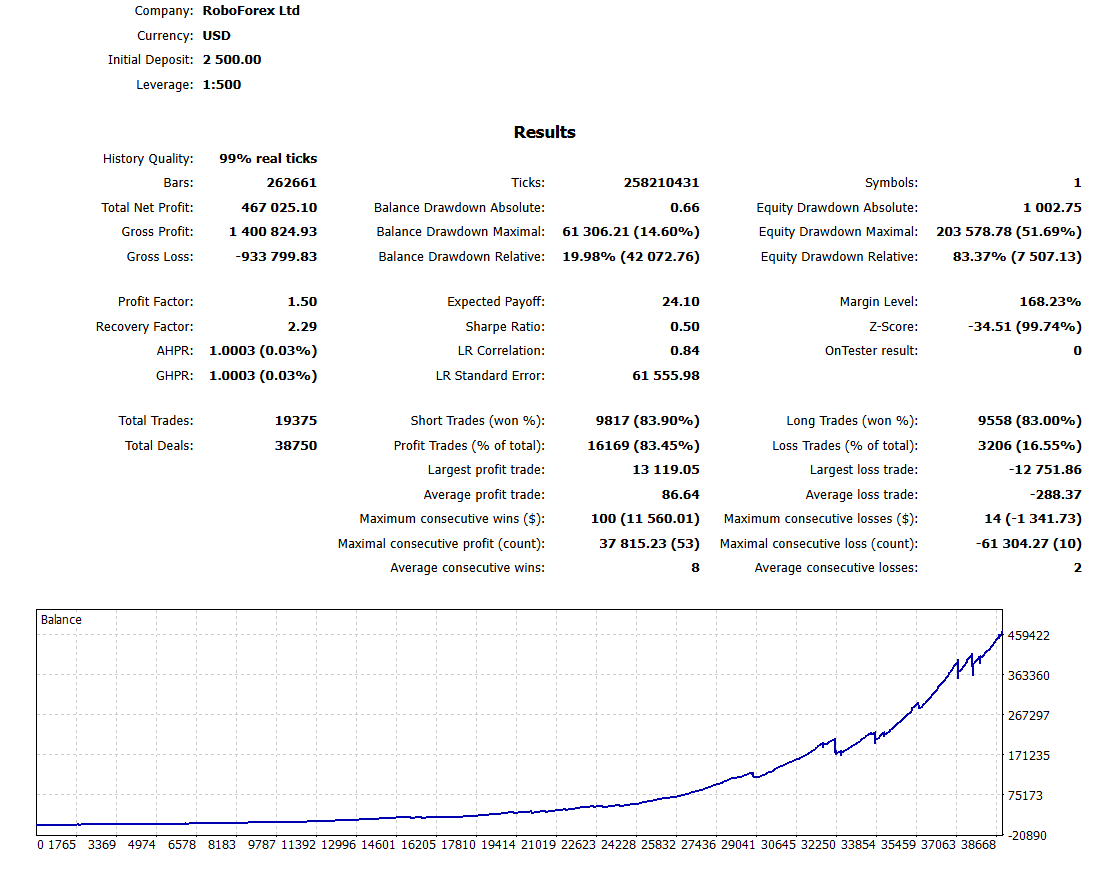
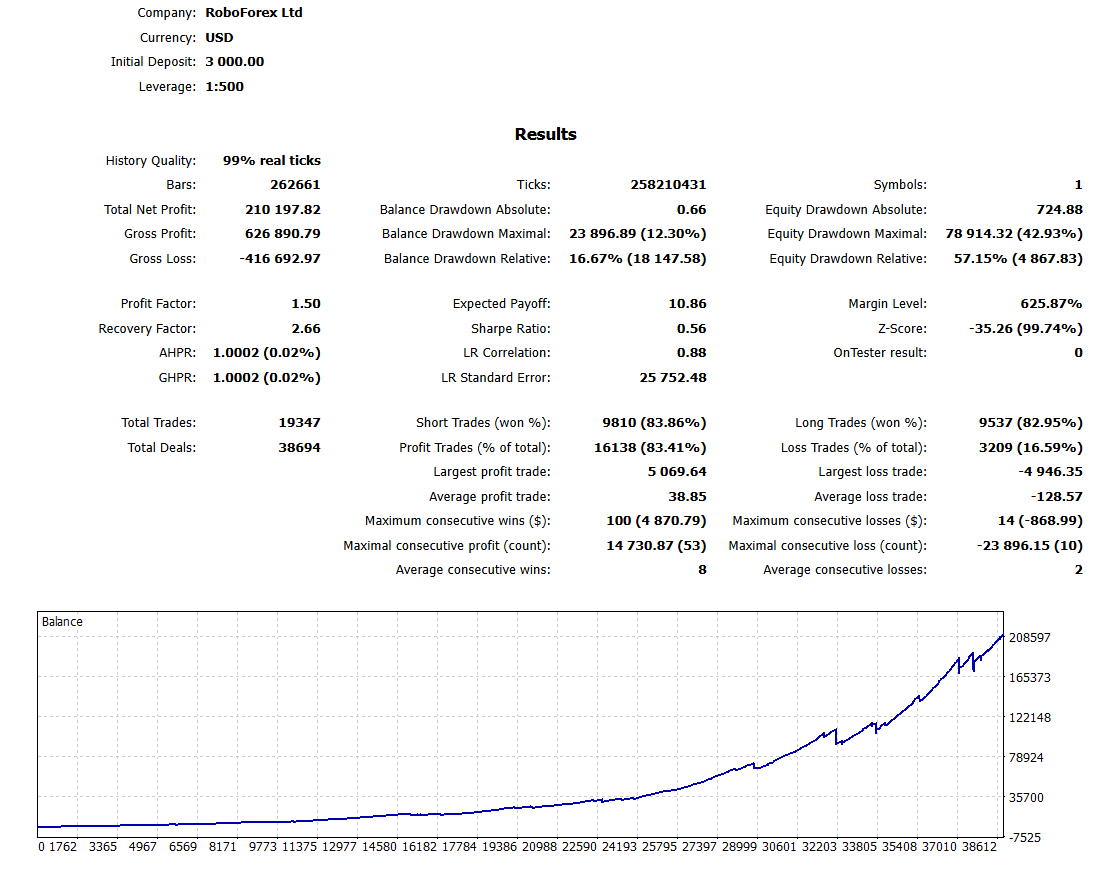
Before we look at the actual results, I would like to point out one important thing. Both backtests contain approximately 39,000 trading transactions over more than ten years of testing. When evaluating a trading strategy, I consider the size of the statistical sample to be far more important than the final return itself. Individual trades can be random to some extent. Only a sufficiently large number of trades can demonstrate whether a strategy has a genuine long-term statistical edge.
The testing was conducted on the EURUSD currency pair over the period from January 1, 2016, to August 1, 2026, using 99% Real Ticks.
The results below use the same trading logic. The only difference is the money management settings.
Dynamic Configuration
-
Initial Capital: USD 2,500
-
Position Size Increase: Every USD 2,500 of account growth
-
Final Account Balance: USD 469,525
-
Trading Transactions: 38,750
-
Total Return: 18,681%
-
CAGR: 64.0%
-
Maximum Equity Drawdown: 51.69%
Conservative Configuration
- Initial Capital: USD 3,000
- Position Size Increase: Every USD 3,000 of account growth
- Final Account Balance: USD 213,198
- Trading Transactions: 38,694
- Total Return: 7,007%
- CAGR: 49.6%
- Maximum Equity Drawdown: 42.93%
Although I am naturally pleased with the current results, I do not consider them the most important part of the entire project.
Throughout the development process, I gradually formed an idea of what I considered to be a reasonable long-term balance between return and risk for this type of strategy. Approximately 60% annual return with a maximum drawdown of up to 50% seemed to me to be an ambitious, yet still realistic goal. After nearly nine years of development, the current version of the strategy has come very close to achieving that balance.
However, I do not consider the total return or the CAGR to be the greatest achievement. What matters much more to me is that the strategy successfully made it through more than ten years of historical data, executed nearly 39,000 trading transactions, and maintained its long-term performance throughout the entire period without the trading account collapsing.
Even so, I do not consider the strategy's development to be complete. There are still historical periods where I see significant room for improvement. My primary goal is no longer to achieve even higher historical returns, but to gradually reduce drawdown, increase the robustness of the entire system, and verify that the strategy can maintain its characteristics under future market conditions as well.
Why EURUSD Only?
I chose EURUSD deliberately. Thanks to its high liquidity, low transaction costs, and long history of high-quality data, I consider this currency pair to be an ideal environment for developing and testing trading strategies.
My goal was never to add more currency pairs or other markets as quickly as possible. I wanted to first verify that the entire concept genuinely works on a single market that I have known well for many years.
Only if I manage to further reduce drawdown and improve the strategy's robustness in future versions will expanding it to additional currency pairs or other markets become the next logical step.
What Comes Next
Although I consider the current results encouraging, I certainly do not see them as the final goal.
There are historical periods that represent an exceptionally difficult test for virtually every strategy based on a similar principle. For me, one of those periods is the year 2015.
The ability to successfully handle periods like this is one of the greatest challenges of the entire project. If I can find a solution that improves the strategy's resilience without significantly compromising its long-term performance, I will consider it one of the most important milestones in its further development.
This is the direction I want to continue pursuing in future versions of Evolution Alpha—not by chasing ever-higher historical returns, but by gradually improving robustness, reducing drawdown, and finding solutions that will continue to make sense under future market conditions.
After nine years of development, testing, and hundreds of different experiments, this is the direction I believe in the most. Only time will tell how well it performs in the future.
If you have experience developing automated trading strategies, I would sincerely appreciate any objective opinion, experience, or constructive criticism you would be willing to share.