A Ranking You Can't Game With Sales or Fake Reviews. A Walkthrough of EA Ranking

Five Stars and a Zeroed Account
Sergey spent two evenings choosing an EA. He took it seriously: sorted by popularity, shortlisted a few products from the top of the list, read the reviews. The one he picked had over two hundred purchases and a near-perfect rating, with enthusiastic and detailed reviews. The equity curve in the screenshots was almost a straight line at forty-five degrees, drawdown barely visible.
He bought it, attached it to a $3,000 account, and spent the first five weeks very pleased. Up 9%, not a single noticeable pullback, two or three winning trades a day.
In week six the account went to zero over two trading days.
The post-mortem took him half an hour and consisted of a single discovery: behind the phrase "intelligent position management system" was a martingale. A losing trade wasn't closed — it was averaged with a doubled lot, then again, then again. For five weeks that looked like flawless drawdown-free trading, because every sequence eventually pushed through into profit. In week six one didn't.
The worst part of this story is that Sergey did everything right by the market's own logic. He looked at sales, at the rating, at the reviews and at the curve. It's just that none of those four signals says anything about what an EA will do to his money.
The EA Ranking section in FX Monitor is built around a simple idea: whatever the author shows should sit next to what actually happened to the people who bought the product — and all of it should be computed from trades rather than from descriptions.
Why the Familiar Signals Aren't Enough
Worth going through each one, because that's the justification for building yet another ranking.
Sales measure marketing, not results
The number of purchases reflects how well a product was promoted: how many impressions it got, how convincingly the description was written, how attractive the equity screenshot is, how much went into promotion. That's an honest metric — but it's about marketing, not trading. A product that sells brilliantly can produce any result at all on buyers' accounts: there simply is no link between the two.
And the better a product sells, the higher it sits in the list, the more it gets bought, the higher it climbs. It's a self-reinforcing loop in which results play no part.
Reviews are skewed from the start
Someone who lost money is more likely to leave quietly than to write an analysis. That isn't specific to forex — it's how feedback works everywhere: a disappointed person is on average less inclined to return to a place that upset them.
Add to that the fact that a review is text, and text can be written, requested, or exchanged for a discount or a refund. There's nothing to verify it against.
Author monitoring answers only half the question
It's important not to overstate this one. An author's monitoring is real trading, and it's the only place where the product can be seen the way its creator runs it: at his settings, on his account, with his risk. That data has genuine value, and waving it away would be foolish.
But that circuit alone isn't enough, for a reason that's nobody's fault. The account an author shows was chosen by that author, and chosen after the result was known. He may have honestly traded ten accounts with different settings and shown the one that worked best — that's his right. The buyer simply sees one result and doesn't know there were ten.
So author monitoring answers "how does this work for the author" and doesn't answer "is it reproducible for me". Only other people's accounts close the second question.
Demo gets passed off as live trading
Without slippage, requotes and real execution, a demo result says nothing about an EA. That's especially critical for scalpers and anything that depends on entry quality.
The mechanics hide behind words
"Scalper", "intelligent algorithm", "proprietary position management system" — any of these can describe a martingale that draws a smooth curve for six months and closes the account in a single day. Exactly Sergey's case.
The upshot: the buyer decides based on a picture and learns the truth with his own money.
What We Built
Two data circuits, and the value is in the combination
Every product in EA Ranking has two independent columns of numbers. Neither replaces the other — and that's the whole idea.
Author monitoring — the author's own accounts and backtests. He decides what to attach here; whatever he attaches becomes fully public: curve, trades, broker, server. The login is never shown, and trading through the page is impossible. This is a full-fledged first circuit: it shows how the product performs in the hands of the person who wrote it and knows how to configure it.
The independent aggregate — accounts of buyers who enabled participation themselves. And here's the key part: the author can't see who is in it and can't exclude a single account from it. This circuit answers a different question — what the product delivers at other brokers, on other deposits, in other hands.
Numbers you can cherry-pick and numbers you can't read differently. The author controls the first column entirely — and the buyer knows it. He has no control over the second one. Together they answer what neither answers alone.
Alongside sits the difference between the two circuits. Usually it's explained by broker conditions, lot size and entry latency rather than by deception. But that difference is precisely what a person wants to know before buying: how reproducible the author's result is on an ordinary account at an ordinary broker.
Why it can't be gamed
None of the three usual ways of gaming a ranking works here:
With sales — because the number of purchases doesn't enter the score at all. You can sell ten thousand copies and still hold a low score if buyers' results are poor.
With reviews — because there are no reviews in the score. The score is computed from trades.
By cherry-picking an account — because the second column is out of the author's reach. He can show the best of ten accounts in his own circuit, and that's his right; but next to it will stand what actually happened to people.
The Buyer's Data Stays the Buyer's Data
Before going further — the question everyone asks when they read "buyers' accounts".
Participation does not publish your account. Only your contribution to the aggregate leaves your side. The curve, the trades and the account number stay private. The EA's author never learns who participated. Participation can be switched off at any moment.
On top of that, the independent aggregate isn't displayed at all while it contains fewer than three distinct people. That isn't a quality threshold but a privacy one — on a smaller sample the aggregate makes an individual participant computable.
One more practical detail: if several EAs run on one account, what gets connected is not the account but the EA group. Only that group's trades feed into the product; the rest of the trading stays outside the calculation.
Verification: Why You Can't End Up in the Ranking by Accident
Being able to attach your account to someone else's product is simultaneously the ability to spoil their numbers or inflate your own. So every source is verified — and not once at the time it's added, but every night.
What is checked against the author's reference:
| What is checked | Default threshold |
|---|---|
| Share of trades on the product's instruments | 80% and up |
| Trade match after subtracting a random baseline | 70% and up |
| Or a match on behavioural fingerprint | 78% and up |
| Verification window | 14 days |
| Minimum trades to judge at all | 10 |
| Consecutive failed days before auto-revocation | 3 |
Four decisions sit behind that table, and each is worth explaining.
We don't look for exact trade matches. Different brokers have different quotes, different server times and different spreads — a hundred percent match doesn't exist in principle. Verification runs with tolerances on time, price and levels, and a correction for quote differences between brokers is computed separately, per instrument.
Matching is tested against chance. Two gold strategies will overlap within a single trading day with no connection whatsoever. So a baseline — how much random pairs would have matched — is subtracted from the raw match percentage, and the remainder is what gets evaluated. Same principle as any statistical test: what matters isn't the absolute number but the excess over background.
The second route in is behavioural. If the trades don't line up but the behaviour does — entry hours, holding duration, stop placement, direction distribution — the source is admitted on that basis. This is needed to catch the same EA running on different settings: the trades will differ, the manner won't.
Revocation isn't instant. A single failed day is not a violation: the person may have switched the EA off, changed settings or gone on holiday. An absence of trades doesn't count as a failure at all. Auto-revocation triggers after three consecutive failed days.
Separately: verification runs immediately when a source is added, not overnight. If an account doesn't qualify, the person sees the reason at the moment they press the button rather than after a day of silence.
And a hard rule: demo accounts are not accepted. Without real execution a result says nothing about an EA.
R: The Unit Everything Is Measured In
Every metric in the section is computed in R = net trade result ÷ account balance at the moment the trade was opened.
This isn't decoration but a precondition for comparability. A $500 account and a $50,000 account running the same EA at the same risk are incomparable in money — and fully comparable in R. A result in R doesn't depend on deposit size or lot settings, which are exactly the two things that differ for every buyer.
The balance is reconstructed from account snapshots at the moment of each opening, so deposits and withdrawals are already accounted for. Trades for which the balance can't be reconstructed are excluded rather than guessed at, and the share of excluded trades is printed right on the product card.
How the Score Is Computed
The score is built from five components, each with saturation — rising fast at first and slowly afterwards, so that a single outlier can't buy the top of the table.
| Component | Weight | What it means |
|---|---|---|
| Drawdown in R | 30 | how much risk the result cost |
| Recovery factor | 25 | profit against drawdown |
| Expectancy in R | 22 | what the average trade brings |
| Profit factor | 13 | skew of winners to losers |
| Share of profitable sources | 10 | how many participants ended up in profit |
Three multipliers are then applied, each closing a specific hole.
Sample confidence. The score is pulled toward the catalogue median the less is known about the product. Confidence is the geometric mean of three saturating quantities — participants, trades, weeks — so one weak part drags everything down: five hundred trades over two weeks are not proof. While the catalogue holds fewer than ten cards there is no median — a fixed anchor of 25 points is used instead. That's what a product we know nothing about is worth.
Age is a multiplier, not a bonus. The distinction is fundamental: a bonus can only help, whereas a product with no history simply hasn't had time to draw down, and a small drawdown reads as low risk. The multiplier runs from 0.20 to 1.15 on a continuous scale — with steps, 89 and 91 days would differ threefold, which would be absurd.
Risk flags reduce the score. Martingale ×0.70, grid ×0.80, no broker-side stop ×0.85, hedging ×0.95. The multipliers compound, but there's a floor of 0.50: four flags shouldn't zero a product, because removal from the ranking is a moderator's decision on a complaint, not the output of arithmetic.
Return is deliberately excluded from the score. A non-obvious decision, and the reasoning is this: a product whose sources are all EA groups inside shared accounts could otherwise never receive a score at all. And those are precisely the multi-strategy EAs the market finds most interesting.
All weights and thresholds are configurable, and — an important detail — the methodology page on the site reads them from the settings rather than from hand-written text. A threshold changes, and the text changes with it. There can be no gap between what's written and what's computed.
Risk Flags: Measured, Not Declared
This is the second most important part of the section after the independent aggregate — and the one that speaks directly to Sergey's problem.
A flag is raised from the sequence of positions and lot progression, evaluated separately for each magic series, so that two different EAs on one account don't get read as a single martingale.
| Flag | When it's raised |
|---|---|
| Martingale | lot grew 1.5× or more after a loss — on 15%+ of losing trades |
| Grid | positions added against the move to a depth of 3+ — on 15%+ of trades |
| No broker-side stop | a stop is registered with the broker on fewer than half the trades |
| Hedging | opposing positions on one instrument more than 5% of the time |
Two essential qualifications.
A flag is raised only if confirmed on at least 60% of sources. One person adding to positions by hand is a property of that person, not of the EA, and attributing it to the product would be wrong.
Pyramiding is displayed but not penalised. Adding to a position along the move is position management, not loss accumulation. Conflating it with grid trading would be a methodological error.
There's a separate mechanic for authors: the mechanics can be declared in advance. We'll measure them from the trades regardless — but an honest declaration turns a red "undisclosed risk" flag into a green "disclosure confirmed" one. In other words, a martingale is not in itself a crime; the crime is selling one as an "intelligent position management system".
What the Buyer Sees
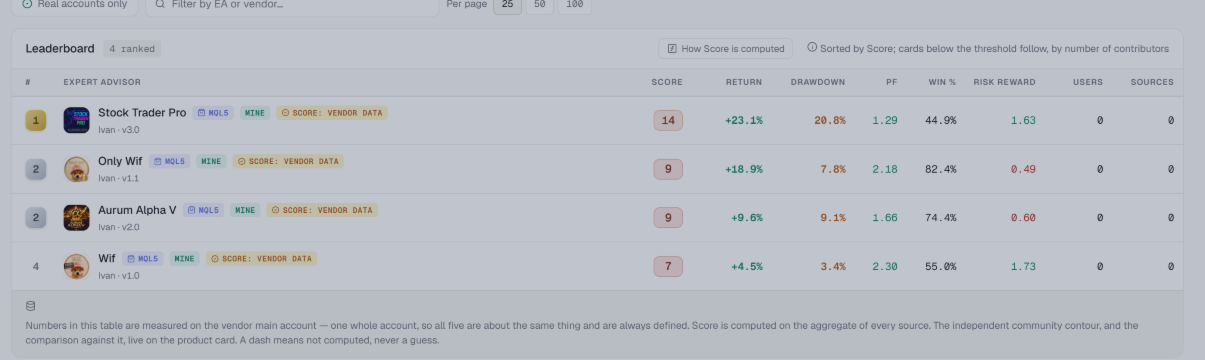
- Leaderboard — score, return, drawdown, PF, win rate, expectancy in R, participant and source counts. The table's figures are measured on the author's primary account: one whole account, so every metric refers to the same thing and is always defined.
- Product card — both circuits, the difference between them, the author's curve, the community aggregate.
- Participant result fan — normalised curves of every account: median, P25–P75 and P10–P90 bands, over any period. Each account starts from zero, so accounts of different ages are comparable. The tail is cut where the number of participants falls below the privacy threshold.
- Broker breakdown — where exactly the EA performs better. Rows backed by too few distinct people aren't shown at all.
- Risk profile — measured flags, with how many sources confirm each.
- Change log — including moderation decisions. A product can be deleted; its history cannot be erased.
- Methodology — one click from the ranking, with live numbers from the settings.
What the Author Gets
It may look as though the section is built against authors. It isn't — it's built against those who sell a picture, which is exactly why it benefits those who sell a result.
- A product page with two data sources, the second of which the author doesn't control — and that's precisely why people believe it. It's the strongest trust signal anyone can put in front of the market.
- Several accounts and backtests, with one designated as primary.
- Declaring the mechanics in advance — turning suspicion into confirmed disclosure.
- Disputing a specific source. If an outside account clearly isn't running his product, the author files a dispute and a moderator decides. The source stays in the aggregate until the decision — otherwise a dispute would be a "remove inconvenient numbers" button.
- The right to close the independent circuit — but not the right to hide data already collected. The closure is visible on the card and recorded in the log.
That last point is worth reading twice. An author can switch off the second column. But switching it off becomes a public fact in itself — and the market will draw its own conclusions from that.
Complaints and Moderation
A user can file a complaint about a product: the numbers don't match reality, the product isn't what it claims to be, the author doesn't respond.
A complaint isn't a button but a discussion. A moderator reads it, the author takes part and sees the claim but not the complainant's name. While the review is ongoing, nothing happens to the product.
An upheld complaint removes 5 points of score, capped at 20 in total: a coordinated group shouldn't be able to zero a product. This is the only part of the score that doesn't come from trades — which is why it's shown as a separate number rather than buried inside the base.
Card moderation checks metadata only: name, description, store link. Nobody evaluates the mechanics by hand — an algorithm measures them from the trades.
Conflict of Interest
A section about trust can't pass over this in silence.
FX Monitor takes no money for placement in the ranking. You cannot move up the table by paying.
EAs authored by FX Monitor are excluded both from the ranking and from the catalogue median used for shrinkage. Otherwise we'd be setting the bar we're then measured against.
What We Don't Promise
The section rests on the numbers being trustworthy, so the caveats here are part of the product rather than fine print.
Past results don't predict future ones. No number on the page is a forecast.
The sample is survivorship-biased. Participants are those who enabled participation themselves. Someone who abandoned an EA after losses is underrepresented — and we don't correct for it, because saying so is more honest than pretending the problem isn't there.
Pooled and percentile figures don't mix. Pooled metrics describe the strategy; percentile metrics describe what a typical participant got. They're computed differently and aren't comparable with one another.
Risk flags are raised by an algorithm, and it can be wrong. A flag is a flag, not a verdict: a martingale is a property of a strategy, not proof of fraud. There are people who deliberately trade martingales with full awareness of the risk; the only question is that they should understand it before buying rather than after.
A dash means "not computed", not "zero". There are no invented numbers on these pages.
Access and Roadmap
In the plans this is two independent capabilities:
- View EA Ranking — access to the section: ranking, cards, methodology, breakdowns.
- Add EA to Ranking — publishing your own product in the ranking.
The second makes no sense without the first; the reverse works fine — you can browse the ranking with nothing to publish in it.
In development: a monthly results heatmap, a "backtest versus forward" panel, and daily aggregate exports. Execution quality — slippage and spread — is deferred to a later version.
The Bottom Line
Back to Sergey. Here's what he would have seen in EA Ranking before buying.
Next to the author's curve, an aggregate from the accounts of people who had already bought that EA, and the difference between the two circuits. A fan of participant results — median and bands — so not "here's one good account" but "here's what a typical buyer got, and here's what an unlucky one got". And a red martingale flag in the risk profile, with the number of sources confirming it.
The decision would still have been his. He might well have bought the same EA anyway — understanding that he was trading a martingale and sizing his risk accordingly. But that's a fundamentally different situation from the one he ended up in.
Sales measure marketing. Reviews measure the mood of those who chose to write one. Author monitoring measures real trading — but the trading the author chose to show, on his terms. Buyers' accounts measure how much of that reproduces for everyone else, provided the author can't reach into them.
Neither circuit answers the buyer's question in full. Together they do. That's exactly what this section does.
EA Ranking is part of FX Monitor. Participation in the independent aggregate is voluntary and can be switched off at any time; a participant's account, curve and trades remain private. MT4 and MT5 are both supported.