Why Bitcoin and Gold Are the Ultimate Stress Test for AI Trading Systems

Why Bitcoin and Gold Are the Ultimate Stress Test for AI Trading Systems
If you want to know whether a trading AI is genuinely robust or simply well marketed, do not ask about its win rate. Ask how it performs on Bitcoin and Gold specifically. These two markets happen to stress test almost entirely different failure modes, and very few systems handle both honestly. Most vendors show a single flattering chart from whichever market currently looks good and let you assume the rest generalizes. It rarely does. A genuinely sound architecture should hold up reasonably across both, not because the two markets behave similarly, they do not, but because the underlying engineering discipline required to survive either one is the same discipline, applied correctly in both directions.
This article treats Bitcoin and Gold as a joint diagnostic rather than two separate case studies, explains precisely which failure mode each one exposes, what this demands from a neural network specifically, what genuine robustness actually requires beyond an impressive backtest, and gives you a practical framework for evaluating any AI trading claim against this exact test.
Part One: Two Markets, Two Completely Different Failure Modes
Bitcoin is the volatility and tail risk stress test. It trades continuously with no closing session at all, exhibits genuinely fat tailed, momentum persistent directional swings, and offers no quiet overnight window in which a system can pause and recalibrate. It tests, ruthlessly, whether a system's risk sizing genuinely scales with real time volatility rather than resting on a static assumption, and whether its stops are adaptive enough to survive a genuine volatility spike without being so wide they defeat the purpose of having a stop at all.
Gold is the macro sensitivity and event risk stress test. It exhibits comparatively lower baseline volatility punctuated by sharp, discrete jumps concentrated around scheduled economic releases, with safe haven flows that can reverse direction quickly as sentiment shifts. It tests whether a system properly recognizes and handles scheduled information events as a distinct category, rather than treating all volatility as identical, undifferentiated noise regardless of its actual source.
The genuinely important insight is that these are not variations on the same problem. They are different problems entirely. A system built to survive Bitcoin's continuous, grinding volatility can still be destroyed by Gold's discrete, news driven gap risk if it has no dedicated event awareness whatsoever. A system with excellent scheduled news filtering for Gold can still fail badly on Bitcoin if its position sizing does not genuinely track real time volatility swings. Passing both tests simultaneously requires two distinct engineering disciplines to both be present and both be correct, not one clever trick applied twice.
Part Two: What Each Market Specifically Demands From a Neural Network
Bitcoin creates a distinct challenge around distribution shift and memory. Training data distribution can shift extremely quickly, a network calibrated during a relatively calm crypto period can become badly miscalibrated within weeks once a genuinely violent regime begins, demanding an architecture built for continuous adaptation rather than a single frozen calibration. Bitcoin's long memory momentum character also means a network naively assuming independence between consecutive price movements is structurally mismatched to the asset from the start, regardless of how much data it is trained on, since that independence assumption is simply false for this specific market's actual behavior.
Gold creates a distinct challenge around information concentration. A meaningful share of Gold's genuinely tradeable structure is concentrated in narrow windows around scheduled releases rather than spread evenly across all time, meaning a network has to learn to weight discrete, calendar tied information far more heavily than it would for a market where informational density is roughly uniform across time. A network that treats every hour as equally informative is structurally blind to exactly the moments that matter most in this specific market.
Part Three: What Genuine Robustness Actually Requires
Generalization across these two specific stress tests is a sharper, more demanding standard than generalization in the abstract. A model overfit to Bitcoin's particular historical volatility pattern will very likely fail when forced onto Gold's genuinely different statistical character, and the reverse applies with equal force. Passing both honestly requires several specific properties working together, not a single architectural trick.
- Risk calibration that adapts to real time conditions rather than baking in one market's assumed volatility profile. A fixed risk assumption tuned comfortably for one market's typical behavior will be systematically wrong the moment it is applied to a market with a fundamentally different volatility character.
- Validation across genuinely different regimes and assets, not merely walk forward testing on the same single instrument. A system validated exclusively on Bitcoin's own history, however rigorously, has told you nothing about how it behaves under Gold's different statistical pressures, and vice versa.
- Warmup gating that requires accumulated evidence before trusting a learned adjustment. A system that reacts confidently to thin evidence risks overfitting specifically to whichever asset happened to dominate its most recent experience, precisely the failure mode this cross asset stress test is designed to expose.
Part Four: A Practical Framework for Evaluating Any AI Strategy Against This Test
The principles above convert directly into specific, concrete questions worth asking before trusting any system claiming to handle both crypto and traditional macro sensitive assets.
- Does position sizing and stop distance genuinely scale with real time volatility, or is the same fixed assumption applied regardless of which asset is being traded?
- Is there dedicated handling for scheduled economic events, or does the system treat all volatility as interchangeable regardless of its underlying source?
- Was the system validated separately against each asset's own genuine statistical character, or was a single calibration developed on one market simply reused unchanged on the other?
- Does the vendor show honest performance across both a genuinely volatile crypto period and a genuinely event heavy macro period, or only the flattering half of that picture?
Part Five: Systems Specifically Engineered to Pass Both Tests
ICONIC BTC AI+ and ICONIC GOLD AI+ share the same underlying plastic cognitive kernel, proof that the same core engineering philosophy is genuinely portable, while being deliberately tuned to pass their respective stress test rather than sharing one calibration blindly. ICONIC BTC AI+ addresses the volatility stress test directly, ATR adaptive stop distance and position sizing that mechanically track real time conditions, Grünwald Letnikov fractional calculus capturing the long memory momentum character specific to crypto, and a MAP Elites archive of specialist variants ready for whichever regime actually develops. ICONIC GOLD AI+ addresses the event risk stress test directly, an integrated economic calendar filter built specifically because Gold concentrates so much of its genuine structure around scheduled releases, alongside drift detection and Sortino ratio based reward shaping suited to a market where downside risk around discrete events matters more than volatility in the abstract.
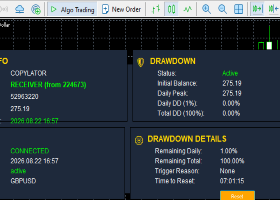
The flagship ICONIC KYBERNETIC AI+ takes this a step further, running both stress tests simultaneously inside one coordinated system, with a hard, code level margin floor and a three tier portfolio drawdown framework specifically engineered to survive both failure modes at once rather than being tuned comfortably for only one of them.
Frequently Asked Questions
Why are Bitcoin and Gold considered a strong combined test for AI trading systems? They expose genuinely different failure modes, continuous extreme volatility for Bitcoin and discrete, event driven macro sensitivity for Gold, meaning a system that handles both honestly has demonstrated two distinct engineering disciplines rather than one narrow specialization.
Can a model trained well on Bitcoin be assumed to work equally well on Gold? No. The two markets have fundamentally different statistical characters, and a model calibrated for one will very likely be systematically mismatched when applied unchanged to the other.
What does genuine robustness actually require beyond a good backtest? Risk calibration that adapts to real time conditions rather than a fixed assumption, validation across genuinely different market regimes rather than a single instrument, and warmup gating that requires real accumulated evidence before trusting any learned adjustment.
What should a trader specifically ask when evaluating a claimed multi asset AI system? Whether risk sizing genuinely scales with real time volatility, whether scheduled news events receive dedicated handling, whether validation occurred separately on each asset's own character, and whether the vendor shows honest results across both a volatile crypto period and an event heavy macro period.
The Test That Actually Separates Genuine Engineering From Marketing
A spectacular backtest on one market proves very little on its own. A system that genuinely holds up across Bitcoin's relentless volatility and Gold's sharp, event driven risk has passed a far more demanding and far more honest test, one that exposes exactly the shortcuts a purely marketed system cannot survive.
Explore systems specifically engineered to pass both, from the volatility hardened architecture of ICONIC BTC AI+ and the event aware design of ICONIC GOLD AI+, to the coordinated dual stress resilience of the flagship ICONIC KYBERNETIC AI+, at iconicfx.tech.
Risk Disclaimer. Trading foreign exchange, cryptocurrencies, commodities and other leveraged financial instruments carries a high level of risk and may not be suitable for all investors. The high degree of leverage can work against you as well as for you. Past performance is not indicative of future results. Automated trading systems, indicators and Expert Advisors do not guarantee profits and can produce losses. ICONIC.FX provides software tools only and does not provide investment advice, portfolio management or financial recommendations. You are solely responsible for your own trading decisions. Seek advice from an independent licensed financial advisor if you have any doubts.