Could an AI Predict the Next Financial Crisis Before the World Notices?

Could an AI Predict the Next Financial Crisis Before the World Notices?
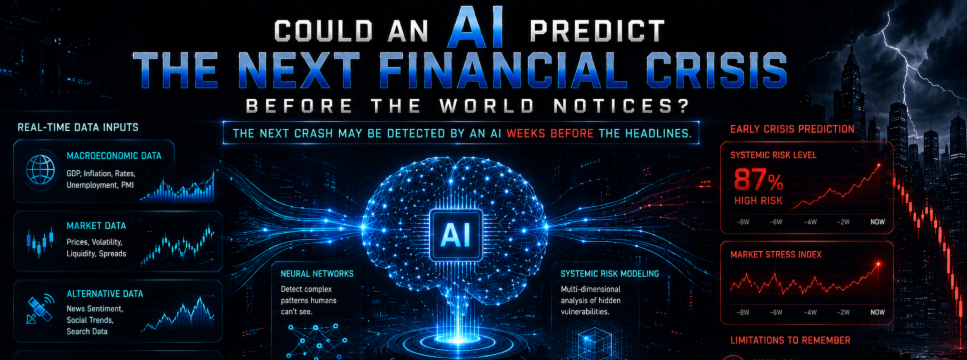
The next crash may be detected by an AI weeks before the headlines. It is a genuinely compelling idea, and it deserves a genuinely honest answer rather than either breathless hype or dismissive cynicism. This article draws a careful, important distinction that most coverage of this topic skips entirely, the difference between detecting elevated systemic fragility, which is a real and actively researched capability, and reliably predicting the specific timing of the next crisis, which no system, artificial intelligence or otherwise, currently does with any established track record. Understanding that distinction precisely is more valuable than any confident sounding prediction claim.
Part One: What Genuine Early Warning Indicators Actually Look Like
Systemic risk research, much of it predating modern machine learning entirely, has identified several categories of genuine early warning signal worth understanding on their own terms.
- Macro indicators. Credit growth accelerating well beyond underlying economic growth, yield curve inversions, rising leverage ratios across households or institutions, and shrinking currency reserves have each preceded past episodes of financial stress, forming the raw material central banks and international institutions have tracked for decades, independent of any AI involvement.
- Market based indicators. Unusual breakdowns in normally stable correlations between asset classes, a classic signature of systemic stress where previously diversified assets suddenly begin moving together, alongside volatility term structure anomalies and simultaneous spread widening across multiple, normally unrelated markets, offer real time signals visible directly in price data.
- Network based indicators. Mapping genuine interconnectedness, who is exposed to whom across interbank lending relationships and counterparty webs, can reveal concentrated fragility a purely price based view would miss entirely, since a shock can propagate through these structural connections even when no individual price series looks obviously alarming in isolation.
Part Two: What Neural Networks Can Genuinely Add, and Where They Genuinely Struggle
The genuine capability neural networks bring to this problem is processing these heterogeneous categories, macro, market and network data, simultaneously, and identifying unusual joint patterns across them that a human analyst tracking each domain in a separate silo might miss, particularly subtle interactions between variables that only become meaningful when considered together rather than individually.
The genuine limitation deserves equal, honest weight. Financial crises are, almost by definition, rare events, and critically, each historical crisis has genuinely different specific triggers and propagation mechanics even where some structural warning signs rhyme across episodes. This creates a severe data scarcity problem for any learning system, there are simply very few historical examples to learn from compared to the vast amount of ordinary, non crisis market data available, making genuine confidence in how well a model generalizes to a structurally new, never before observed crisis mechanism honestly difficult to establish.
A second, less discussed limitation is reflexivity. Once an early warning system becomes influential enough that market participants actually observe and react to its signal, that very reaction can change subsequent market behavior, either partially self fulfilling the warning through the reaction itself, or self defeating it as participants adjust preemptively, a well documented complication in systemic risk forecasting broadly, not a flaw unique to any particular AI implementation.
Part Three: Why Prediction and Causality Are Not the Same Thing
This distinction sits at the intellectual core of the entire question. A model can discover that a specific indicator historically preceded past crises, a genuinely predictive, correlational pattern, without that model ever genuinely understanding the causal mechanism actually connecting that indicator to crisis onset. This matters enormously here specifically, because a purely correlational signal learned from a very small number of historical crisis examples may simply be capturing incidental features unique to those specific past episodes rather than a genuine causal trigger mechanism likely to generalize to a structurally different future crisis with different underlying causes.
Approaches genuinely grounded in causal structure, such as network contagion modeling or causal inference techniques measuring actual directed influence between related markets rather than assuming fixed correlation, offer a more defensible foundation for anticipating genuinely novel crisis pathways than pure historical pattern matching, precisely because causal structure is inherently more likely to generalize beyond the specific historical instances it happened to be learned from. Even this more principled approach, stated honestly, cannot fully escape the fundamental rarity and genuine uncertainty surrounding real systemic crisis events. It is a meaningfully better foundation, not a solved problem.
Part Four: The Honest Bottom Line for You as an Individual Trader
No system, artificial intelligence or otherwise, offers a reliable, established capability to predict the specific timing of the next financial crisis today, and any product confidently claiming otherwise deserves serious, informed skepticism rather than trust. This is not a disappointing conclusion. It points directly toward the genuinely more actionable and more honest response.
Since crisis timing cannot be reliably predicted, the defensible strategy is not attempting to precisely exit before one arrives. It is building architecture that survives crisis conditions whenever they eventually materialize, regardless of whether any warning system saw it coming in advance. This is precisely the philosophy underlying the risk framework inside ICONIC KYBERNETIC AI+, a hard, code level margin floor and a three tier portfolio drawdown system that function as unbreakable law rather than a predictive bet on catching the next crisis early. Its causal, Transfer Entropy based approach to understanding the relationship between Bitcoin and Gold reflects the same causal over correlational philosophy discussed above, applied at the more modest, honestly scoped level of two coordinated markets rather than an overreaching claim of whole system crisis forecasting. The same non negotiable discipline, a hard stop loss on every position and a categorical rejection of grid and martingale, runs through ICONIC BTC AI+ and ICONIC GOLD AI+ as well, the honest answer to genuine uncertainty is resilience, not false confidence in prediction.
Frequently Asked Questions
Can AI reliably predict the exact timing of the next financial crisis? No system, AI or otherwise, currently has an established, reliable track record of predicting specific crisis timing. What genuinely exists is the ability to detect elevated systemic fragility through macro, market and network indicators, a meaningfully different and more honest claim than precise prediction.
What data do genuine early warning systems actually use? Macro indicators such as credit growth and leverage ratios, market based signals like correlation breakdowns and spread widening, and network based mapping of interconnected exposure between institutions, categories developed largely independent of AI and long studied by systemic risk researchers.
Why is data scarcity such a challenge for AI based crisis detection? Financial crises are rare events with genuinely different specific triggers each time, meaning very few historical examples exist to learn from compared to the vast amount of ordinary market data, making confident generalization to a structurally new crisis mechanism genuinely difficult to establish.
Why does the difference between prediction and causality matter here? A model can find that an indicator historically preceded past crises without understanding the actual causal mechanism, meaning that correlation may not generalize to a future crisis with different underlying causes. Causally grounded approaches offer a more defensible, though still imperfect, foundation.
If crisis prediction is not reliable, what should traders actually do? Focus on architecture that survives crisis conditions whenever they occur, hard stop losses, rejection of loss averaging techniques, and enforced portfolio level drawdown protection, rather than relying on any system's claimed ability to predict and avoid the next crisis in advance.
The Honest Answer Is More Useful Than a Confident One
The genuinely interesting truth is less dramatic than the hook that opened this article, and considerably more useful. AI cannot reliably tell you exactly when the next crisis arrives. What well engineered systems can offer is a more honest, causally grounded read on elevated systemic fragility, combined with the actual answer to genuine uncertainty, architecture built to survive whatever regime eventually materializes rather than a false promise of seeing it coming in time.
Explore systems built on exactly this resilience first philosophy, including ICONIC BTC AI+, ICONIC GOLD AI+ and the flagship ICONIC KYBERNETIC AI+, at iconicfx.tech.
Risk Disclaimer. Trading foreign exchange, cryptocurrencies, commodities and other leveraged financial instruments carries a high level of risk and may not be suitable for all investors. The high degree of leverage can work against you as well as for you. Past performance is not indicative of future results. Automated trading systems, indicators and Expert Advisors do not guarantee profits and can produce losses. No system can predict or guarantee protection against market crises or extreme events. ICONIC.FX provides software tools only and does not provide investment advice, portfolio management or financial recommendations. You are solely responsible for your own trading decisions. Seek advice from an independent licensed financial advisor if you have any doubts.