The Next Generation of Trading AI: From Prediction to Adaptive Decision Making

The Next Generation of Trading AI: From Prediction to Adaptive Decision Making
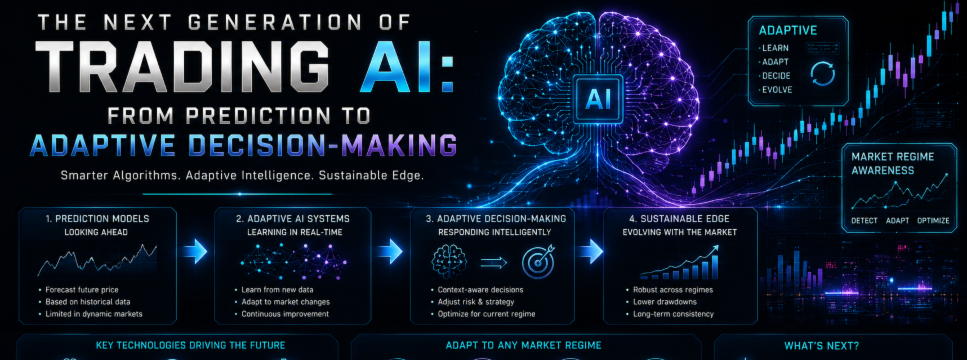
Ask most people, including many developers building trading systems, what AI actually does in this context, and the answer usually boils down to prediction. The model looks at the market and predicts whether price will go up or down. This framing is not wrong exactly, but it describes an older, structurally limited paradigm that the most advanced systems have already moved beyond. The genuinely important shift happening in serious trading AI is not merely better prediction. It is a categorical move away from prediction as the objective entirely, toward systems that learn to make good decisions directly, whether or not they ever explicitly predict anything at all.
This article explains that distinction precisely, why it matters far more than it sounds, how reinforcement learning and online learning combine to produce genuinely adaptive decision making, how this approach naturally responds to changing market regimes in a way prediction focused systems structurally cannot, and, with appropriate honesty about the limits of forecasting the future, where this field plausibly heads over the coming years.
Part One: The Old Paradigm, Prediction Models and Their Hidden Weakness
The classical machine learning approach to trading treats the problem as supervised prediction. A model is trained to answer a narrow, well defined question, will price be higher after some number of bars, and outputs a probability or a directional forecast. A separate, often hand coded decision layer then wraps around that prediction, entering a trade if the predicted probability clears some threshold, applying a roughly fixed position size, exiting at a predetermined target.
The weakness in this design is subtle but genuinely important, and most retail systems never address it. The model is optimized purely to maximize prediction accuracy on its narrow question, not to maximize the thing that actually matters, the risk adjusted profitability of the trading decisions that result from that prediction. These are not the same objective, and optimizing one does not guarantee optimizing the other. A model correctly predicting direction fifty five percent of the time is worthless, or worse than worthless, if the average loss on the wrong forty five percent of trades meaningfully exceeds the average gain on the correct fifty five percent. Prediction accuracy and trading expectancy are related but genuinely distinct quantities, and a system built purely to maximize the former has no guarantee whatsoever of maximizing the latter.
Part Two: The New Paradigm, Adaptive Decision Making Through Reinforcement Learning
Reinforcement learning reframes the entire problem. Rather than training a model to predict a future value and bolting a separate decision layer on afterward, an RL agent learns a policy, a direct mapping from the current perceived market state to an action, optimized against the actual objective that matters, cumulative reward defined in terms of realized, risk aware outcomes rather than a disconnected proxy metric such as directional accuracy. The agent never needs to correctly forecast what will happen next. It needs only to learn which actions, taken in which states, have tended to produce good outcomes over time, a fundamentally more directly aligned objective than prediction ever was.
The architecture typically involves several cooperating pieces. A state representation captures current market conditions. An action space defines what the agent can actually do, enter, exit, hold, adjust size. A reward signal reflects the genuine, realized consequence of that action, correctly incorporating risk rather than raw profit alone. And a policy, refined continuously through experience, governs how the agent behaves. Actor critic architectures implement this through two cooperating components, an actor proposing actions and a critic evaluating how good those actions actually turned out to be, each continuously sharpening the other through iteration. This is precisely the decision core inside ICONIC KYBERNETIC AI+, using TD lambda learning with eligibility traces to correctly assign credit for an outcome across the actual sequence of decisions that led there, refining its policy directly against realized consequence rather than a narrow prediction target divorced from the ultimate trading objective.
Part Three: Online Learning, The Continuous Adaptation Layer
It is worth being precise about a distinction often blurred in casual discussion. Reinforcement learning describes how an objective is framed, learning a decision policy rather than a prediction. Online learning describes something different, when and how a model updates. A reinforcement learning system can, in principle, be trained once in an offline simulation and then deployed completely frozen, which quietly reintroduces the exact staleness problem prediction models suffer from, an agent whose policy was shaped by conditions that may no longer exist and has no mechanism to notice the drift.
Genuine online learning solves this by continuing to update against live evidence as it arrives, rather than freezing after an initial training phase. Concrete mechanisms make this real rather than aspirational. An exponentially weighted recursive least squares readout with a forgetting factor keeps a perception layer regime adaptive rather than static. A self calibrating confidence gate built on Adaptive Conformal Inference continuously regulates its own threshold against a stated accuracy target, automatically noticing when its own calibration begins drifting. Independently updating estimators, such as a meta labeling model refining its win probability assessment with every new observed outcome, and regime specific reward tracking that continuously updates which conditions have actually proven profitable, together ensure the system's understanding of the market keeps pace with the market itself, rather than aging quietly in the background between infrequent retraining cycles. Experience replay adds a data efficient hybrid element, revisiting past decisions to extract additional learning signal per real observation while remaining part of a genuinely continuous, online updating process rather than a purely offline batch procedure.
Part Four: How Adaptive Decision Making Actually Responds to Changing Regimes
The deepest advantage of the decision making paradigm over pure prediction becomes visible specifically during regime change. A prediction focused system experiences a regime shift as declining prediction accuracy, a metric that requires someone or something to notice the decline and intervene, often well after damage has accumulated. A genuinely adaptive decision making system experiences the exact same regime shift directly through its reward signal, since the realized consequences of its actions change immediately as conditions change, and that shift begins reshaping the policy through the ordinary mechanics of online learning without requiring separate detection and intervention.
This is precisely the mechanism underlying the regime awareness inside ICONIC KYBERNETIC AI+. Its regime filter tracks a continuously updated reward estimate for specific market condition buckets, and when genuine conditions shift, the realized rewards for a given bucket shift directly and immediately, which in turn reshapes the system's own threshold for what counts as sufficiently favorable to trade. Regime change is not a separate event requiring a distinct detection module bolted onto the decision engine. It is absorbed directly into the same continuous learning loop already governing every other aspect of the policy, a structurally cleaner solution than maintaining prediction accuracy and regime detection as two disconnected systems that each have to work correctly and stay synchronized with one another.
Part Five: Where This Plausibly Heads Over the Next Few Years
Forecasting the future of any technical field carries obvious uncertainty, and this section is offered with appropriate hedging rather than confident prediction, fittingly enough given the subject matter. Several directions already visible in current research and early deployment seem likely to deepen rather than reverse.
- Deeper causal reasoning beyond current implementations. Techniques already measuring directed influence between related markets are likely to extend further, toward richer, multi instrument causal graphs rather than pairwise relationships alone, allowing genuinely coordinated reasoning across a wider portfolio of related assets simultaneously.
- More sophisticated multi agent coordination. Systems that today coordinate a small number of specialized sub agents under one governing policy are a plausible foundation for architectures that negotiate resource and risk allocation across a genuinely larger population of specialized agents, extending current coordination mechanisms rather than replacing them.
- Uncertainty quantification becoming a baseline expectation rather than a differentiator. Self calibrating confidence mechanisms, still relatively rare in retail systems today, seem likely to become an expected standard rather than an advanced feature, as the industry matures and buyers become more sophisticated about demanding genuine calibration evidence.
- Explainability shifting from nice to have toward competitive and possibly regulatory necessity. As adaptive systems handle increasing amounts of capital, pressure toward genuinely inspectable reasoning, not full mechanistic transparency, which remains a hard open problem, but meaningful, checkable decision points, seems likely to intensify from both informed buyers and eventual regulatory attention.
None of these plausible developments changes the fundamental limits already worth taking seriously today. Markets remain non stationary regardless of how sophisticated decision making becomes. No architecture eliminates risk, only manages it. And hard, structurally enforced boundaries, a stop loss on every position, a rejection of loss averaging techniques, remain non negotiable regardless of how advanced the underlying policy learning becomes. Better decision making architecture is not a substitute for enforced discipline. It is a complement to it.
This Is Not Only a Future Direction, It Already Runs Today
Everything described in this article as the next generation of trading AI is not purely theoretical. ICONIC KYBERNETIC AI+ already embodies the decision making paradigm directly, an actor critic reinforcement core optimized against realized outcomes rather than a disconnected prediction target, layered with genuine online learning across its confidence gating, regime tracking and position sizing components. ICONIC BTC AI+ applies a related but architecturally distinct form of continuous policy adaptation, differentiable plasticity that physically reshapes the network's own internal connections in response to live feedback, ensuring the system's behavior keeps evolving with the specific asset it trades rather than remaining frozen at the moment of initial deployment.
Frequently Asked Questions
What is the difference between a prediction model and an adaptive decision making system in trading? A prediction model forecasts a future value, such as price direction, with a separate decision layer acting on that forecast. An adaptive decision making system learns a policy directly optimized against realized trading outcomes, without necessarily predicting the future explicitly at all.
Why does optimizing prediction accuracy not guarantee good trading results? Prediction accuracy and trading expectancy are related but distinct objectives. A model can correctly predict direction a majority of the time and still lose money if losses on incorrect predictions are disproportionately larger than gains on correct ones.
What is the difference between reinforcement learning and online learning? Reinforcement learning describes how the objective is framed, learning a decision policy rather than a prediction. Online learning describes when and how a model updates, continuously against live evidence rather than in infrequent frozen batches. A system can combine both.
How does adaptive decision making respond to market regime changes? A regime shift changes the realized rewards an agent observes directly, which immediately begins reshaping its policy through ordinary online learning mechanics, rather than requiring a separate detection system to notice declining prediction accuracy after the fact.
Will future AI trading systems eliminate the need for hard risk management? No. Regardless of how sophisticated decision making architecture becomes, markets remain non stationary and no system eliminates risk entirely. Hard, structurally enforced boundaries remain a necessary complement to intelligent decision making, not a step that becomes obsolete as the technology improves.
The Real Frontier Was Never Better Prediction
The next generation of trading AI is not defined by marginally more accurate forecasts. It is defined by systems that stop trying to predict an inherently uncertain future at all, and instead learn, directly and continuously, which decisions genuinely tend to produce good outcomes under real, evolving conditions. This is a categorically different and more honest problem to solve, and it is already running in production rather than waiting in a research paper.
Explore this decision making paradigm in working form, from the actor critic reinforcement core of ICONIC KYBERNETIC AI+ to the continuously self modifying architecture of ICONIC BTC AI+, at iconicfx.tech.
Risk Disclaimer. Trading foreign exchange, cryptocurrencies, commodities and other leveraged financial instruments carries a high level of risk and may not be suitable for all investors. The high degree of leverage can work against you as well as for you. Past performance is not indicative of future results. Automated trading systems, indicators and Expert Advisors do not guarantee profits and can produce losses. ICONIC.FX provides software tools only and does not provide investment advice, portfolio management or financial recommendations. You are solely responsible for your own trading decisions. Seek advice from an independent licensed financial advisor if you have any doubts.