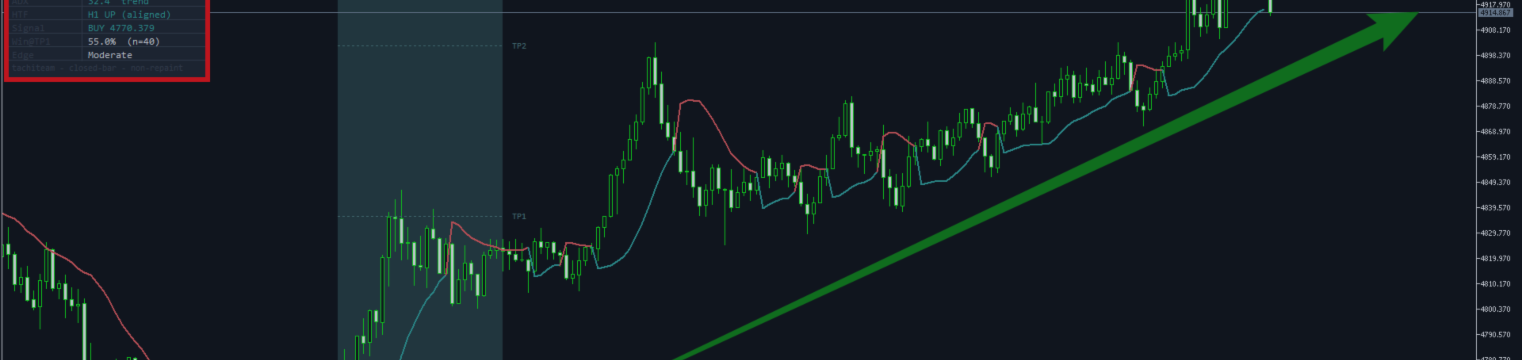
How I Trade Trends With Gann — and Why Knowing When to Stay Out Changed My Results

A simple, rules-based swing system that gives me a direction, an entry, a stop, and three targets — and, just as importantly, tells me when the market isn’t worth trading.
For a long time my charts looked busy and my account looked flat. I had indicators stacked three deep, and every one of them gave me a slightly different opinion. When a clean trend showed up, I hesitated. When the market went sideways, I overtraded. The result was predictable: I gave back my trend profits during the chop.
The turning point wasn’t a new indicator. It was a realization: most of my losses didn’t come from being wrong about direction. They came from trading when there was no direction at all.
Why I came back to GannW.D. Gann’s work gets mythologized, but one piece of it is refreshingly practical: the Gann HiLo Activator. Strip away the mystique and it’s a clean way to define the active swing. It averages recent highs and recent lows, and it flips a rail from one side of price to the other when momentum genuinely changes. When price is holding above the rail, I’m in an up-swing. When it breaks below, the swing has turned.
What I like is that it’s honest. It doesn’t predict; it reacts to closed prices. That means it can be built to never repaint — the signal you see after a candle closes is the signal that stays there.
The core idea, in one paragraphI trade in the direction of the Gann swing, but only when the market is actually trending, only when a higher timeframe agrees, and always with a pre-defined stop and three scaled targets. If those conditions aren’t met, I do nothing. That last sentence is the strategy as much as the first one.
My strategy, step by step1. Read the swing
The activator line tells me the current swing direction at a glance. Teal rail below price: bullish swing. Red rail above price: bearish swing. I only look for entries in that direction. No counter-trend heroics.
2. Confirm the trend is real (this is the key filter)
This is the rule that fixed my biggest leak. Before I take any signal, I check the ADX — a measure of trend strength, not direction. If ADX is below my threshold, the market is drifting, and I skip the trade no matter how tempting the arrow looks. High ADX means a trend has enough force behind it to carry a position to target. Low ADX means I’m about to feed the spread.
3. Align with the higher timeframe
A signal on my trading timeframe means more when the higher timeframe is leaning the same way. When both agree, I size normally. When they diverge, I either pass or treat it as a faster scalp with tighter management.
4. Take the entry on the close
I wait for the candle to close before acting. It costs me a few points of the move, but it removes the single biggest source of false signals: reacting to a wick that never becomes a close.
The trade plan I follow on every signalEvery valid setup gives me the same five-part structure. Having it defined in advance is what lets me act without second-guessing.
| Level | What it means in my plan | My action |
| Entry | Where the swing flips and my filters agree | Enter |
| Stop Loss | Anchored to the recent swing structure, not a random distance | Protect |
| TP1 | First target at 1R — I bank partial and move stop to break-even | Bank + BE |
| TP2 | Second target at 2R — the core of the move | Trail |
| TP3 | Runner at 3R for trending days | Let it run |
Stops sit on structure, not on a fixed pip count. Anchoring the stop to the recent swing high or low is what makes TP1 realistic — a stop parked at the far edge of a range just guarantees a worse reward-to-risk ratio.
The one rule that changed everything: don’t trade the rangeIf I could give a newer trader a single habit, it would be this. A trend system makes its money in trends and gives it back in ranges. So the highest-value thing an indicator can do for me is not another entry — it’s permission to sit on my hands.
When the ADX filter says “range”, the chart goes quiet. No arrows, no noise. Empty space on the chart is a feature, not a bug.
Reading the dashboard at a glanceI don’t want to calculate anything mid-session. A compact panel keeps the context in front of me:
• Trend — the current swing direction.
• ADX — the live trend-strength reading, flagged as trend or range.
• HTF — whether the higher timeframe agrees or diverges.
• Signal — the latest confirmed entry.
• Win-rate + edge — a rolling read on how the recent setups have behaved, so I trade the current regime, not last month’s.
My pre-trade checklistThirty seconds, every time, before I risk anything:
• Is the ADX above my threshold? (Is there a trend at all?)
• Is the signal in the direction of the activator swing?
• Does the higher timeframe agree?
• Is my stop on structure, and does TP1 give me at least 1R?
• Am I sizing this by risk, not by gut feeling?
If every box is ticked, I take it and manage it mechanically. If one isn’t, I wait. The waiting is where the edge lives.
The psychology: a plan beats a predictionThe reason a system like this works isn’t that it predicts the future. It doesn’t. It works because it converts a chaotic decision into a repeatable one. When the entry, stop, and targets are drawn before I click, I’m no longer negotiating with myself in real time. I’m just following a plan I already agreed to when I was calm.
That is the quiet benefit most traders underrate: a good tool doesn’t just tell you where to enter. It protects you from yourself on the days when your discipline is thin.
How I apply it across marketsThe logic is symbol-agnostic. I use it most on XAUUSD and the major FX pairs, typically from M15 to H4. Lower timeframes give more signals and need a stricter ADX threshold; higher timeframes give fewer, cleaner setups. The parameters — Gann period, ADX threshold, EMA filter, higher-timeframe selection, and the R multiples for TP1/TP2/TP3 — are all adjustable, so the same framework adapts to a scalper or a swing trader.
Managing risk like it mattersNo indicator removes risk; it only helps you structure it. I risk a fixed, small percentage per trade, I let the structure-based stop do its job, and I bank partials at TP1 so a winner can’t turn into a loser. The system’s job is to keep me in good trends and out of bad conditions. Position sizing is still mine to own.
| Trade this system without the manual work Gann Trend Navigator draws every one of these steps for you — the swing direction, the ADX regime check, the higher-timeframe agreement, and a full Entry / SL / TP1 / TP2 / TP3 plan on each confirmed, closed-bar signal. A gridded dashboard shows the live trend, ADX state, and a rolling win-rate so you always know the context before you act. Get Gann Trend Navigator on the MQL5 Market — search “Gann Trend Navigator” by TachiTeam, or visit the seller profile linked below. |
Risk disclaimer. Trading foreign exchange and other leveraged instruments carries a high level of risk and may not be suitable for everyone. The strategy and tool described here are analytical aids to support your own decisions; they do not guarantee any particular result, and past signal behaviour does not guarantee future performance. Never risk capital you cannot afford to lose.
© TachiTeam • Seller profile: https://www.mql5.com/en/users/tachiteam/seller


![[iVISTscalp5]: XAUUSD. Forecast First. Market Reaction Afterwards](https://c.mql5.com/6/1035/splash-preview-777232.png "[iVISTscalp5]: XAUUSD. Forecast First. Market Reaction Afterwards")
