Quantum Finance in MetaTrader: Why I'm experimenting with wave functions instead of indicators

Hey everyone,
Lately, I’ve been spending way too much time looking past the usual suspects. Let's be honest: how many times can we tweak an RSI, re-optimize a moving average crossover, or train a standard random forest model on historical OHLCV data before it feels like chasing our own tails?
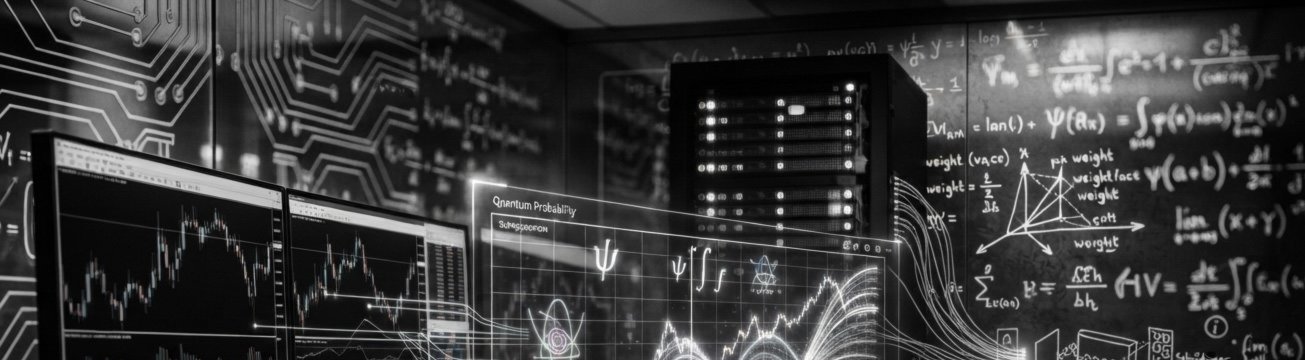
A few months ago, I got sucked down a rabbit hole inspired by quantum physics and quantum finance. The core idea sounds amazing on paper: instead of treating the market as a flat, deterministic time series, what if we view price action and volatility through the lens of superposition states and probability wave functions (similar to the Quantum Harmonic Oscillator or path integrals)?
Sounds super academic and cool, right? Well, translating that theory into actual, running MQL5 code is a whole different beast. Here is what I’ve learned so far—and where the friction hits hard.
The Brutal Reality of MQL5 Meets Quantum Math
- The Performance Bottleneck in OnTick() If you try to calculate complex probability amplitudes or solve matrix-heavy wave equations directly in pure MQL5 on every single tick, your terminal is going to choke. MetaTrader is fast, but it’s not built for heavy quantum simulations natively. I ended up having to spin up asynchronous Python scripts via ZeroMQ just to do the heavy lifting in the background and feed the data back to MT5. It works, but it adds architectural complexity.
- Decoherence vs. The Order Book In physics, measuring a quantum state causes wave function collapse (decoherence). In trading, the moment your order hits the broker, the "decoherence" is called slippage, spread, and latency. You can build the most elegant probability distribution in the world, but if the market's liquidity microstructures chew it up the second you execute, the math doesn't save you.
- The Overfitting Trap Historical backtesting with these models is dangerous. Because the mathematics are so flexible, it’s ridiculously easy to overfit your parameters to past market noise, tricking yourself into thinking you found the Holy Grail.
So, is it worth it?
Honestly? For retail trading through MT5, 90% of this stuff is pure academic overkill. The transaction costs and platform limitations will eat you alive if you treat it like a plug-and-play strategy.
However, the mental shift is valuable. Shifting away from rigid, lagging support and resistance lines toward thinking in terms of dynamic probability fields completely changes how you approach risk management and position sizing.
I’m still tinkering with it as a side project. Has anyone else here ever tried bridging the gap between non-standard mathematical models (like quantum finance or advanced physics concepts) and MetaTrader via DLLs or Python? Where do you draw the line between a genuinely useful edge and a massive waste of time?
Would love to hear your thoughts in the comments!
Cheers, Lukas Szyry