
A demo trading account is one of the best tools available to a new trader, but only when it is used seriously.
A demo account is not an arcade game, a place to take random oversized trades, or proof that a trading method will automatically work with real money. It is a training environment where you can learn platform skills, test a trading plan, practice risk management, and build habits before placing capital at risk.
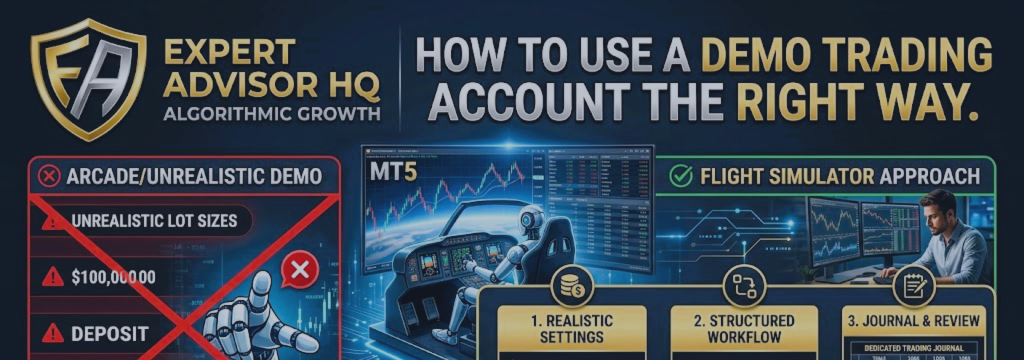
The best way to think about a demo account is as a flight simulator. A pilot does not use a simulator to prove that flying has no risk. The simulator is used to learn procedures, practice responses, identify mistakes, and build confidence before entering a real aircraft.
Trading should be approached in the same way. Use demo trading to practice decisions and processes that you intend to repeat on a live account.
Risk warning: A demo account uses virtual money. It does not expose you to real financial loss, real emotional pressure, or every possible live-execution condition. Forex, CFDs, futures, stocks, cryptocurrencies, and other financial instruments involve substantial risk. Demo results do not guarantee future live results.
What Is a Demo Trading Account?
A demo trading account is a simulated trading account that allows you to practice buying and selling financial instruments using virtual funds rather than your own money.
In MetaTrader 5, a demo account can be used to:
- Learn the platform interface.
- Practice opening and closing trades.
- Test market, limit, stop, and stop-limit orders.
- Learn how leverage, margin, spread, and swap work.
- Practice placing stop loss and take profit levels.
- Test a manual trading plan.
- Test an Expert Advisor or indicator.
- Practice position sizing and risk control.
- Record trades and review decision-making.
MetaTrader 5 describes demo accounts as training accounts that use virtual money and allow users to learn trading operations and test strategies without an initial financial investment. [123]
What a Demo Account Can Teach You
A demo account can teach several important skills that beginners often underestimate.
Platform Skills
Before risking real money, you should know how to use your trading platform confidently. This includes understanding how to:
- Open and close charts.
- Change timeframes.
- Add indicators and drawing tools.
- Find symbols in Market Watch.
- Place a market order.
- Place a pending order.
- Set stop loss and take profit levels.
- Modify an open trade.
- Cancel a pending order.
- Read the Trade, History, Experts, and Journal tabs.
- Check balance, equity, free margin, and margin level.
A beginner should not be learning these actions for the first time while real money is exposed to a fast-moving market.
Order Types
A demo account is a safe place to learn how different order types work.
| Order Type | General Purpose |
|---|---|
| Market Buy | Opens a buy position at the available market price. |
| Market Sell | Opens a sell position at the available market price. |
| Buy Limit | Requests a buy order below the current market price. |
| Sell Limit | Requests a sell order above the current market price. |
| Buy Stop | Requests a buy order above the current market price. |
| Sell Stop | Requests a sell order below the current market price. |
| Stop Loss | Defines a level intended to close a position if price moves against the trade. |
| Take Profit | Defines a level intended to close a position after a favorable price move. |
Do not assume an order type works exactly as you imagine. Practice each one in demo and observe how it behaves when price approaches, gaps through, or moves quickly around the order level.
Risk-Management Arithmetic
Demo trading is an excellent place to practice risk calculations. Before every trade, you should know:
- Your entry price.
- Your stop-loss price.
- Your trade volume.
- Your maximum loss if the stop loss is reached.
- Your target or exit plan.
- Your potential reward compared with the planned risk.
Many beginners focus only on whether price will rise or fall. Professional risk management begins with a different question:
“How much can I lose if I am wrong?”
A demo account helps you practice position sizing without financial pressure. This is valuable because correct position sizing is a skill, not an instinct.
Make Your Demo Account Realistic
One of the most common demo-account mistakes is using unrealistic settings. A large virtual balance can encourage oversized trades, excessive leverage, and drawdowns that would not be acceptable on a future live account.
If you expect to begin live trading with a small account, build your demo account around similar conditions.
Use a Realistic Starting Balance
Set the demo balance close to the amount you genuinely expect to deposit into a live account. If you expect to begin with $500, a $100,000 demo account will not teach realistic risk behavior.
A large demo balance can make losses feel irrelevant. It may also encourage a trader to use lot sizes that would be impossible or unsuitable on a smaller real account.
For example, losing $2,000 on a $100,000 demo account may feel insignificant. Losing $10 on a $500 account represents the same 2% loss, but it teaches a much more realistic lesson about risk.
Use Similar Leverage
Leverage affects how much margin is required to open and maintain positions. Use leverage that is similar to the account you intend to trade later.
High leverage does not reduce risk. It only allows a trader to control larger positions with less initial margin. A trader who uses excessive leverage can lose money quickly if position sizing is not controlled.
Use the Same Instruments
Practice on the symbols you genuinely intend to trade later. Every instrument behaves differently.
For example:
- EURUSD may have different spread and volatility behavior than GBPJPY.
- XAUUSD can move differently from major currency pairs.
- Indices, cryptocurrencies, and commodities may have different contract sizes, trading hours, and margin requirements.
- Broker symbol names may include prefixes or suffixes.
Do not build confidence by trading instruments you do not plan to trade live.
Use Similar Trading Hours
Trade during the same sessions you expect to trade on a live account.
If your plan is to trade the London session before work, practice during the London session. If you intend to trade New York-session breakouts, practice at that time. Trading randomly throughout the day does not prepare you for a strategy with specific session rules.
Risk a Fixed, Small Amount Per Trade
A demo account should help you build the habit of controlled risk. One practical way to do this is by using a fixed percentage of account equity per trade.
For example, a trader may decide that each trade will risk a small percentage of account equity. The exact percentage depends on the trader’s goals, strategy, account size, and tolerance for drawdown.
The important lesson is consistency. Do not risk a tiny amount on one trade and a very large amount on the next simply because one setup “feels better.”
A fixed-risk process can help you learn:
- How to calculate position size.
- How stop-loss distance affects volume.
- How losing streaks affect equity.
- Why a strategy can be right over time but still have losing trades.
- Why protecting capital is more important than trying to recover quickly.
Small fixed risk may feel less exciting in a demo account. That is exactly the point. The goal is to learn a process that can be repeated, not to create exciting screenshots.
Practice the Entire Trading Workflow
Do not use a demo account only to practice entries. A real trading process includes planning, execution, management, review, and risk control.
Every demo trade should follow a complete workflow.
Before the Trade
Before entering, write down:
- The symbol you are trading.
- The date and time.
- The market session.
- The timeframe used for analysis.
- The trading setup.
- The reason the setup is valid.
- The entry price.
- The stop-loss price.
- The target or exit plan.
- The position size.
- The monetary amount at risk.
- Any scheduled news or unusual market condition.
If you cannot explain why a trade is being taken before entering it, the trade may be based on impulse rather than a repeatable process.
During the Trade
While a trade is open, practice following the original plan.
Ask yourself:
- Am I managing this trade according to my written rules?
- Am I moving the stop loss for a valid reason or because I dislike being wrong?
- Am I closing early because the trade plan changed or because I feel nervous?
- Am I adding to a losing position without a tested rule?
- Has new information genuinely invalidated the setup?
Demo trading is where you should build the discipline to avoid impulsive changes. A random change may occasionally improve one trade, but it prevents you from learning whether the original method works over a large sample.
After the Trade
After every trade closes, record the result and review the process.
Your post-trade notes may include:
- Whether the trade followed the plan.
- Whether entry timing matched the setup rules.
- Whether position size was correct.
- Whether the stop loss and target were placed correctly.
- Whether you changed the trade without a valid rule.
- What market condition was present.
- What you would do differently next time.
Take screenshots before entry, during management if relevant, and after the trade closes. A visual journal makes it easier to identify repeated mistakes.
Use a Trading Journal
A trading journal turns demo trading from random practice into useful data.
Your journal can be a spreadsheet, notebook, database, or dedicated journal application. The format matters less than the consistency.
A simple journal may include the following columns:
| Journal Item | Purpose |
|---|---|
| Date and time | Shows when the trade was taken and which session was active. |
| Symbol | Shows which instrument was traded. |
| Setup type | Helps identify which setups perform best or create mistakes. |
| Entry and exit | Records the exact trade prices. |
| Stop loss | Confirms whether risk was defined before entry. |
| Position size | Helps review whether volume matched the risk plan. |
| Risk amount | Shows the planned maximum loss. |
| Result | Records profit or loss in money, points, or risk units. |
| Screenshot | Provides visual evidence of the setup and execution. |
| Rule followed? | Separates strategy performance from execution mistakes. |
| Post-trade note | Captures lessons and recurring errors. |
A journal should not be used only to record profits and losses. Its main purpose is to show whether you followed your own process.
Test a Written Trading Plan
A demo account is most useful when you have a written plan. Your plan does not need to be complex, but it should be clear enough that another person could understand the conditions for a trade.
A basic trading plan should define:
- Which markets you trade.
- Which timeframes you use.
- Which sessions you trade.
- What a valid setup looks like.
- What confirms an entry.
- Where the stop loss belongs.
- How position size is calculated.
- How take profit or exits are managed.
- How much you risk per trade.
- The maximum loss allowed per day or week.
- Which conditions prevent trading.
For example, a rule such as “buy when the chart looks strong” cannot be tested consistently. A rule such as “buy only when price retests H1 support and an M15 candle closes above the previous candle high during the London session” is more specific and can be reviewed historically.
Use Demo Trading to Test Your Psychology
Demo trading cannot fully reproduce the emotional pressure of real money. However, it can reveal habits that may become more harmful when you later trade live.
Watch for these behaviors:
- Taking trades without a setup because virtual losses do not feel important.
- Using huge position sizes because there is no real consequence.
- Opening many positions at once.
- Ignoring stop losses.
- Moving stops farther away after price moves against the trade.
- Trying to recover losses immediately.
- Changing strategy after only a few trades.
- Focusing on daily profit instead of process quality.
Real-money trading can amplify fear, greed, hesitation, and the urge to recover losses. A trader who practices careless behavior in demo is likely to carry those habits into a live account.
Demo and live accounts can also differ in execution conditions. Live trading may involve changing spreads, slippage, partial fills, and other conditions that a simulated environment may not reproduce in the same way. [121][124]
Practice Expert Advisors on Demo
A demo account is also important for traders who use Expert Advisors.
Before allowing an EA to trade a live account, use demo trading to check:
- Whether the EA installs correctly.
- Whether it appears in the Navigator window.
- Whether AutoTrading is enabled.
- Whether the EA is attached to the correct symbol and timeframe.
- Whether input settings are correct.
- Whether lot size or risk settings are appropriate.
- Whether stop loss and take profit levels are placed as expected.
- Whether the EA respects spread, session, and news filters.
- Whether it manages positions correctly.
- Whether the Experts and Journal tabs show errors or warnings.
Do not assume that an EA is ready for live trading because it has a good backtest. A demo forward test can reveal installation issues, broker symbol differences, execution behavior, and configuration mistakes.
Understand the Limits of Demo Trading
A demo account is useful, but it is not identical to live trading.
No Real Financial Consequences
The largest difference is that demo money is virtual. A demo loss may be disappointing, but it does not affect your bank account or personal finances.
Real money can change behavior. A trader who calmly follows a plan in demo may hesitate, close winners too early, move stops, or avoid valid entries when real capital is at risk.
Execution May Differ
Demo accounts may not reproduce every live execution condition. Depending on the broker and market conditions, live trading may experience:
- Spread widening.
- Slippage.
- Requotes or price changes.
- Partial fills.
- Order rejection because of margin or trading restrictions.
- Different liquidity during volatile conditions.
This is one reason why a strategy that appears strong in demo should still begin with conservative risk if it is later tested live.
Large Virtual Balances Distort Behavior
A trader who uses an unrealistic demo balance may learn unrealistic habits. A large balance can make a deep drawdown appear harmless, even though the same percentage drawdown may be emotionally and financially difficult on a smaller personal account.
Demo Success Is Not Statistical Proof
A few winning demo trades do not prove that a strategy is profitable. A strategy should be reviewed across a meaningful sample of trades and different market conditions.
One successful week may simply be a favorable market period. One losing week may simply be normal variation. The goal is to collect evidence over time, not to react emotionally to a small number of results.
Create Graduation Criteria
Moving from demo trading to live trading should not depend on one profitable week, one exciting trade, or a desire to “make real money now.” It should depend on whether you can follow a process consistently.
Consider creating written graduation criteria. For example:
- A minimum number of fully documented trades.
- No major risk-rule violations during the practice period.
- Consistent position sizing.
- Consistent use of stop loss and predefined exits.
- A complete trading journal with screenshots and notes.
- Evidence that you understand your strategy’s drawdown and losing streaks.
- Experience trading both winning and losing periods.
- Ability to explain the strategy clearly without changing rules after every trade.
Some traders choose to require 30 to 50 fully documented trades before considering a small live test. The appropriate number depends on the strategy frequency and complexity, but the principle is more important than the number: move forward only after demonstrating consistent behavior over enough examples.
How to Transition to a Live Account
Passing a demo stage does not mean training is finished. Moving to a live account is another stage of learning because real-money emotions and live execution conditions can change how you behave.
A cautious transition process may include:
- Begin with the smallest practical position size.
- Use the same setup rules that were tested in demo.
- Risk less than you think you can handle at first.
- Keep the same detailed trading journal.
- Do not increase size after a winning streak.
- Do not change the strategy after a small number of live trades.
- Review execution quality, spread, and slippage.
- Stop and reassess if you begin violating your risk rules.
The purpose of the first live stage is not to maximize profits. It is to learn whether you can apply the same discipline with real money involved.
A Simple Daily Demo Routine
A structured routine can make demo practice much more useful.
Before the Trading Session
- Check your account balance and risk limit.
- Review major scheduled economic events.
- Mark important support and resistance zones.
- Review your setup checklist.
- Decide which markets and sessions you will trade.
During the Trading Session
- Take only trades that meet your written rules.
- Calculate position size before entering.
- Place stop loss and target levels correctly.
- Take screenshots of valid setups.
- Do not exceed your daily trade or loss limit.
After the Trading Session
- Record every trade in your journal.
- Review whether every trade followed the plan.
- Save screenshots.
- Identify one mistake or one improvement point.
- Do not judge the day only by profit or loss.
Frequently Asked Questions
How long should I use a demo account?
Use a demo account until you can follow a written trading plan consistently across a meaningful number of trades and different market conditions. The goal is process consistency, not reaching a specific number of profitable days.
Should I use the same amount of money in demo as I will use live?
Yes, whenever possible. A realistic balance helps you practice realistic lot sizing, drawdown management, and risk decisions.
Can I learn trading completely from a demo account?
A demo account can teach platform skills, strategy execution, and risk-management procedures. It cannot fully reproduce the emotions and execution conditions of live trading. Treat it as essential preparation, not a complete substitute for cautious live experience.
Should I use a stop loss in demo trading?
Yes. If you plan to use stop losses on a live account, use them in demo. Practice the full process exactly as you intend to trade later.
Can I use a demo account to test an EA?
Yes. Demo forward testing is an important step for checking whether an EA works correctly under your broker’s conditions. Confirm that its settings, symbol, timeframe, risk controls, and order management behave as expected.
What if my demo strategy loses money?
A losing result is information, not a reason to increase risk or take random trades. Review whether the strategy was followed correctly, whether the sample size is meaningful, whether market conditions changed, and whether the rules need testing or refinement.
Final Thoughts
A demo account is most valuable when it is used with the same seriousness you plan to bring to live trading. Use realistic account settings, small and consistent risk, written trade plans, screenshots, and a complete journal.
Do not use demo trading to chase large virtual profits. Use it to build habits that protect your future capital: patience, risk control, consistent execution, careful review, and respect for uncertainty.
Risk disclosure: This article is for educational purposes only and does not constitute investment advice, a recommendation, or a guarantee of results. Trading forex, CFDs, futures, stocks, cryptocurrencies, and other financial instruments involves substantial risk. Demo-account results, backtests, and simulated performance do not guarantee live trading results.