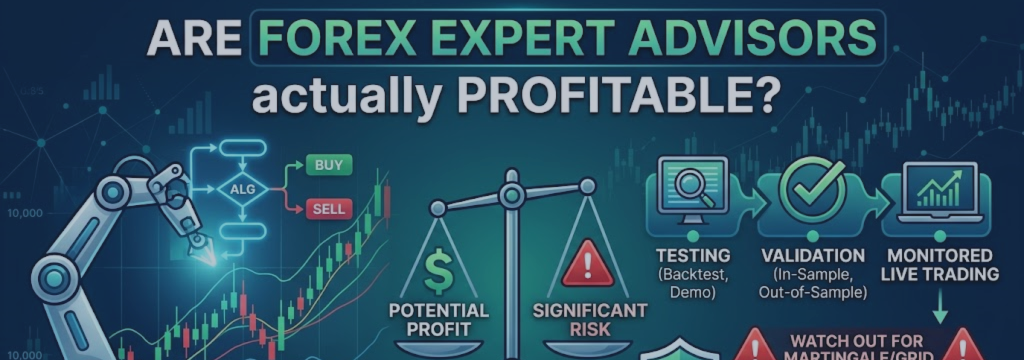

The honest answer is: some Expert Advisors can be profitable, many are not, and no EA can guarantee future profits.
An Expert Advisor, or EA, is software that follows programmed trading rules inside MetaTrader 5. It can monitor prices, calculate indicators, identify conditions, place orders, and manage open trades. However, automation does not create a trading edge by itself. An EA is only as good as its strategy logic, risk management, execution design, testing process, and ability to operate under changing market conditions.
A well-designed EA can help a trader apply rules consistently. A poorly designed EA can apply poor rules consistently and potentially create losses faster than a manual trader would.
This guide explains what profitable EA trading actually means, what to look for before using an EA, which warning signs to avoid, and how new traders can evaluate automated systems more responsibly.
Risk warning: Forex and CFD trading involve substantial risk. An EA can lose money, including more than expected if risk controls are weak or market conditions change rapidly. Past performance, backtests, demo results, and verified live results do not guarantee future performance.
The Honest Answer
Yes, an EA can be profitable. There are automated strategies based on legitimate trading concepts such as trend following, mean reversion, breakouts, volatility filters, statistical relationships, and systematic risk management.
But profitability is not permanent, automatic, or guaranteed. A strategy that worked in one market environment may struggle in another. For example, a trend-following system may perform well during sustained directional movement but experience repeated small losses in a choppy range. A mean-reversion strategy may perform well in stable conditions but face greater risk when price makes an unusually strong directional move.
The key question is not simply:
“Did this EA make money in the past?”
The more useful questions are:
- What trading logic does the EA use?
- What market conditions is it designed for?
- How does it control risk?
- How much drawdown has it experienced?
- Does it use stop losses?
- How sensitive is it to spread, commission, slippage, and broker conditions?
- Has it been tested on data that was not used to create it?
- Is there credible live evidence, not only a favorable backtest?
- Can your account tolerate losses larger than the historical maximum?
Profitable automated trading is not about finding a “set and forget” robot. It is about finding or building a strategy with a reasonable logic, then applying it with realistic expectations and disciplined risk control.
What Makes an EA Potentially Viable?
There is no single formula for a successful EA. However, more credible systems usually have several characteristics in common.
Clear and Testable Strategy Rules
A credible EA should have understandable rules, even if some proprietary details are not disclosed. You should know the general trading approach and when the system is intended to trade.
Examples of defined approaches include:
- Trend following based on moving averages, price structure, or volatility breakouts.
- Mean reversion after statistically unusual price movement.
- Session-based breakout trading during defined market hours.
- Range trading during low-volatility conditions.
- Multi-timeframe momentum confirmation.
- Portfolio systems that trade several instruments with controlled total exposure.
Be cautious when an EA description uses vague language such as “advanced AI,” “secret algorithm,” or “institutional strategy” without explaining the general risk model, trade behavior, or conditions under which the EA may struggle.
Defined Risk Management
Risk management is usually more important than finding a perfect entry signal. An EA should have a clear method for controlling position size and limiting losses.
Common risk-management features include:
- Fixed lot sizing.
- Risk-based position sizing using a percentage of equity.
- Stop-loss orders.
- Take-profit or time-based exit rules.
- Maximum number of simultaneous positions.
- Maximum trades per day.
- Maximum daily loss limit.
- Maximum equity-drawdown limit.
- Spread filters.
- Trading-session filters.
- News-event filters.
For example, a fixed-fractional approach may calculate position size so that a losing trade at its stop loss represents a predefined portion of account equity. This does not eliminate risk, but it can prevent trade volume from being chosen arbitrarily.
Hard Stops and Defined Exit Logic
Every EA should have a clear answer to this question:
“What happens if price continues moving against the trade?”
Some systems use a hard stop loss. Others use time exits, volatility exits, trend-reversal exits, or portfolio-level loss controls. The specific method can vary, but the risk should be measurable and understood.
An EA that appears profitable only because it allows losing positions to remain open indefinitely should be evaluated with extreme caution. Unrealized losses can make an account look stable until market movement exposes the full risk.
Realistic Treatment of Trading Costs
A strategy must survive real trading costs. These may include:
- Bid-ask spread.
- Commission.
- Swap or overnight financing.
- Slippage.
- Execution delay.
- Broker volume restrictions.
- Stop-level and freeze-level restrictions.
Trading costs are especially important for scalping systems and strategies that make many small trades. A strategy with a narrow historical edge can become unprofitable when actual spread and commission are included.
Market-Regime Awareness
Markets change. Volatility rises and falls, liquidity changes around sessions and news events, trends begin and end, and broker conditions can vary.
Some EAs include filters designed to avoid conditions where their strategy is less suitable. For example:
- A breakout EA may avoid low-liquidity hours.
- A mean-reversion EA may pause during extreme volatility.
- A scalping EA may avoid trading when spread exceeds a limit.
- A trend-following EA may use volatility or trend-strength filters.
- A portfolio EA may reduce exposure when correlated symbols are already open.
Filters do not guarantee safety, but they can make the strategy more selective and help align its trading behavior with its intended market environment.
Backtests: Useful but Not Proof
A backtest simulates how an EA would have traded on historical data. It is an important development tool, but it should never be treated as proof that the same result will occur in the future.
A credible backtest should use realistic assumptions, including:
- A meaningful historical period with different market conditions.
- Appropriate tick modeling for the strategy.
- Realistic spread, commission, and swap.
- Reasonable assumptions about slippage and execution delay.
- The correct broker symbol and contract specification where possible.
- A realistic account balance, leverage level, and position-sizing method.
For strategies that depend on intrabar movement, tight stops, pending orders, or scalping logic, use detailed tick-based testing whenever possible. Faster testing modes may be useful during early development, but they may not accurately represent the price movement required by the strategy.
Why an Attractive Backtest Can Mislead
A backtest can look impressive for reasons that have little to do with real strategy quality. Common issues include:
- Testing only a favorable market period.
- Using unrealistic low spreads or omitting commissions.
- Ignoring slippage during volatile periods.
- Using too little historical data.
- Over-optimizing inputs to fit past price movement.
- Using the same data for both development and evaluation.
- Hiding open floating losses in the final report.
- Using position-sizing methods that increase risk after losses.
A backtest should be treated as a hypothesis. It tells you what happened under the stated assumptions. It does not tell you what must happen next.
In-Sample, Out-of-Sample, and Forward Testing
One way to evaluate an EA more honestly is to separate development data from evaluation data.
In-Sample Testing
In-sample data is the historical period used to develop the strategy, choose settings, or optimize parameters. It is useful, but it is also the easiest place to create overfitting because the developer can keep adjusting settings until the historical report looks good.
Out-of-Sample Testing
Out-of-sample data is historical data that was not used to build or optimize the strategy. Once the strategy settings are locked, the EA is tested on this untouched period.
If the EA performs reasonably across both periods, that may be more encouraging than a system that performs exceptionally well only on the data used to create it.
Forward Testing
Forward testing means running the EA on new market data after development. This can be done on a demo account or with very conservative live risk.
Forward testing helps reveal differences between historical simulation and real operating conditions, including:
- Live spread behavior.
- Execution quality.
- Slippage.
- Broker symbol differences.
- Network or VPS issues.
- Input configuration mistakes.
- Behavior during new market conditions.
Forward testing does not guarantee future performance either, but it is an important step before committing significant capital.
Warning Signs to Avoid
Not every high-performing EA is fraudulent, and not every grid or averaging system will fail immediately. However, certain features deserve careful scrutiny because they can hide risk or create misleading historical results.
Martingale Position Sizing
Martingale strategies increase trade size after losses in an attempt to recover previous losses with a later winning trade. This can produce long sequences of small wins, but the required position size can grow rapidly during an extended losing sequence.
The main risk is that the account may run out of margin or exceed its acceptable drawdown before the recovery trade occurs.
Before using any EA, check whether its lot size increases after losses, whether it uses recovery multipliers, and whether it can open increasingly large positions during unfavorable market movement.
Grid Systems Without Defined Risk Limits
A grid system may place multiple buy or sell orders at preset price intervals. Some grid systems use strict limits and risk controls. Others continue adding exposure as price moves against the original position.
A grid can appear stable during normal price movement because it may close baskets of trades after small reversals. The danger can appear during a sustained trend or unusually large market move, when the system accumulates exposure without a clearly defined maximum loss.
If an EA uses a grid, ask:
- What is the maximum number of grid orders?
- What is the maximum total volume?
- Is there a hard account-level stop?
- What happens if price trends much farther than expected?
- Has the system been tested through major volatility events?
Extremely High Win Rates Without Context
A high win rate is not automatically good. An EA can win frequently while occasionally taking losses that are much larger than its normal gains.
For example, an EA that earns many small profits but allows rare, very large losses may look attractive until a difficult market period occurs. Always compare win rate with:
- Average winning trade.
- Average losing trade.
- Largest historical loss.
- Maximum drawdown.
- Maximum consecutive losses.
- Use of stop losses.
- Use of averaging or recovery methods.
Only Screenshots, No Verifiable Evidence
A screenshot can be edited, selective, or incomplete. It may not show deposit history, floating drawdown, closed losses, account type, leverage, risk settings, or the full trading history.
Stronger evidence may include a verified trading record through an independent tracking service or an MQL5 signal with visible account statistics. Even then, verify what you are looking at. A record should be reviewed for duration, drawdown, deposits, withdrawals, trade history, lot sizing, and consistency.
Guaranteed Returns or “No Loss” Claims
No EA can honestly guarantee profits or guarantee that losses will never occur. Financial markets are uncertain, and execution conditions can change.
Be cautious of phrases such as:
- “Guaranteed monthly income.”
- “No drawdown.”
- “Never loses.”
- “Risk-free EA.”
- “Turn a small account into a large account quickly.”
- “Works in every market condition.”
Professional trading communication should describe risk as clearly as potential opportunity.
EA Due-Diligence Checklist
Before buying, renting, downloading, or deploying an EA, work through the following checklist.
1. Understand the Strategy Type
- Does the description explain the basic trading approach?
- Does the EA trend follow, mean revert, scalp, trade breakouts, use a grid, or average positions?
- What symbol or symbols does it trade?
- What timeframe does it use?
- What sessions does it trade?
- Which market conditions are likely to be difficult for the strategy?
2. Check the Risk Model
- Does the EA use a stop loss or other clearly defined exit protection?
- How is trade volume calculated?
- Does volume increase after losses?
- Can multiple positions be open at the same time?
- What is the maximum total exposure?
- Does it have daily loss or drawdown protection?
- What is the largest historical drawdown?
- Can you tolerate a drawdown larger than the historical maximum?
3. Review the Backtest Carefully
- How many years of data were tested?
- How many trades were generated?
- Were spread, commission, and swap included?
- Was an appropriate tick-modeling method used?
- Were the results tested outside the optimization period?
- Does the strategy remain reasonable with slightly different settings?
- Are there unusually large open floating losses?
- Does the equity curve depend on one short favorable period?
4. Review Live or Forward-Test Evidence
- Is there a verified live or forward-tested record?
- How long has it been operating?
- Does the record show trading history, drawdown, and account conditions?
- Are deposits and withdrawals visible or explained?
- Does the live behavior resemble the claimed backtest behavior?
- Was the result achieved with the same broker, account type, and risk settings you plan to use?
5. Verify Broker Compatibility
- Does your broker offer the required symbol?
- Does the symbol name include a prefix or suffix?
- Is your spread and commission structure similar to the tested account?
- Does the EA require a raw-spread, ECN, standard, or another account type?
- Are your leverage and margin conditions suitable?
- Does the EA use broker-server time for its session settings?
6. Review Developer Support and Documentation
- Are installation instructions clear?
- Does the documentation explain all important inputs?
- Does the developer publish updates when platform or broker conditions change?
- Is there a clear support channel?
- Is the product description transparent about risks and limitations?
- Are there recent user reviews that describe support quality and actual setup experience?
How to Start Safely With an EA
Even after thorough research, do not begin with your maximum intended risk. A safer staged process is:
- Read the documentation and understand every major input.
- Run the EA in the MetaTrader 5 Strategy Tester.
- Use Visual Mode to inspect example entries and exits.
- Test the EA on a demo account under your broker’s conditions.
- Check the Experts and Journal tabs for errors or warnings.
- Compare live spreads and trade behavior with the expected settings.
- Use very conservative risk if you decide to forward-test on a live account.
- Monitor drawdown, execution, open exposure, and system behavior regularly.
- Increase risk only if you fully understand the strategy and accept the potential loss.
Do not assume that an EA is safe because it has not lost recently. Risk can accumulate quietly, especially in strategies that average losing positions or delay taking losses.
What Results Should You Expect?
There is no universal “normal” return for a forex EA. The relationship between return and risk varies widely by strategy, market, broker, leverage, trade frequency, and position sizing.
Higher historical returns often come with higher drawdown, larger exposure, more leverage, more dependence on favorable conditions, or a greater risk of severe loss. A lower-return system with controlled drawdown and understandable risk may be more sustainable than a high-return system that depends on large recovery trades.
Instead of asking only, “How much can this EA make?” ask:
- What is the worst plausible loss I can accept?
- How large has historical drawdown been?
- What happens if future drawdown is larger than historical drawdown?
- How much leverage and margin does the system use?
- Can I remain disciplined during a long losing period?
- Does this EA fit my account size and risk tolerance?
A responsible trader chooses risk first and return expectations second.
Frequently Asked Questions
Can an EA trade forex without supervision?
An EA can monitor the market and send orders automatically while MetaTrader 5 is running and connected. However, it should still be supervised. Markets, broker conditions, internet connections, VPS services, and strategy performance can change.
Is a verified live account enough proof that an EA is safe?
No. A verified account can provide stronger evidence than a screenshot, but it does not remove risk. Review the duration, drawdown, risk settings, trade history, account type, deposits, withdrawals, and strategy behavior.
Does a high win rate mean an EA is good?
No. A high win rate can hide large occasional losses. Review average win, average loss, maximum drawdown, stop-loss behavior, position sizing, and the strategy’s response to extended adverse movement.
Are grid EAs always bad?
Not necessarily, but grid strategies require especially careful risk analysis. The critical question is whether exposure, position count, lot size, and maximum loss are firmly limited under prolonged directional movement.
Can I use the same EA settings on every broker?
Not always. Symbol specifications, spread, commission, leverage, server time, swap, execution conditions, and symbol names can differ between brokers. Test the EA using your intended broker and account type.
Should I use an EA on a real account immediately?
No. Begin with testing and forward validation. A demo account helps verify installation and behavior, while a small-risk live test can reveal real execution differences. Do not risk capital you cannot afford to lose.
Final Thoughts
Forex EAs can be useful trading tools, but they are not automatic money machines. A credible EA should have understandable logic, defined risk controls, realistic testing, transparent evidence, and ongoing monitoring.
The most important skill is not finding the most exciting equity curve. It is learning how to identify hidden risk, test assumptions, control exposure, and reject systems that make promises they cannot support.
Risk disclosure: This article is for educational purposes only and does not constitute investment advice, a recommendation, or a guarantee of results. Forex, CFDs, futures, cryptocurrencies, and other leveraged financial instruments involve substantial risk. Past performance, backtests, simulations, and live records do not guarantee future results.