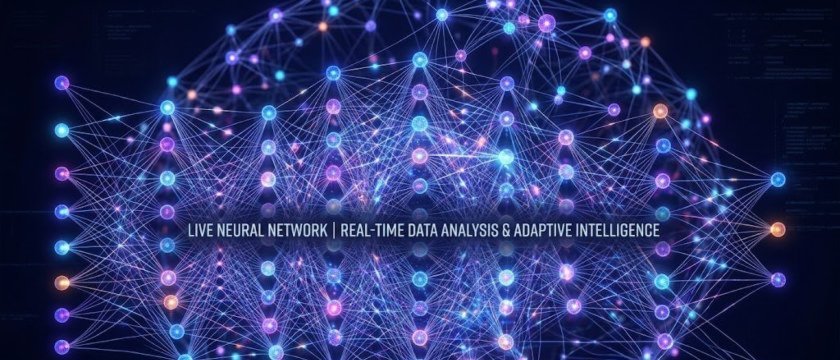
The Boltzmann Matrix: How Energy-Based AI Models Revolutionize Neural Network Architecture

The financial markets are no longer linear systems. Traditional technical analysis relies on indicators that stem from an era when data streams were calculated in hours or days. Today, in a fast-paced landscape dominated by high-frequency trading, algorithmic market makers, and institutional liquidity sweeps, the market operates as a highly dynamic, non-linear, and chaotic environment.
To extract a sustainable statistical edge from these environments, standard forward-facing neural networks are often limited because they cannot easily compute deep, hidden structural probabilities. The answer to navigating this market complexity lies in a completely different, energy-based stochastic model that bridges the gap between statistical physics and computational intelligence: The Boltzmann Machine.
This comprehensive architectural guide analyzes the inner workings of Boltzmann AI, its deep-learning frameworks, its structural evolution alongside canonical neural networks, and how we deploy these energy models at ICONIC.FX to achieve unprecedented capital protection.
1. What is a Boltzmann Machine and How Does It Function?
A Boltzmann Machine is a type of stochastic recurrent artificial neural network named after the physicist Ludwig Boltzmann. Unlike standard feedforward networks that pass information linearly from input to output layers, a Boltzmann Machine operates as an unsupervised generative model designed to discover hidden internal representations and dependencies within high-dimensional datasets.
The Energy-Based Framework
The core architectural differentiator of a Boltzmann Machine is that it is an energy-based model. Instead of just mapping an input directly to an output, the state of the entire network is defined by a global energy function. The network learns by systematically minimizing this energy, similar to how physical systems naturally settle into a state of thermal equilibrium.
The configuration of the network's internal units assigns a specific energy level to every possible state. Lower energy states represent highly stable, highly probable structural configurations, while high-energy states signify statistical anomalies, imbalances, or random noise.
The probability of the network settling into a specific global state is determined strictly by a thermodynamic distribution. At a high pseudo-temperature, the network actively explores a highly varied energy landscape to avoid getting stuck in local traps. As this temperature parameter cools toward zero, the system's decisions settle into highly stable, low-energy, and high-probability configurations.
2. Structural Evolution: General vs. Restricted vs. Deep Boltzmann Machines
As a computational medium, the structural connectivity of a Boltzmann Machine directly dictates its efficiency, learning speed, and scalability in high-dimensional environments.
A. General Boltzmann Machines
In a Full or General Boltzmann Machine, every single neuron is symmetrically connected to every other neuron in the network. The units are broadly categorized into visible units—which interact directly with environmental data inputs—and hidden units, which act as latent variables to explain underlying statistical features.
While highly expressive, this unconstrained connectivity makes general Boltzmann machines practically impossible to scale. The training process requires running incredibly slow, iterative sampling algorithms across the entire fully connected topography, resulting in extreme computational bottlenecks.
B. Restricted Boltzmann Machines (RBM)
To eliminate the massive computational overhead of unrestricted connectivity, the architecture was modified to create the Restricted Boltzmann Machine (RBM). An RBM restricts connectivity by enforcing a strict bipartite graph structure: visible units connect to hidden units, but no connections are allowed within the same layer.
Because the hidden units are conditionally independent given a specific visible input vector, unbiased samples can be calculated in parallel steps. RBMs utilize an efficient training routine called Contrastive Divergence, which approximates the necessary mathematical gradients using short, fast sampling chains, drastically compressing the required training times.
C. Deep Boltzmann Machines (DBM)
Deep Boltzmann Machines extend the RBM framework by stacking multiple layers of hidden units hierarchically. Unlike Deep Belief Networks (DBNs)—which utilize top-down directed connections—DBMs feature completely undirected, bidirectional connections between all layers.
This bidirectional data flow allows the network to simultaneously execute bottom-up and top-down inference routines. As raw data moves up through the network, the higher levels pass abstract representations back down, allowing the deep system to accurately reconstruct complex, high-level features from noisy data.
3. Structural Synergy: How Boltzmann AI Complements Canonical Neural Networks
A common architectural misconception is that energy-based models compete directly with standard deep learning setups. In modern institutional artificial intelligence systems, Boltzmann Machines are deployed as complementary infrastructures that resolve the intrinsic vulnerabilities of canonical architectures.
The Problem of Weight Initialization
Standard deep feedforward networks and deep Convolutional Neural Networks (CNNs) are highly sensitive to initial parameter values. If weights are initialized randomly, deep networks frequently suffer from severe training issues, such as the vanishing or exploding gradient problem during standard training runs, which paralyzes the network's ability to learn.
Layer-by-Layer Generative Pre-Training
Stacked RBMs or Deep Boltzmann Machines solve this by executing an unsupervised, layer-by-layer greedy pre-training phase. By treating the latent feature outputs of one RBM layer as the visible data inputs for the next layer, the stacked architecture maps the structural distribution of the data without requiring any external labels or human intervention.
Once this unsupervised generative phase completes, the weights are already in a highly optimized state. The model can then be fine-tuned using standard training routines to perform supervised classification or regression tasks with maximum accuracy and minimal additional training time.
4. Disrupting Quantitative Finance: Boltzmann AI in Market Infrastructure
While the broader retail market remains fixated on simple moving averages or basic linear trading bots, institutional quantitative desks leverage the probabilistic nature of Boltzmann AI to analyze chaotic market microstructures.
Multi-Dimensional Market Generators
A major bottleneck in developing robust quantitative trading strategies is the lack of historical data across diverse market regimes. Testing a system purely on historical paths leads to severe overfitting bias, meaning it excels in the past but fails in the live market.
Deep Boltzmann Machines are deployed as highly advanced market generators. By learning the underlying probability distribution of historical time-series data, an RBM can generate synthetic asset price paths that perfectly preserve real-world statistical moments—such as skewness, extreme tail events, and non-linear volatility clustering. This allows quantitative infrastructures to backtest strategies across thousands of realistic, synthetic market environments.
Early Warning Systems for Regime Shifts
Financial markets undergo rapid transformations, moving from orderly consolidations to high-volatility structural breakdowns. Because Boltzmann Machines evaluate data based on global energy states, they excel at spotting structural anomalies.
When real-time returns and order flow sequences shift from a normal baseline, the energy state of the Boltzmann network spikes. This dynamic shift allows institutional systems to flag market bubbles, liquidity crunches, and impending flash crashes long before standard trailing indicators register a trend change.
5. The Architecture of ICONIC.FX: Strategic Deployment of Boltzmann AI and Advanced Neural Layers
At ICONIC.FX, our development philosophy is absolute: we reject generic performance theater and fragile retail tools in favor of a resilient, mathematical Clean Risk Architecture. We have engineered our core applications around a precise, multi-layered machine learning framework designed to protect principal equity at all costs.
ICONIC BTC AI: High-Dimensional Feature Extraction
The Bitcoin (BTCUSD) market is defined by intense volatility, complex derivatives positioning, and rapid liquidity sweeps. The ICONIC BTC AI executes order routing based on a hybrid neural network model.
Before trade execution occurs, stacked restricted Boltzmann layers perform continuous feature extraction on raw tick-level order book data. The generative nature of the network filters out artificial retail noise, isolating institutional volume blocks and structural support matrices. This algorithmic setup allows the execution layer to capture directional alpha under a strict No-Grid, No-Martingale risk parameter.
ICONIC NEUROCORE AI: Generative Governance and Risk Shielding
Operating as the overarching cognitive governor of our system, the ICONIC NEUROCORE AI leverages advanced reinforcement learning and energy-based modeling. It utilizes a continuous Boltzmann-like stochastic distribution layer to assess the health of the current trading environment.
Rather than looking at isolated price points, the Neurocore Engine computes the global statistical energy of current market movements. If the market structure displays an anomalous, high-energy profile that conflicts with our learned safety models, the system flags a high-probability regime shift. The engine immediately activates our Adaptive Volatility Shield, automatically reducing position sizes, adjusting stop-loss structural thresholds, or sidelining execution to shelter portfolio equity from market anomalies.
Conclusion: The Era of Pure Computational Supremacy
The evolution of quantitative finance has established a clear boundary: human emotion, manual charting, and static retail bots cannot withstand high-frequency, institutional algorithmic systems. The integration of Boltzmann AI and multi-layered neural networks represents the baseline standard for sustaining a long-term statistical advantage.
By combining the structural pattern extraction of the ICONIC BTC AI with the predictive capital protection of the ICONIC NEUROCORE AI, we isolate execution from human error and establish a disciplined, highly secure approach to automated trading.
Are you ready to integrate institutional-grade quantitative infrastructure into your portfolio?
Stop relying on emotional execution. Explore our fully automated trading models and secure an exclusive allocation via our official MQL5 Copytrading Signal Service.