![[iVISTscalp5 indicator]:Timing Work Schedule](https://c.mql5.com/6/1006/splash-770360.png "[iVISTscalp5 indicator]:Timing Work Schedule")

iVISTscalp5 indicator: Timing Work Schedule
One of the most important elements
when working with timings
is the correct market observation schedule.
Inside TLV (Time Language VISTmany),
time is considered
one of the key components
of market movement.
Because of this:
analysis timing
active trading hours
and market behavior during different sessions
become extremely important.
⸻
Professional Traders
Professional traders usually choose:
their own trading hours
active analysis periods
and timing workflow independently
Why?
Because experience allows them:
to quickly evaluate context
understand market structure
identify liquidity conditions
and adapt to different market phases
An experienced trader
can effectively work:
during any trading session
and almost any time of day
⸻
Recommendation for Most Traders
My recommendation
is not a strict rule.
All traders:
live in different countries
have different time zones
different lifestyles
and different levels of experience
Therefore,
comfortable trading hours
should always be selected individually.
However,
for studying timings
and reducing risks,
I consider the following periods
to be the most comfortable:
03:00–16:00 (UTC)
07:00–16:00 (UTC)
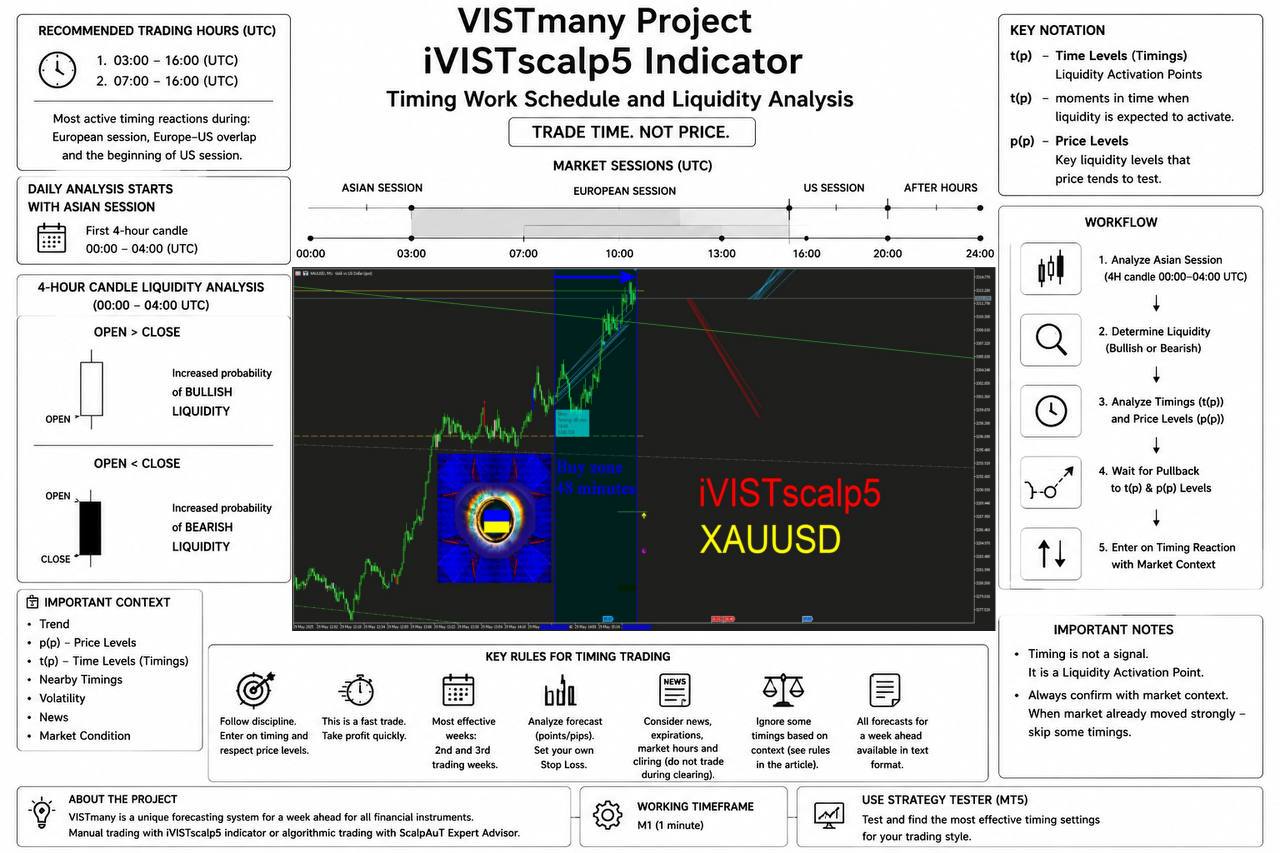
Why these periods?
During these hours:
major global trading sessions are active
liquidity increases
the market produces stronger timing reactions
and more intraday movement appears
Especially important:
the European session
the Europe–US overlap
and the beginning of the US session
During these periods:
Liquidity Activation Points (timings)
often become significantly more active.
How the Trading Day Analysis Begins
Every trading day for me
starts with analyzing
the Asian session.
The first thing I observe:
the four-hour candle
formed between:
00:00–04:00 (UTC).
Analysis of the First 4H (UTC) Candle
If:
OPEN > CLOSE
then there is an increased probability
that bullish liquidity
is present inside the market.
If:
OPEN < CLOSE
then probability is more often
on the side of bearish liquidity.
This analysis:
is not a direct trading signal.
But it helps:
understand the character of the day
identify market condition
and evaluate possible intraday liquidity direction
After this,
I proceed
to timing analysis.
⸻
What Is Important When Working With Timings
A timing
is not an order to enter the market.
A timing is:
a Liquidity Activation Point
(a moment of liquidity activation).
Because of this,
it is always necessary to analyze:
market context
trend condition
p(p) (Price Levels)
t(p) (Time Levels)
news
volatility
and nearby timings
⸻
Especially important:
if the market has already made
a strong directional movement,
some timings
are better ignored.
Context is always more important
than an isolated signal.
⸻
Scalping and Fast Scalping
During:
scalping
fast scalping
some impulses
may last only a few minutes.
Because of this:
market observation timing
becomes critically important.
The more a trader:
researches the market
observes timing structures
analyzes liquidity reactions
the better they begin to understand:
how time behaves inside the market.
⸻
Market Research
TLV (Time Language VISTmany)
is not only about trading.
It is primarily:
the study of interaction
between time and price.
Because of this:
continuous observation,
testing,
and market analysis
become an essential part
of trader development.
For this process,
the MT5 Strategy Tester
is an excellent tool.
It allows traders to simultaneously study:
movement activation timing
major price levels
timing structures
and liquidity reactions
iVISTscalp5 indicator - Welcome to the world of time!
The system projects time, direction, and expected movement
through Liquidity Activation Points (timings). Timing-Based Market Forecasting System


![[EURUSD]: Weekly Liquidity Activation Points (LAP), October 12-16, 2026](https://c.mql5.com/6/1035/splash-preview-777305.png "[EURUSD]: Weekly Liquidity Activation Points (LAP), October 12-16, 2026")