![[Two Different Approaches to Market Timing]: The Spiral Calendar and the VISTmany Research Project](https://c.mql5.com/6/1012/splash-771691.png "[Two Different Approaches to Market Timing]: The Spiral Calendar and the VISTmany Research Project")
[Two Different Approaches to Market Timing]: The Spiral Calendar and the VISTmany Research Project

Two Different Approaches to Market Timing:
The Spiral Calendar and the VISTmany Research Project
Introduction
One of the most challenging questions in financial market research is whether market behavior contains recurring time structures.
Most technical analysis methods focus on price. However, a number of researchers have attempted to place time itself at the center of market analysis.
Among these approaches, two particularly interesting methodologies can be compared:
*Christopher Carolan’s The Spiral Calendar
*The VISTmany research project and the iVISTscalp5 indicator
Although both approaches investigate timing phenomena, they are built on fundamentally different concepts.

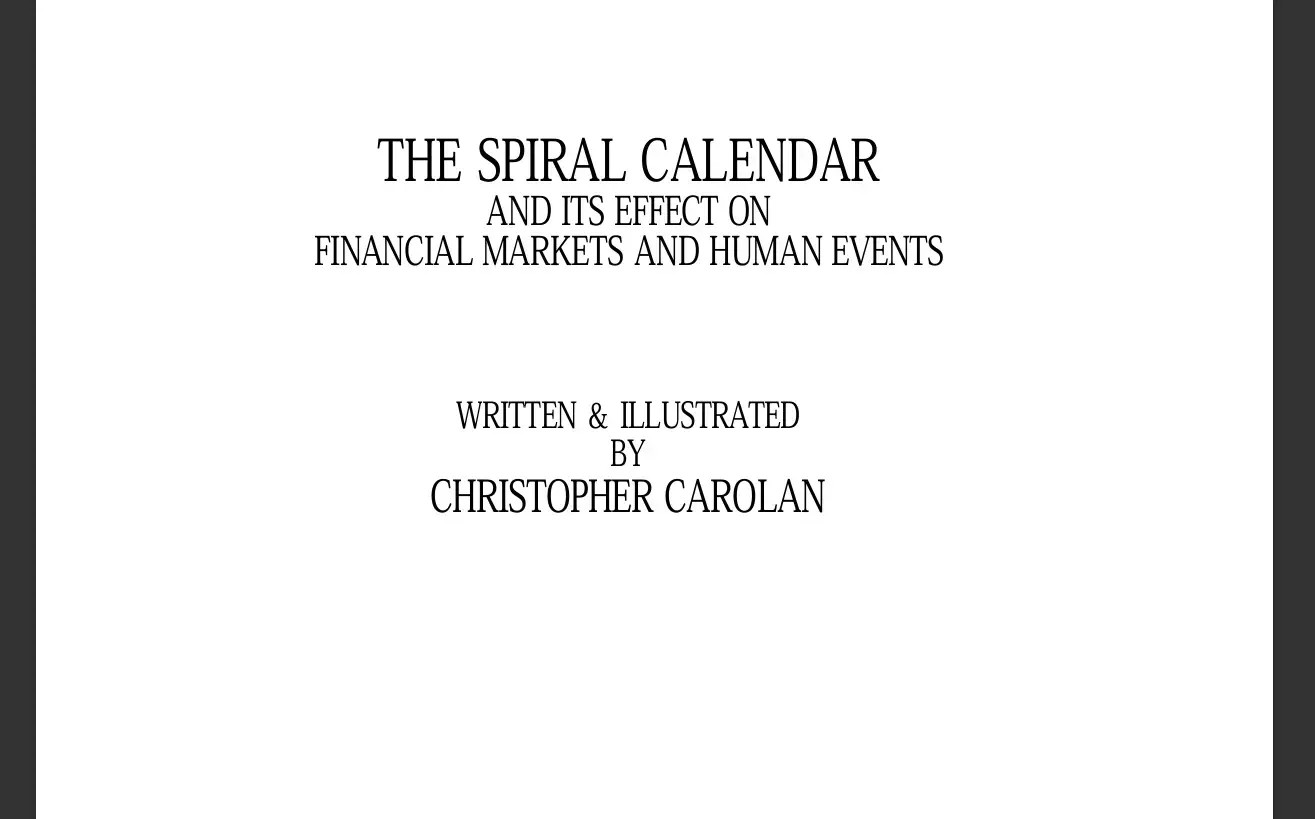
Christopher Carolan’s Spiral Calendar
Christopher Carolan introduced the concept of the Spiral Calendar as an alternative approach to market timing.
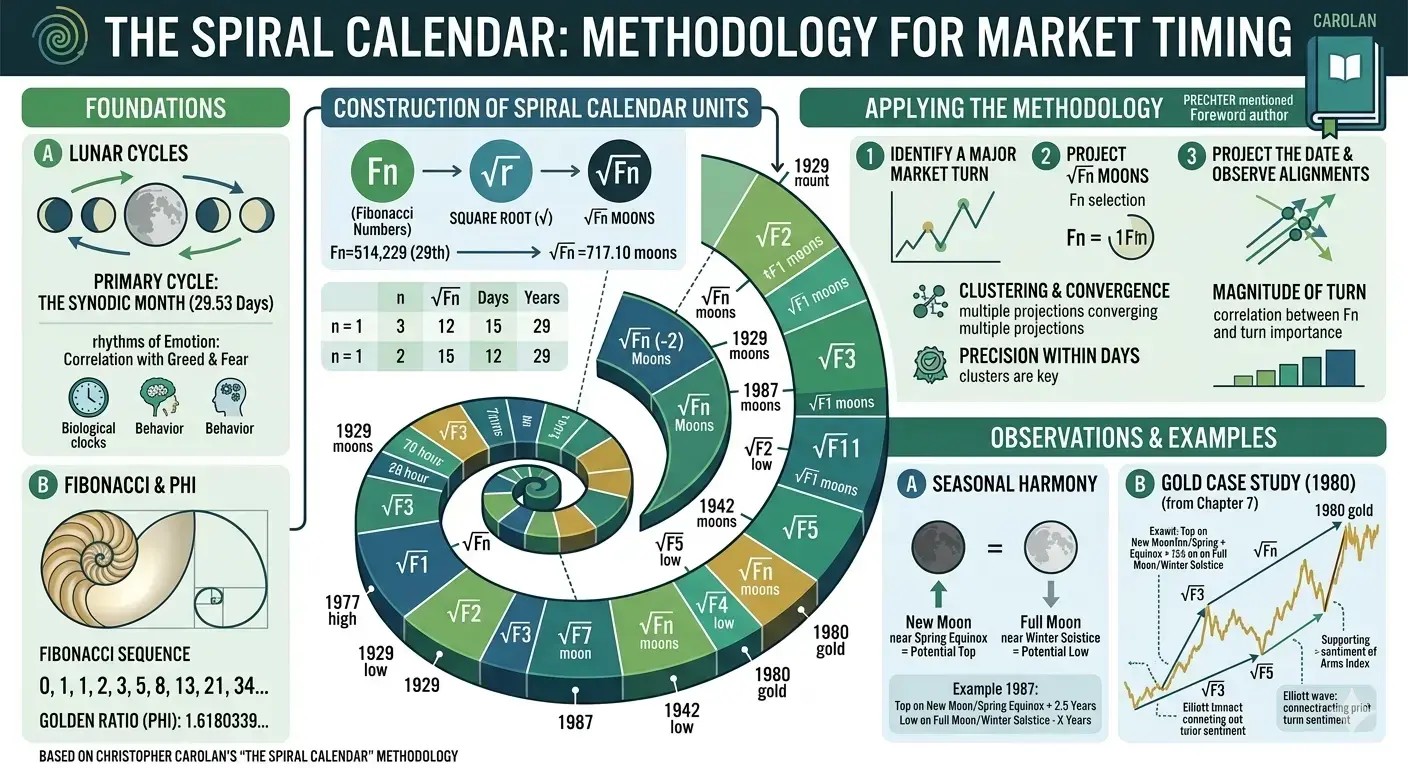
The methodology is based on several key elements:
Lunar cycles
The synodic month
Fibonacci numbers
Golden ratio relationships
Spiral time projections
The main idea is to identify a significant market turning point and project future dates using mathematical relationships derived from Fibonacci numbers and lunar cycles.
In this framework:
A major high or low is selected.
Fibonacci-based intervals are calculated.
Time projections are generated.
Clusters of projected dates are analyzed.
Potential reversal windows are identified.
The primary objective is to forecast future market turning points.
The market is viewed as a system that may respond to recurring natural cycles.
⸻
The VISTmany Research Project
The VISTmany project approaches the problem from a different direction.
Instead of beginning with predefined astronomical or mathematical cycles, the project studies temporal structures emerging directly from market behavior.
The central research question is:
Can market movements be associated with recurring timing activation structures?
The project introduces its own analytical language known as:
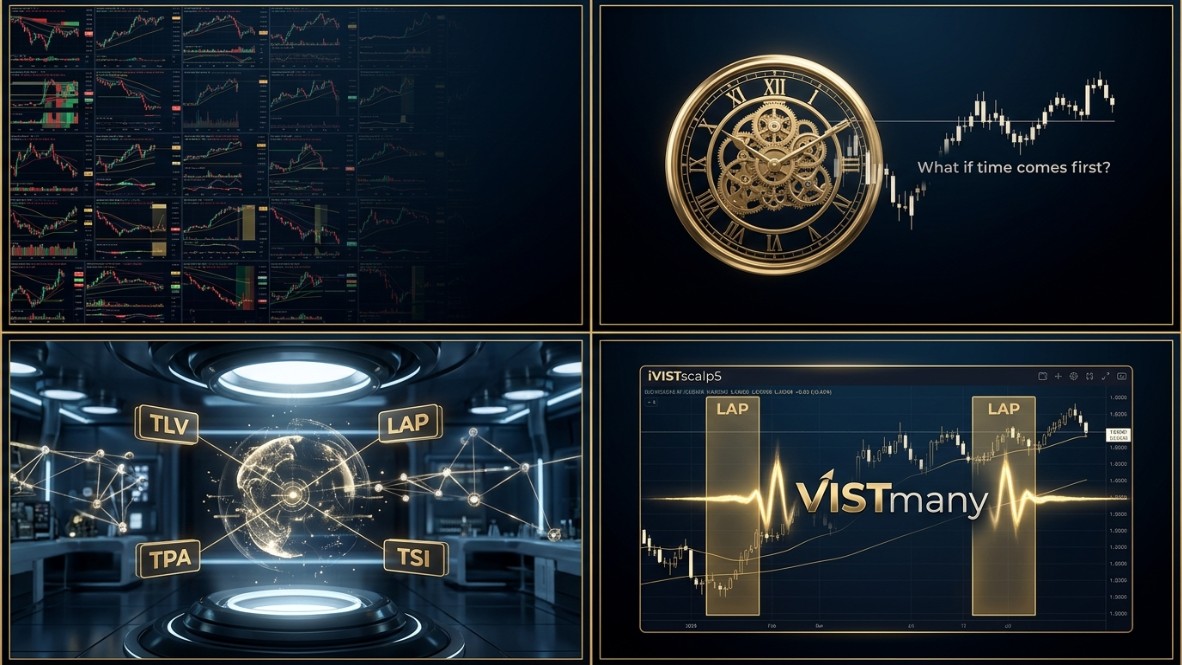
TLV — Time Language VISTmany
The framework consists of several core concepts:
LAP — Liquidity Activation Points
Moments when market activity becomes activated and the probability of directional movement increases.
t(p)
Price levels where timing activation occurs.
p(p)
Price levels generated by the iVISTscalp5 system.
TPA — Time Price Alignment
Interaction between timing structures and price structures.
TSI — Timing Strength Index
A measure used to evaluate timing concentration and momentum clustering.
Different Research Philosophies
The most important distinction between the two methodologies lies in their starting assumptions.
Spiral Calendar
Starts with:
Lunar cycles
Fibonacci relationships
Geometric projections
External natural structures
The researcher projects future dates from a predefined model.
VISTmany
Starts with:
Market behavior
Timing activations
Liquidity structures
Temporal clustering
The researcher studies structures that emerge from the market itself.
One approach is primarily projection-based.
The other is observation-based.
⸻
Market Interpretation
Within the Spiral Calendar framework, timing originates from external cyclical structures.
Within the VISTmany framework, timing is treated as an internal property of market behavior.
The VISTmany project views the market as a dynamic system of temporal events where liquidity activation may precede observable price movement.
This idea is summarized by one of the project’s central statements:
“The market moves when time activates price.”
⸻
Practical Implementation
The Spiral Calendar is primarily a research methodology.
The VISTmany project additionally includes a practical implementation through the iVISTscalp5 indicator.
The indicator is designed to study:
Timing activations
Directional expectations
Average movement ranges
Momentum clusters
Time-price interactions
The system currently generates forecast structures one week ahead and is being expanded into a broader research laboratory for studying timing behavior across multiple financial markets.
Conclusion
Both methodologies attempt to address the same fundamental question:
Does time play a larger role in market behavior than traditional technical analysis assumes?
However, they approach this question from very different perspectives.
The Spiral Calendar seeks timing through natural cycles and mathematical projections.
The VISTmany project seeks timing through the study of market-generated temporal structures and liquidity activation behavior.
Whether one approach proves more effective than another remains a matter for ongoing research.
What is clear is that both methodologies encourage traders and researchers to look beyond price alone and consider the role of time as a potentially important component of market dynamics.
*************************************************************
Sincerely,
VISTmany Team
****************************************************************************
iVISTscalp5 indicator - Welcome to the world of time!
https://substack.com/home/post/p-202442006
The system projects time, direction, and expected movement
through Liquidity Activation Points (timings). Timing-Based Market Forecasting System