![[TLV]: Timing Activation and Timing Zone Test](https://c.mql5.com/6/1006/splash-770309.jpg "[TLV]: Timing Activation and Timing Zone Test")

TLV: Timing Activation and Timing Zone Test
Liquidity Activation Point → Impulse → Test
One of the most important behavioral models inside the TLV (Time Language VISTmany) framework is:
👉 activation → impulse → test of the activation zone
This structure appears very frequently during live market timing behavior.
⸻
Core Idea
A Liquidity Activation Point (timing) is not simply a “signal”.
It is:
👉 a movement activation zone.
When time activates price, the market often:
creates an impulse,
returns back,
and tests the timing activation zone.
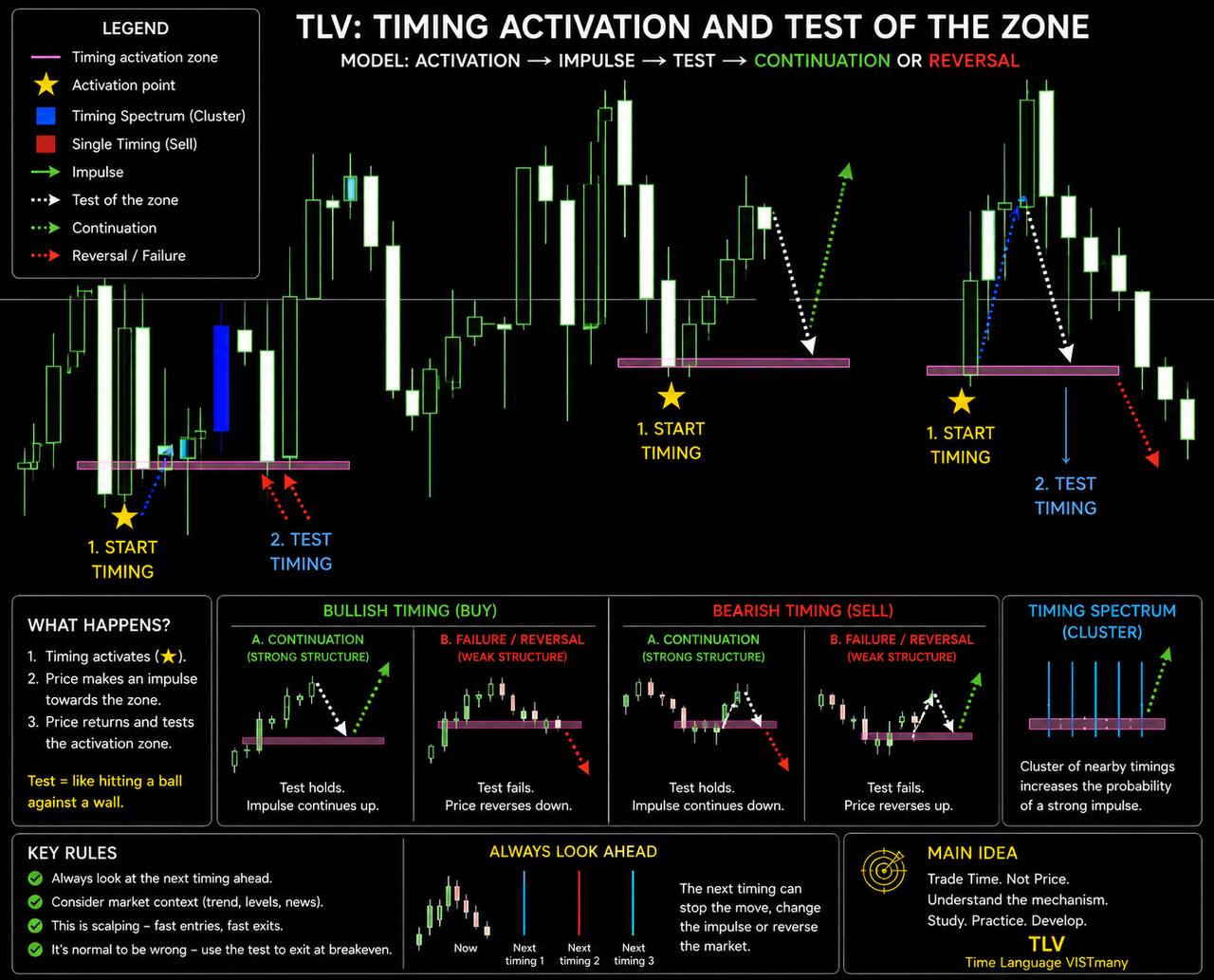
What Is a Timing Zone Test
A test is a strength check of the timing zone.
A very good analogy is:
👉 throwing a ball against a wall.
The market:
hits the timing zone,
reacts,
comes back,
and checks whether the structure still holds.
⸻
How It Looks in Practice
Buy Timing
First:
a buy timing appears,
the market impulsively moves upward,
then price pulls back,
and tests the activation zone from above.
If the structure remains strong:
👉 the upward movement may continue.
⸻
Sell Timing
First:
a sell timing appears,
the market impulsively moves downward,
then price retraces upward,
and tests the sell timing activation zone from below.
After the test:
👉 the downward movement may continue.
This is exactly what can be seen on the chart example.
⸻
Why the Test Is Important
The test reveals:
timing structure strength,
liquidity presence,
market readiness to continue the impulse.
Sometimes:
the impulse becomes weak,
the market enters a range,
or the movement fades.
But the test often helps determine:
👉 whether the timing is still active.
⸻
Momentum Clusters (Timing Spectrums)
The chart example also demonstrates:
👉 Momentum Clusters (timing spectrums)
These are groups of nearby timings that increase the probability of an impulse.
⸻
Why This Matters
A single timing:
may create only a short reaction.
But:
👉 a timing spectrum
often indicates:
liquidity accumulation,
impulse preparation,
growing market pressure.
⸻
Ranging Markets and Timings
Inside a range, the market may:
repeatedly test timing zones,
move inside a small range,
create false impulses.
However, timing spectrums often suggest:
👉 that the market is preparing for a stronger move.
⸻
Very Important TLV Rule
Everyone working with timing zones and timing structures should always monitor:
👉 which timing is located ahead.
This is critically important.
Because the next timing may:
stop the movement,
change the impulse,
create a liquidity reaction,
or completely reverse the market.
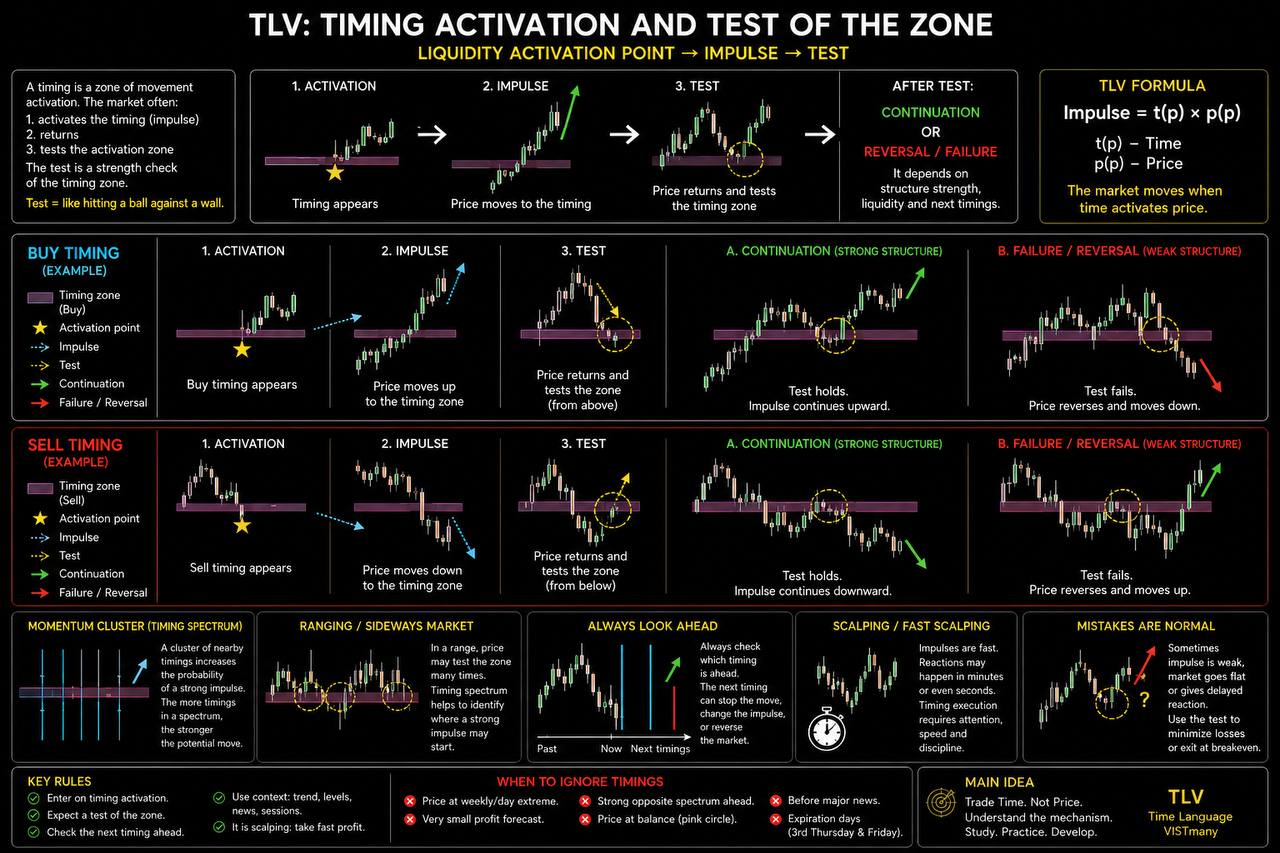
Scalping and Fast Scalping
Inside the TLV framework:
many movements are extremely fast,
impulses may last only minutes,
market reactions sometimes occur instantly.
Therefore:
👉 timing execution requires attention and fast reaction.
Especially during:
fast scalping,
timing intersections,
and Momentum Clusters.
⸻
Mistakes Are Part of the Market
It is important to understand: the market is not a perfect mathematical machine.
Sometimes:
timings partially execute,
impulses remain weak,
the market enters a range,
or delayed reactions appear.
However, the model:
👉 activation → impulse → test
very often helps traders:
minimize losses,
exit at breakeven,
or re-enter after the test.
⸻
TLV Is Market Research
TLV (Time Language VISTmany) is not an attempt to “guess the market”.
It is:
👉 the study of interaction between time and price.
By studying the market piece by piece, it becomes possible to gradually understand:
timing mechanics,
liquidity behavior,
and financial market structure.
⸻
Core TLV Formula
Impulse = t(p) × p(p)
👉 t(p) — Time 👉 p(p) — Price
👉 The market moves when time activates price.
iVISTscalp5 indicator - Welcome to the world of time!
The system projects time, direction, and expected movement
through Liquidity Activation Points (timings). Timing-Based Market Forecasting System


![[iVISTscalp5]: XAUUSD. Forecast First. Market Reaction Afterwards](https://c.mql5.com/6/1035/splash-preview-777232.png "[iVISTscalp5]: XAUUSD. Forecast First. Market Reaction Afterwards")