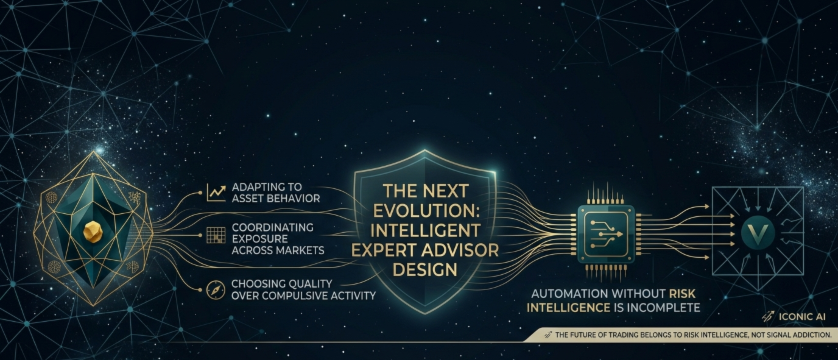
The Future of Trading Belongs to Risk Intelligence, Not Signal Addiction!
22 May 2026, 16:15

0
153
The Future of Trading Belongs to Risk Intelligence, Not Signal Addiction!
Article Summary
For years, the trading industry has been obsessed with one thing: signals. More entries, more alerts, more setups, more action. But the next generation of Expert Advisors will not be defined by how often they trade. It will be defined by how intelligently they manage risk.
This is where the real shift begins.
In modern markets, the strongest systems are not the ones that fire constantly. They are the ones that understand when risk is justified, when market conditions are degrading, when exposure should be reduced, and when capital must be protected before opportunity is chased. That is what risk intelligence means.
This article explains why the future of algorithmic trading belongs to risk intelligence, not signal addiction, and why this philosophy is increasingly relevant in the design language behind systems such as ICONIC BTC AI and ICONIC NEUROCORE AI.
Why Signal Addiction Became a Problem in the First Place
A large part of the retail trading world still evaluates systems with the wrong questions.
The focus is often on:
how many signals a system produces
how quickly it reacts
how active it stays
how many entries it can find in a day
how exciting the equity curve looks during favorable conditions
That mindset created an entire culture of signal addiction.
The trader becomes conditioned to believe that more activity means more edge. More alerts create the illusion of intelligence. More trades create the illusion of productivity. More action creates the illusion of control.
But in live trading, that logic breaks down fast.
A system can generate endless signals and still be weak. It can trade constantly and still be blind. It can find entries every day and still lack the one quality that determines long-term survival: the ability to manage risk intelligently under changing conditions.
That is the difference between activity and quality.
And in the next phase of the Expert Advisor market, quality will win.
What Risk Intelligence Actually Means
Risk intelligence is not just “using a stop loss” or “trading smaller lots.”
That definition is too shallow.
True risk intelligence means that the system understands that risk is dynamic, not static. It changes with volatility, structure, regime, timing, event risk, correlation, liquidity, and recent system behavior.
A risk-intelligent EA does not ask only:
Is there a signal?
It also asks:
Is this a high-quality environment?
Does this market still match the logic behind the setup?
Has volatility expanded beyond efficient conditions?
Has the market moved into compression, instability, or noise?
Is event risk nearby?
Is this the right moment to reduce aggression?
Is preserving capital a better decision than taking the next trade?
That is a much more advanced question set.
Signal addiction chases entries.
Risk intelligence evaluates conditions.
Signal addiction is excited by activity.
Risk intelligence is disciplined by context.
Signal addiction wants to be in the market.
Risk intelligence wants to be aligned with the market.
That is the real evolution.
Why More Signals Do Not Mean More Edge
One of the biggest misunderstandings in automated trading is the belief that opportunity is directly proportional to trade frequency.
It is not.
More signals do not automatically create more profit. Very often, they create more noise, more overexposure, more poor-quality entries, and more opportunities to be wrong in conditions that do not deserve risk in the first place.
This is exactly why many systems perform well in clean periods and struggle the moment the market becomes unstable. Their logic is designed to detect triggers, but not necessarily to evaluate signal quality in context.
That is a dangerous limitation.
A signal without context is not intelligence.
It is just a trigger.
And a trigger can become expensive very quickly when the surrounding market no longer supports the original idea.
The next generation of EAs will gain their edge not by finding more reasons to trade, but by finding more reasons to filter, reduce, delay, or avoid bad exposure.
That is where performance becomes more durable.
Market Regime Awareness Is the Foundation of Risk Intelligence
Markets are never static for long.
They transition between:
trend and range
expansion and compression
clean structure and unstable structure
normal volatility and distorted volatility
orderly sessions and event-driven conditions
Any EA that ignores these shifts becomes fragile over time.
This is why market regime awareness is one of the most important pillars of risk intelligence. A system must understand that the same signal does not carry the same meaning in every environment. A breakout in healthy momentum is not the same as a breakout inside late-stage exhaustion. A pullback in structured trend is not the same as a pullback in unstable compression.
That difference is everything.
The broader philosophy described around ICONIC BTC AI and ICONIC NEUROCORE AI reflects this idea well. Both are positioned around adaptive logic, market context, risk management, and filtering layers rather than pure one-dimensional execution. That matters because the future belongs to systems that are not only able to act, but able to judge when action still makes sense.
And that is exactly what regime awareness improves.
Risk Intelligence Protects Capital Before the Damage Becomes Visible
Most weak systems recognize danger too late.
They continue trading at full confidence while the market quality is already deteriorating. They keep the same exposure through changing volatility. They ignore the warning signs of instability because the signal still looks technically valid on the surface.
But serious systems understand a deeper truth:
By the time drawdown becomes obvious, the conditions that created it often started changing much earlier.
This is why capital protection begins before the loss, not after it.
Risk intelligence works as an early defense layer. It reduces harm by responding to market deterioration before the account absorbs the full impact.
That may show up in many forms:
reduced exposure
cooldown behavior
quality filters
trade frequency limits
pending-order reevaluation
news-sensitive pauses
selective rejection of lower-quality setups
This is not fear-based trading.
It is structurally mature trading.
The strongest systems of the future will not win because they are always active. They will win because they know when not to force risk.
Loss Streaks Should Trigger Intelligence, Not Aggression
Another major difference between weak automation and advanced automation is how the system responds to a cluster of losses.
A simplistic model keeps going.
Same pace. Same logic. Same pressure.
But a better system interprets a loss streak as useful information.
Sometimes, a sequence of losses is not just randomness. Sometimes, it is a sign that the relationship between model assumptions and current market behavior has weakened. In that case, the correct response is not emotional escalation. It is mathematical restraint.
That is why loss-streak protection and cooldown structures matter so much.
The materials around ICONIC BTC AI, ICONIC GOLD AI, and ICONIC NEUROCORE AI point to protection-oriented components such as risk management layers, cooldown logic, daily reset structures, and loss-streak handling. That signals a design philosophy that treats protection as part of core system behavior rather than an afterthought.
And this is exactly what risk intelligence looks like in practice:
a system recognizes statistical deterioration
it reduces aggression
it preserves capital
it waits for better conditions
it protects long-term survival over short-term ego
That is the opposite of signal addiction.
News Awareness Is Part of Risk Intelligence
One of the clearest signs that a system thinks beyond signals is how it handles news.
High-impact events do not merely increase movement. They can distort the entire environment:
spreads widen
execution quality changes
slippage risk rises
price structure becomes unreliable
pending orders can trigger inside low-quality conditions
A system that ignores this is not being efficient. It is being reckless.
Risk intelligence understands that not all market time is equal. Some phases invite clean execution. Others temporarily punish it. The right decision during unstable event conditions is often not to push harder, but to protect more intelligently.
This is why news filtering is such an important part of modern EA design. The available material around ICONIC BTC AI and ICONIC NEUROCORE AI includes news systems and event-aware logic, which fits directly into this broader thesis: the future does not belong to systems that trade through everything. It belongs to systems that recognize when preservation beats participation.
That is a very different level of maturity.
Bitcoin and Gold Do Not Reward the Same Risk Behavior
Another reason risk intelligence will matter more than signal addiction is that different markets punish mistakes differently.
Bitcoin and Gold are both highly attractive trading environments, but they demand different respect.
Bitcoin can move with violent momentum, irregular liquidity, and sharp repricing behavior. Gold often reacts through a different mixture of macro sensitivity, structure behavior, and institutional flow. Treating both with the same emotional expectations or the same generic automation logic creates unnecessary risk.
This is where asset-aware risk intelligence becomes valuable.
The distinction between ICONIC BTC AI and ICONIC NEUROCORE AI is relevant in that context. Based on the available descriptions, ICONIC BTC AI focuses on a BTC-centered framework with Neurocore AI, risk management, multi-action logic, and context evaluation. ICONIC NEUROCORE AI expands the scope through BTC and Gold strategy integration, portfolio coordination, cross-asset management, and synchronized risk behavior.
That reflects an important principle:
Better systems do not only search for opportunities across markets. They adapt their protective logic to the character of each market.
That is a much higher standard than simply multiplying signals across symbols.
Portfolio Coordination Is the Next Layer of Risk Intelligence
The future of risk management is not only trade-level.
It is portfolio-level.
Many EAs still think in isolated positions. But live accounts experience risk as a total environment. Multiple positions can interact, overlap, or concentrate stress in ways that are not obvious if the system only looks at one trade at a time.
That is why the next generation of EAs must think in broader terms:
total exposure
cross-symbol pressure
account-level stress
concentration risk
synchronized protection logic
This is one of the stronger conceptual aspects behind ICONIC NEUROCORE AI. Its emphasis on portfolio coordination, cross-asset stress management, and synchronized logic reflects a more advanced understanding of how serious systems should behave.
Because the future of algorithmic trading will not belong to bots that simply trade more markets.
It will belong to systems that can coordinate risk across markets intelligently.
That is risk intelligence at a higher resolution.
Why Serious Traders Will Care More About Risk Intelligence Than Signal Count
The Expert Advisor market is maturing.
More traders are beginning to understand that high activity is not the same as high quality. Smooth backtests are not the same as resilience. And signal frequency is not the same as edge.
That is a healthy evolution.
It means serious traders will increasingly ask different questions:
How does the system behave in changing regimes?
How does it react to loss streaks?
Does it reduce aggression when quality falls?
How does it handle news-sensitive periods?
Does it respect asset-specific behavior?
Can it coordinate exposure intelligently?
Is it designed to protect capital, or simply to stay active?
These are better questions because they lead to better long-term decisions.
And they also create a more favorable environment for systems built around adaptive logic and protective architecture. In other words, the market is slowly shifting away from signal addiction too.
That shift benefits frameworks like ICONIC BTC AI and ICONIC NEUROCORE AI, which conceptually align more with context-aware, protection-first system design than with simplistic alert-driven automation.
Final Thoughts
The future of trading does not belong to the loudest system.
It does not belong to the busiest system.
And it certainly does not belong to the system with the most signals.
It belongs to the system with the highest risk intelligence.
That means:
understanding market context
protecting capital when conditions degrade
reducing exposure during statistical weakness
respecting event risk
adapting to asset behavior
coordinating exposure across markets
choosing quality over compulsive activity
This is the real shift now taking place in Expert Advisor design.
For years, the industry was obsessed with automation.
Now the next frontier is becoming clear:
Automation without risk intelligence is incomplete.
The strongest EAs of the future will not be the ones that simply execute more.
They will be the ones that judge better, filter harder, protect smarter, and survive longer.
And that is why the future of trading belongs to risk intelligence, not signal addiction.


![[EURUSD]: Weekly Liquidity Activation Points (LAP), October 12-16, 2026](https://c.mql5.com/6/1035/splash-preview-777305.png "[EURUSD]: Weekly Liquidity Activation Points (LAP), October 12-16, 2026")