Aurum Imperator: inside a focused mean-reversion Expert Advisor

Aurum Imperator: A focused mean-reversion Expert Advisor
Most Expert Advisors try to do too much. They trade too many symbols, react to too many market conditions, and often rely on recovery mechanisms to compensate for weak entries.
Aurum Imperator was built with a different objective. It is a specialized Expert Advisor designed for AUDCAD, using an internal M15 execution model, with one clear purpose: to identify meaningful price extensions away from equilibrium and manage the return-to-mean opportunity with discipline.
The default profile is not designed to trade constantly. It is designed to wait for specific market conditions where price becomes statistically more interesting.
Interested in testing Aurum Imperator? You can view the Expert Advisor on MQL5 here: Aurum Imperator on MQL5.
The Core Idea: Price, Equilibrium, and Return
Aurum Imperator is based on a simple market behavior:
price often moves away from balance, but extreme deviations can create return-to-mean opportunities.

The EA does not treat every movement as a signal. A small move around the average is usually just noise. A strong move away from the average may be momentum. But a stretched move, confirmed by exhaustion and volatility-adjusted distance, can become a qualified mean-reversion setup.
This is the logic behind the default entry model.
The EA looks for three main elements:
- price stretched away from its equilibrium zone
- RSI-based exhaustion
- volatility-adjusted distance from the moving average
The goal is not simply to buy low or sell high. The goal is to identify moments where price has moved far enough from balance that a return becomes more attractive than a random entry.
A model built specifically for market return
Aurum Imperator does not rely on RSI alone. RSI can remain overbought or oversold for a long time. A market can look exhausted and still continue in the same direction.
That is why the EA adds another layer: volatility-adjusted distance.
Instead of only asking, “Is RSI extreme?”, the model also asks:
Has price moved far enough from equilibrium relative to current volatility?
This creates stronger filtering. The point is not to increase the number of trades. The point is to increase the quality of the conditions before a trade is allowed.
Aurum Imperator is built around selectivity, not activity.

What happens after entry
Entry is only one part of the system. Once a trade is open, Aurum Imperator does not simply wait and hope. The trade must continue to make sense.
The default management model is based on one principle:
A valid mean-reversion trade should begin moving back toward equilibrium within a reasonable structure.
If price returns toward the mean, the EA can close the trade into that normalization. If the trade takes too long, the opportunity may lose validity. If price continues to extend in the wrong direction, the cycle can be invalidated.
This gives the EA a structured trade lifecycle:
- detect extension
- confirm the setup
- enter selectively
- monitor return toward equilibrium
- exit on normalization or invalidate the cycle
The system is not only looking for entries. It is also deciding whether the trade still deserves to remain open.
Not grid. Not martingale.
This is one of the most important parts of the default Aurum Imperator profile.
The default live model is:
- not a classic grid
- not a martingale system
- not based on unlimited recovery entries
Many Expert Advisors depend on adding more positions when price moves against them. That can create attractive backtests, but it also increases exposure when the trade is already under pressure.
Aurum Imperator is different. The default structure is built around:
- one focused mean-reversion entry framework
- one structured management architecture
- one disciplined cycle logic
The EA is not designed to survive by constantly increasing exposure. It is designed to enter when the setup is clean, then manage the position according to whether the market still supports the original trade idea.
That difference matters. The system does not rely on an endless sequence of recovery trades to make the strategy work.
A closer look at the backtest
A strong backtest should never be judged by profit alone. The real question is not simply how much the strategy made, but how cleanly, how consistently, and under what level of pressure those returns were produced.

In this standard-risk test, from 2022 to May 2026, Aurum Imperator generated 75,991 in net profit from a 1,000 initial deposit, across 524 trades with 100% history quality.
That gives the result statistical weight. It is not a short burst of performance built on a handful of trades.
You can find Aurum Imperator on MQL5 here: View Aurum Imperator Expert Advisor.
In practical terms, it suggests that the equity curve is not only profitable, but relatively well-structured.
Next comes Profit Factor, at 2.31. This means the strategy produced 2.31 units of gross profit for every 1 unit of gross loss.
That is a healthy margin and an important sign that the strategy is operating with a genuine edge rather than a thin statistical advantage.
Equally important is the Recovery Factor, here 6.25. This metric deserves close attention because it reflects how effectively the strategy transforms drawdown into net profit.
A strong Recovery Factor is often one of the clearest signs of a system that does more than simply survive difficult periods. It regains control after them.
The Z-Score is another metric serious traders should not ignore. In this result it stands at -0.04, which is exceptionally close to zero.
A Z-Score near zero suggests that the sequence of wins and losses is statistically clean, rather than overly dependent on distorted streak behavior.
Drawdown must also be read with precision. In this report, Balance Drawdown Relative is 34.97%, while Equity Drawdown Relative reaches 44.21%.
This distinction matters. Balance drawdown reflects closed pressure. Equity drawdown reflects live floating pressure while trades are still active.
In other words, equity drawdown is the more honest measure of what the account truly experiences during exposure.
Finally, Expected Payoff comes in at 181.16. That figure confirms that the strategy is not relying on a large quantity of low-value trades to produce its result.
Each trade carries meaningful average value, which reinforces the quality of the overall profile.
Key Metrics Summary
Taken together, the key figures tell a coherent story:
- Sharpe Ratio 2.43: strong quality of return
- Profit Factor 2.31: healthy statistical edge
- Recovery Factor 6.25: efficient recovery from pressure
- Z-Score -0.04: exceptionally clean trade distribution
- 631 trades: serious sample depth
- 44.21% equity drawdown: powerful performance, delivered at standard risk
One final point is essential. This report reflects the standard risk profile of the EA. Traders who prefer a more conservative exposure can reduce risk by increasing the Balance per 0.01 Lot setting.
A higher value reduces position size and softens the overall risk profile. A lower value does the opposite.
So while the result shown here represents the strategy in its standard live configuration, it should not be mistaken for the only way the system can be deployed.
Adjust the risk with just one input
The only setting you need to change is Balance for every 0.01 lot.
By default, it is set to 75. That means the EA uses 0.01 lot for every 75 units of balance.
If you want to reduce the risk, increase this value.
For example:
- 75 = standard risk
- 150 = roughly half the risk
- 300 = roughly one quarter of the risk
In simple terms:
- higher value = lower risk
- lower value = higher risk
This makes it easy to adapt the EA to your own account size and risk preference without changing the core strategy.
By doubling the Balance for every 0.01 lot from 75 to 150, the EA reduces its exposure by roughly half. In the example shown in the report, the Equity Drawdown Relative is also reduced significantly, by around 50%.


In the example shown in the report, the Equity Drawdown Relative is also reduced significantly, by around 50%.
If you want an even more conservative profile, simply increase this value further.
Built for robustness, not just backtest profit
Aurum Imperator was not built to chase the highest possible historical return at any cost. It was built to remain stable, credible, and usable beyond the optimization window.
First, the strategy was optimized with a strong focus on Sharpe Ratio and a Z-Score as close to 0 as possible. That matters because profit alone says very little. Sharpe helps measure the quality of the return, while a Z-Score near zero suggests a cleaner and more statistically natural sequence of trades.
Second, the system was not judged on in-sample results alone. The initial optimization and backtest phase covered 2022 to January 2026. The strategy was then evaluated on forward performance over non-trained data, which is where robustness begins to prove itself.
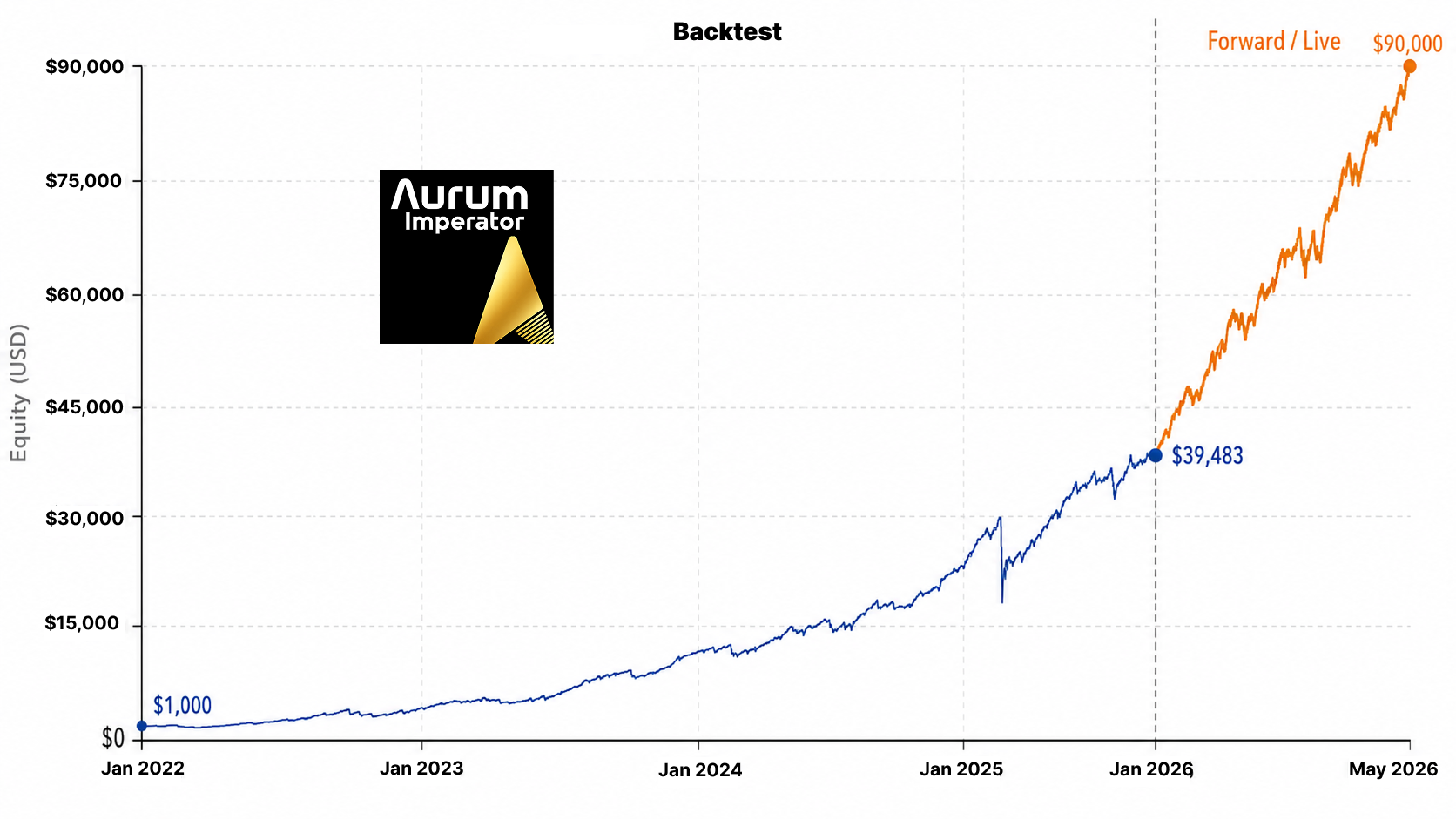
Third, Aurum Imperator was intentionally kept structurally focused. We do not optimize hundreds of variables just to discover one perfect-looking set. That is one of the biggest weaknesses of the MQL5 ecosystem. Over-optimization can produce beautiful backtests and very disappointing live results.
The goal was to avoid that trap from the start.
Finally, the EA was reviewed across different broker data feeds. This is an important part of robustness testing.
One major warning sign in automated trading is a system that needs completely different settings for each broker. In most cases, that is not adaptability. It is broker-specific overfitting.
When that happens, the risk of seeing very different live results becomes much higher.
Aurum Imperator was therefore designed with a focused logic, a limited and understandable parameter structure, and a risk model that can be adjusted without changing the core strategy itself.
Final thoughts
Aurum Imperator is not designed to be a high-frequency system that enters every minor fluctuation. It is designed to wait for a specific type of opportunity: price stretched away from equilibrium, confirmed by exhaustion and volatility-adjusted distance, then managed through a structured return-to-mean lifecycle.
Its strength lies in its selectivity, its disciplined management model, and its refusal to depend on classic grid or martingale recovery logic.
As with any Expert Advisor, traders should evaluate the system according to their own risk tolerance, account size, broker conditions, and long-term expectations. Backtests are useful, but they should always be interpreted through risk, robustness, and live-market discipline.
For traders who want a focused AUDCAD mean-reversion system with a clear structure and adjustable exposure, Aurum Imperator offers a professional framework built around logic, selectivity, and controlled execution.
To learn more, test the product, or add Aurum Imperator to your MetaTrader setup, visit the official MQL5 product page: Aurum Imperator on MQL5.