
From Indicator to Trading System: The Evolution of Owl Smart Levels

Most indicators give signals, but do not provide an understanding of which ones are actually worth trading.
Owl Smart Levels was originally the same. Now it is a full-fledged trading system.
Why signals do not produce results
With experience came the understanding — the issue is not in the indicator itself.
Any indicator works within its own logic. But the market is not limited to this logic — there are news, noise, different movement phases. As a result, a signal may be completely correct from the indicator’s point of view, but not work out in real market conditions.
This is why it often feels like “indicators don’t work”.
Simple example — a moving average.
By itself, it is a basic tool, and if you trade only based on it, the result will most often be negative.
But within a well-thought-out system, it becomes part of high-quality trades.
When a signal is not enough for a decision
Initially, Owl Smart Levels was just an indicator — it provided signals and entry levels. But over time, I started noticing one thing.
Sometimes a signal appeared, but it looked weak — not the kind you want to enter. At the same time, the indicator logic said it was a valid entry.
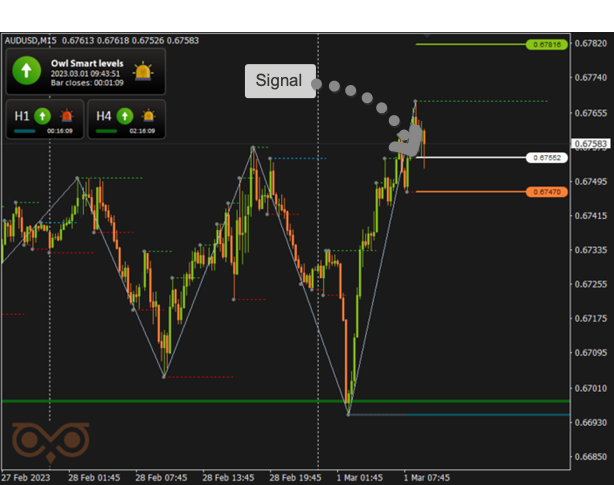
And at that moment, the main question arose — how to make a decision if there is a signal, but there is no confidence in it?
The problem was that these “feelings” had no clear rules. Which means they could not be applied consistently.
How the system appeared
A big role in development was played by trading reports that I collected and published since 2023.
I took all screenshots from the reports and divided them into two groups — trades that made profit and those that resulted in loss.
Then a long analysis began. I tried to understand what similarities they had, whether there were recurring patterns.
At first, nothing obvious could be found. Sometimes some patterns appeared, but they were difficult to clearly describe and apply in practice.
But during this process, similarities gradually began to emerge. They were structured and turned into specific criteria by which each signal can be evaluated.
What it turned into
As a result, it stopped being just a set of signals. A structure appeared that allows working with each signal.
Not just “there is an entry or not”, but an understanding:
- in what context it appeared
- how strong it is
- whether it is worth taking at all
Essentially, this formed into a sequential process: signal → evaluation → decision → trade
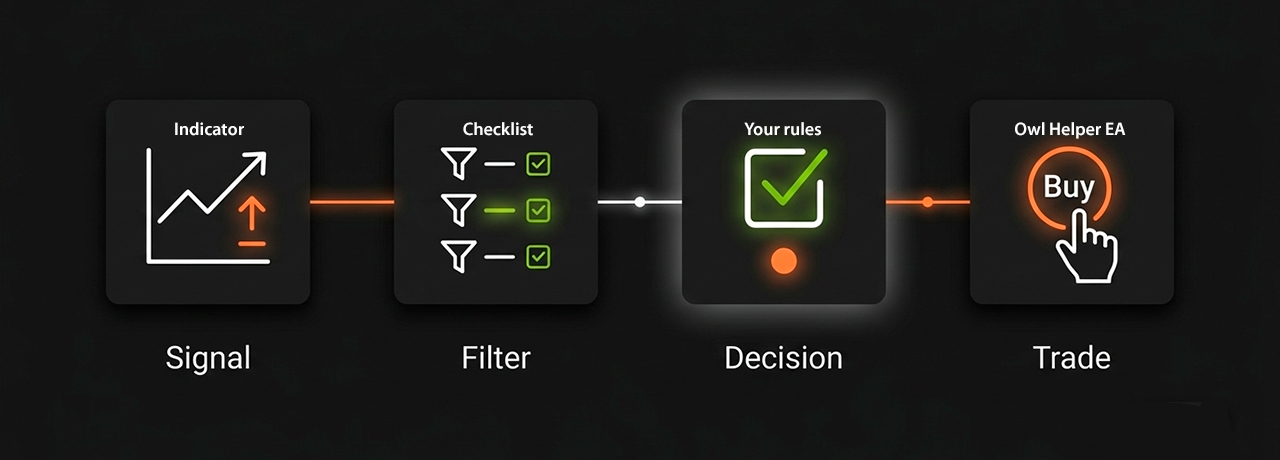
And this is exactly what turned Owl Smart Levels from an indicator into a system. This approach is not for everyone, but it provides a more consistent result.
How perception of signals changes
The main change is not new features. The approach to trading itself has changed.
Now one signal is not enough to enter a trade. Now we choose which ones are worth taking at all. The constant urge to “enter the market” disappears, and an understanding appears of when it is better to skip a trade.
The number of trades decreases, but their quality increases. And the most important thing appears — control over your trading.
How it looks in practice
To make it clearer how this works, here are a couple of simple examples.
For example, important news is released after a signal.

The chart may show a perfect entry, but if the calendar includes, for example, NFP — the market becomes unpredictable at that moment.
Look at the example below.
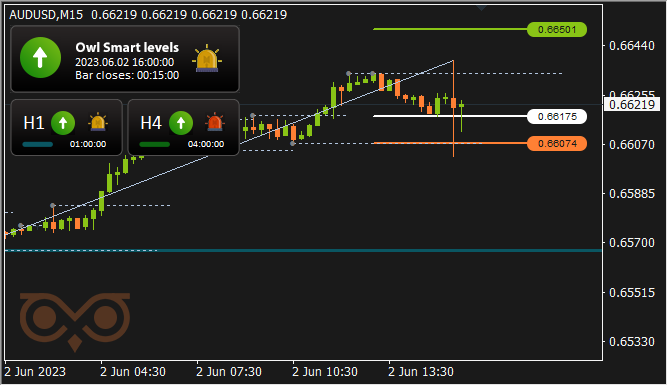
If you had simply entered based on the signal — it could have resulted in a loss.
But this can be easily avoided if you consider the context and simply check the news calendar before entering or once a day in the morning.
The second example — a signal at the end of a strong movement.
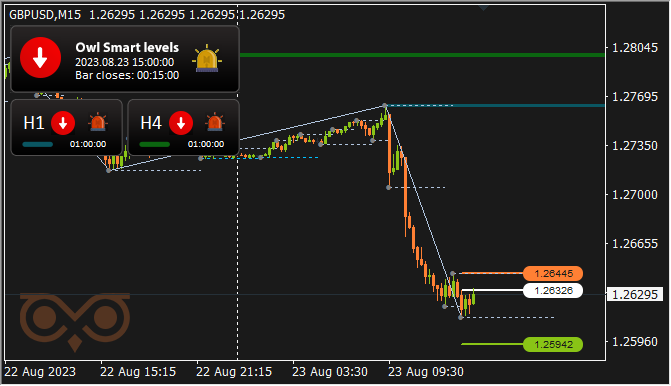
Formally, it may be correct, but visually it is clear that the movement has already “exhausted itself”, and entering at this moment is not the best idea.
It is difficult to program such things. But for a person, one look at the chart is enough, especially if they understand what exactly to pay attention to.
These exact moments are described in the guide and turned into clear rules that can be applied in every trade.
They are not just described, but structured into a ready-to-use system.
New approach to trade selection
Over time, the approach to working with the indicator completely changed. I stopped perceiving a signal as a ready action.
Now it is rather a point of attention — a moment that needs to be evaluated.
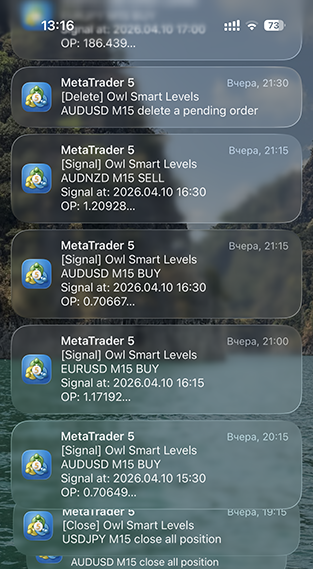
In my work, I use more trading instruments (pairs, gold, indices, etc.) to get a flow of signals. But only those that truly match models close to ideal turn into trades. Everything else stops mattering.
This approach removes the lack of entry opportunities, when you sit without trades for a long time and want to “open something”.
At the same time, the entries themselves become significantly stronger.
What is included in the Owl Smart Levels system
As a result, Owl Smart Levels is not a single tool, but an integrated system.
- The indicator is responsible for finding situations and generating signals.
- Owl Helper Expert Advisor helps with execution and trade management. At the same time, the decision to enter always remains with the trader — the system only helps to structure it.
- The guide provides an understanding of how to evaluate signals and make decisions.
- The checklist helps to quickly navigate the situation, filter out weak signals and not forget anything when entering a trade.
All elements complement each other and work as a single process.
This is no longer about searching for the “perfect” indicator. It is about understanding how to work with the market through a system.

Trading system Owl Smart Levels MT5 | MT4 Version
All logic, selection rules, and examples are collected in the materials that come with Owl Smart Levels.
The system is not static — in the user chat, we analyze real trades and new situations. And the best patterns found over time become part of the system. If strong patterns appear, they are added to the guide.
All materials are regularly updated and evolve together with practice.
The difference becomes clear not in the description — but in trading itself. If you understand this difference — it makes sense to see how it is implemented in the system.


![[EURUSD]: Weekly Liquidity Activation Points (LAP), October 12-16, 2026](https://c.mql5.com/6/1035/splash-preview-777305.png "[EURUSD]: Weekly Liquidity Activation Points (LAP), October 12-16, 2026")
![[Nasdaq]: Weekly Liquidity Activation Points (LAP), October 12-16, 2026](https://c.mql5.com/6/1035/splash-preview-777311.png "[Nasdaq]: Weekly Liquidity Activation Points (LAP), October 12-16, 2026")
![[BRENT]: Weekly Liquidity Activation Points (LAP), October 12-16, 2026](https://c.mql5.com/6/1035/splash-preview-777303.png "[BRENT]: Weekly Liquidity Activation Points (LAP), October 12-16, 2026")