
The most dangerous trade is often the one placed immediately after a loss.
The Stop Loss is hit. You keep watching the chart. Price starts moving back. A thought appears:
“If I enter again now, I can make the loss back.”
That is the moment when the previous loss can begin to change the size, timing, direction, or quality of the next decision.
Revenge trading is not defined by one order type. It is defined by the previous loss changing the next decision.
What Revenge Trading Actually Looks Like
Revenge trading is not limited to one dramatic all-in order.
It can include:
- Immediate re-entry without a valid setup
- A larger position size than the session plan allowed
- An impulsive trade in the opposite direction
- A lower-quality setup that would normally be rejected
- An unplanned additional position
- An unplanned pending order
- Moving the Stop farther away
- Stretching the Take Profit because the day must return to profit
- Continuing after the Daily Loss Limit
- Adding a manual position to an account where EAs are already running
How One Normal Loss Can Become Minus 6R
Consider a simple educational example:
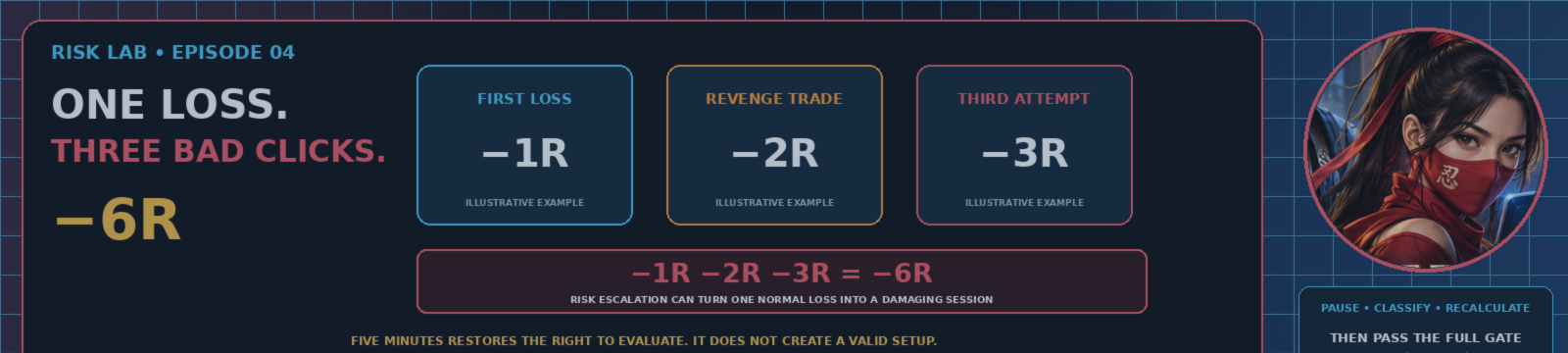
- First Loss: −1R
- Revenge Trade: −2R
- Third Attempt: −3R
−1R − 2R − 3R = −6R
This is not a forecast that three trades will always occur in this order.
It shows how one controlled strategy loss can become a much larger session loss when the trader raises risk and relaxes the entry process after the loss.
The strategy may have created the first −1R. The position-size escalation created the path to −6R.
The Five-Minute Reset Is a Circuit Breaker
The five-minute reset is not a scientifically universal recovery time.
It is a minimum operational pause designed to:
- Stop the immediate re-order
- Interrupt the sequence of chart, button, and click
- Recalculate the day
- Check whether a valid setup actually exists
Some traders may need thirty minutes, the next session, or the next day.
Five minutes restores the right to evaluate. It does not create a valid setup.
Minute 0–1: Hands Off
During the first minute, stop every action that can create a new manual position.
- Close the New Order window
- Take your hand away from the mouse
- Cancel only the pending order that was created for revenge
- Temporarily disable manual One Click Trading if that adds useful friction
- Record the time of the loss
- Record the loss in R
- Do not start searching for the next setup yet
Do not delete every pending order without checking which strategy owns it.
Do not stop an EA, disable terminal-wide AutoTrading, or change another strategy before understanding the effect on the account.
Minute 1–2: Classify the Loss
Classify the loss using evidence from the chart, trade history, Experts tab, Journal, and the original rules.
Normal Strategy Loss
The setup, size, Stop, and execution matched the plan. The outcome was simply a loss.
Execution Problem
Spread expansion, slippage, connection delay, rejection, unexpected fill, or another symbol or broker condition changed the result.
Rule Violation
The trade was early, oversized, outside the session, modified without a rule, added unexpectedly, or placed after a loss limit.
Market Condition Issue
News, gaps, low liquidity, abnormal volatility, or a regime mismatch affected the trade.
A Normal Strategy Loss does not automatically justify immediate re-entry.
A Rule Violation means the process must be corrected before another trade is considered.
Copy This Loss Classification Card
LOSS CLASSIFICATION Symbol: Time: Setup Name: Planned Risk: Actual Loss: Normal Strategy Loss?: Execution Problem?: Rule Violation?: Market Condition Issue?: Evidence: Next Required Action:
Minute 2–3: Recalculate the Day
Recalculate the complete account and session—not only the most recent closed trade.
- Realized P/L
- Realized Loss in R
- Open Position Risk
- Pending Order Risk
- Correlated Exposure
- Remaining Daily Loss Allowance
- Remaining Number of Allowed Attempts
- Margin and Free Margin
- News and Weekend Exposure
A cooldown does not override a shutdown rule.
If the Daily Loss Limit has already been reached, the session remains over after the five-minute pause.
The correct Daily Loss Limit is a strategy parameter. It depends on trade frequency, historical drawdown, account purpose, risk tolerance, and portfolio structure.
Minute 3–4: Interrupt the Loop
Use a short physical interruption to break the sequence:
- Stand up
- Look away from the chart
- Take several slow breaths
- Walk briefly
- Drink water
- Move to another screen
This is not medical treatment and does not guarantee rational behavior.
The purpose is to interrupt the automatic path from Loss → Chart → Order Button → Immediate Re-entry.
Minute 4–5: Pass the Re-entry Gate
Every answer must support the new trade.
- Is a valid setup present now?
- Does it meet the full checklist?
- Is the planned risk the same or lower than the original session plan?
- Is the Daily Loss Limit still intact?
- Would I take this trade if the previous loss had never happened?
- Is there any urgency to make the money back?
- Is total open and correlated risk still within the limit?
- Is there enough time left in the session?
- Am I changing the strategy because of one result?
- Did I record the previous loss?
If one answer is NO, do not trade.
The Make-It-Back Test
Before any post-loss entry, ask:
If my account were flat today, would I still take this exact setup at this exact size?
Also ask:
- Would I use this size after a winning trade?
- Would I take this setup tomorrow?
- Is the entry valid without looking at today's P/L?
- Am I trading the market—or the account balance?
If the trade only makes sense because money must be recovered, the previous loss is still controlling the next decision.
The Cooldown Is Not a Setup
Five minutes passing does not create an entry.
Valid outcomes after the reset include:
- Wait another thirty minutes
- Wait for the next session
- Stop trading until the next day
- End the session because the Daily Loss Limit was reached
- Finish the day without another valid setup
The reset restores evaluation. It does not manufacture opportunity.
Use a Post-Loss Decision Tree
The practical sequence is:
LOSS CLOSED
↓
Daily Limit Hit?

YES → End Session

NO
↓
Rule Violation?

YES → Record Violation
      Correct Process
      No Immediate Trade

NO
↓
Valid Setup Present After Minimum Pause?

NO → Wait

YES
↓
Full Checklist Passed?
Same or Lower Risk?
No Make-It-Back Urgency?

ANY NO → No Trade

ALL YES → Trade the Normal Plan Only Add Friction Inside MetaTrader 5
MetaTrader 5 allows market orders to be sent directly from the chart using One Click Trading. When One Click Trading is enabled, some pending-order placements and modifications can also occur without the standard trading dialog.
Temporary friction for the manual session can include:
- Closing the New Order window
- Temporarily disabling manual One Click Trading
- Canceling only revenge-related pending orders
- Displaying the Daily Loss Limit beside the chart
- Keeping the Re-entry Gate beside MT5
- Separating manual Magic or Comment information where possible
- Checking the Experts and Journal tabs
- Saving the trading history
This does not prevent every impulsive action. It creates extra steps between the urge and the order.
Do not assume that closing MT5 cancels a pending order. A pending order can remain at the broker and later trigger under its own conditions and expiration.
Be Careful on Accounts That Also Run EAs
After a manual loss, do not change an EA's settings, raise its lot size, restart it to force activity, or add a manual position without reviewing the portfolio impact.
Before changing anything, check:
- Which EA owns each position and pending order
- Magic Number and Symbol
- Netting or Hedging account behavior
- Existing open and pending risk
- Whether a Portfolio Guard or other protection utility is active
- Whether terminal-wide AutoTrading changes will affect other strategies
A faulty EA may need to be stopped. The point is to understand the account-wide effect before acting.
Journal the Urge—not Only the Trade
URGE JOURNAL Loss Time: Symbol: Loss in R: Loss Classification: Immediate Thought: Physical Signal: Wanted Action: Wanted Position Size: Wanted Direction: Actual Action: Reset Started: Reset Ended: Daily Limit Remaining: Valid Setup After Reset?: Trade Taken?: Rule Violation Prevented?: What Triggered the Urge?: Lesson:
Possible triggers include:
- Stop-out
- Missed Move
- Early Exit
- Rule Violation
- Unexpected Slippage
- Large Loss
- Multiple Small Losses
- Trying to End the Day Positive
- Seeing Price Reverse After Exit
Define Session Shutdown Rules Before the Session
Your plan can define:
- Maximum Daily Loss
- Maximum Consecutive Losses
- Maximum Rule Violations
- Maximum Number of Attempts
- Time Cutoff
- News Cutoff
- Maximum Open Risk
- Maximum Correlated Risk
The numbers are personal strategy parameters. There is no universal rule that every trader must stop after exactly two losses or at exactly −2R.
Review the Process After the Session
Do not rewrite the strategy because one loss felt painful.
Review:
- Was the setup valid?
- Was the Stop logical?
- Was the position size correct?
- Was there an execution problem?
- Were the rules followed?
- Was the loss inside the historical distribution?
- Has the same issue appeared across several trades?
- Is there enough evidence to justify a strategy change?
Strategy changes should come from a meaningful sample, reproducible evidence, and retesting—not from the emotional intensity of one outcome.
Watch the Full Five-Minute Reset Lesson
Revenge Trading: The 5-Minute Reset Before Your Next Trade
The long-form lesson explains the revenge-trading loop, the five-minute timeline, loss classification, risk recalculation, re-entry gate, MT5 friction, EA-account cautions, urge journaling, session shutdown rules, and after-session review.
See the Minus 6R Example in the Shorts Lesson
One Loss. Three Bad Clicks. −6R. | Revenge Trading #Shorts
The Short uses a separate script, new Andrew narration, a vertical 1080×1920 layout, new NINJA action, large English captions, and the −1R → −2R → −3R = −6R escalation.
Use the Reset Before the Next Click
Subscribe to Atsushi K. Forex Lab for more practical Risk Lab lessons
Before placing the next order after a loss, pause long enough to classify the loss, recalculate the day, and pass the full Re-entry Gate.
If the only reason for the trade is to recover money, the correct position size is zero.
Official References
- MetaTrader 5 — One Click Trading
- MetaTrader 5 — Executing Trades
- CME Group — Planning for Trading Losses
- CME Group — Trading Psychology
- CME Group — Risk Management and Your Trade Plan
Risk notice: Forex and CFD trading involves substantial risk. The five-minute reset is an educational operational workflow, not a guaranteed recovery time, medical treatment, or guarantee that the next trade will be valid or profitable.