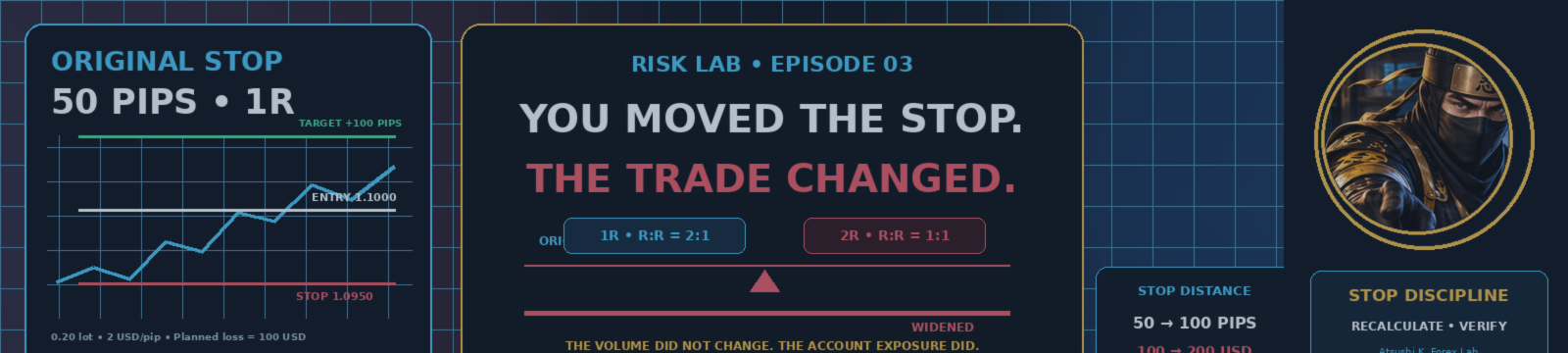

You moved the Stop. The position may look the same, but the trade is no longer the same.
The Entry is unchanged. The ticket is unchanged. The chart still shows the same position.
But moving the Stop can change the invalidation, maximum planned loss, reward-to-risk ratio, position-size fit, trade duration, exit distribution, and expectancy of the process you actually execute.
The lesson is not that a Stop must never move.
The lesson is that every Stop movement should belong to a rule that existed before entry, can be reproduced, can be measured, and has been tested as part of the strategy.
The Original Trade Contract
Before entry, the trade should have a defined contract:
- Entry: Where the position begins
- Invalidation: Where the original market idea is no longer valid
- Initial Stop: The original protective price
- Position Size: The volume fitted to that Stop distance
- Maximum Cash Risk: The planned account loss
- Target: The reference reward objective
- Time Exit: When the setup should no longer remain open
- Allowed Stop Modifications: Any break-even, trailing, time, or volatility rule permitted after entry
The Stop is not only a red line on the chart.
Its distance is one of the links between the market idea, the position size, and the cash-risk budget.
How a One-R Trade Can Quietly Become Two R
Consider an illustrative EURUSD long trade:
- Entry: 1.1000
- Original Stop: 1.0950
- Original Stop Distance: 50 pips
- Position Size: 0.20 lot
- Assumed Pip Value: 2 USD per pip at 0.20 lot
The original planned loss is:
50 pips × 2 USD = 100 USD = 1R
Now assume the Stop is moved to 1.0900 while the 0.20 lot position remains unchanged.
- New Stop Distance: 100 pips
- Position Size: still 0.20 lot
The new planned loss is:
100 pips × 2 USD = 200 USD = 2R
The platform did not change the position volume. The trader changed the account exposure.
This is an educational assumption. It does not mean that 0.20 lot equals 2 USD per pip for every symbol, broker, or account currency.
Recalculate Risk After Every Stop Change
Under a simplified condition where profit and loss are approximately proportional to price distance at the same volume:
New Planned Risk ≈ Original Planned Risk × New Stop Distance ÷ Original Stop Distance
For the example:
100 USD × 100 pips ÷ 50 pips = 200 USD
This is a conceptual shortcut, not a universal MT5 calculation.
The actual result can be affected by:
- Spread
- Commission
- Slippage
- Contract-calculation mode
- Account-currency conversion
- Non-linear products
- Price gaps
After changing a Stop, recalculate in the exact symbol and account environment whenever possible.
Why the Original Position Size No Longer Fits
The volume was calculated from the original Stop and risk budget:
Position Size = Maximum Cash Risk ÷ One-Lot Loss at the Original Stop
If the Stop moves farther away while volume stays fixed, the original cash-risk ceiling is no longer preserved.
At minimum, review:
- New one-lot loss
- New planned cash risk
- New R multiple
- New reward-to-risk
- Total open risk
- Required margin and remaining free margin
- Correlated exposure
The Reward-to-Risk Ratio Can Fall from 2:1 to 1:1
Suppose the target remains 100 pips above Entry.
With the original 50-pip Stop:
100 ÷ 50 = 2R
After widening the Stop to 100 pips:
100 ÷ 100 = 1R
The trader doubled the planned loss without increasing the target.
Even if the Win Rate stayed unchanged, the executed payoff structure would be different.
A Widened-Stop Version Is a Different Strategy
Expectancy is commonly summarized as:
Expectancy = Win Rate × Average Win − Loss Rate × Average Loss
Widening the Stop may:
- Increase Average Loss
- Increase trade duration
- Leave the winner size unchanged
- Change the Win Rate
- Change the exit distribution
- Change strategy expectancy
A wider-Stop strategy can be valid when it was designed and tested as a separate strategy.
The widened-stop version must be evaluated as a different strategy—not assumed to be an improved version of the original one.
Recognize the Emotional Stop-Widening Loop
The loop often looks like this:
- Price approaches the original Stop.
- The loss becomes uncomfortable.
- The trader decides the market only needs “a little more room.”
- The Stop moves farther away.
- The planned cash loss increases.
- The required recovery becomes larger.
- The urge to interfere again becomes stronger.
The first unplanned modification makes the second one easier.
The solution is not self-blame. The practical solution is to define every permitted modification before entry and make any new risk visible immediately.
Not Every Stop Change Is Wrong
A dynamic Stop can be valid when the rule existed before entry, is reproducible, and has been tested as part of the strategy.
Examples include:
- Break-even after a defined trigger
- A trail behind a confirmed swing
- An ATR-based trailing distance
- A bar-close trail
- A time-based exit or Stop rule
- A trail activated after a defined R multiple
- A volatility-adjusted rule
The opposite is an unplanned change made because the current loss feels difficult to accept.
Break-even Too Early Can Change the Strategy
Moving a Stop to break-even can reduce the remaining cash risk.
It can also close trades during normal noise that would later have reached the target.
A break-even rule can change:
- Win Rate
- Average R
- Average Win
- Trade duration
- Premature Exit Rate
- Time to Target
- Expected Payoff
Break-even is not automatically good or bad. It needs a defined trigger and sample-based evaluation.
Use MFE and MAE to Evaluate Modification Rules
MFE means Maximum Favorable Excursion: the greatest favorable movement reached during the trade.
MAE means Maximum Adverse Excursion: the greatest adverse movement reached during the trade.
When evaluating a break-even or trailing rule, review questions such as:
- How far did eventual winners move against the Entry before succeeding?
- How far did trades move favorably before returning to break-even?
- How many original winners would the proposed rule remove?
- Did wider Stops improve the full distribution—or only rescue a few memorable trades?
MFE and MAE describe the sample. They do not predict the next trade.
A Stop Price Is Not a Guaranteed Fill Price
A Stop price is a trigger or protective level. It does not guarantee the final execution price.
Actual loss can exceed planned loss during:
- Price gaps
- Fast markets
- Low liquidity
- Spread expansion
- Slippage
- Weekend opens
- News events
- Execution delays
This is another reason not to enlarge the planned loss after entry.
Why MT5 Can Reject the Requested Stop
MT5 symbols can expose two relevant distance properties:
- Stops Level: A minimum allowed distance from the current price for Stop Loss, Take Profit, and pending-order prices.
- Freeze Level: A distance around the current price where certain modifications can be restricted.
The applicable distance is broker- and symbol-specific. The reference price can also depend on the operation and side.
Do not assume:
- A Stops Level of zero means every requested price will be accepted
- Being outside Freeze Level guarantees acceptance
- Every broker uses identical rules
- BUY and SELL distance calculations use the same reference price
PositionModify True Does Not Prove the Server Changed the Stop
In MQL5, CTrade::PositionModify(...) returning true means the method's basic request structures passed its check.
It does not always mean the trade server executed the modification.
An automated system should also inspect and log the server result, including:
- Requested SL
- Previous SL
- Symbol
- Ticket or Position ID
- ResultRetcode
- ResultRetcodeDescription
- Server comment
- Bid and Ask
- Stops Level
- Freeze Level
- Timestamp
For a manual change, verify that the position's displayed SL actually changed. Review the Journal, Experts tab, Trade information, and broker message when the result is unclear.
Use Fixed Reason Codes in an EA or Trade Utility
A useful Stop-modification audit log can include:
Original Stop: Requested Stop: Accepted Stop: Change Direction: Risk Before: Risk After: Reason Code: Rule Name: Stops Level: Freeze Level: Retcode: Broker Comment: Time: Bar Time: MFE / MAE at Change:
Possible fixed reason codes:
- BE_RULE
- ATR_TRAIL
- SWING_TRAIL
- TIME_EXIT
- MANUAL_EMERGENCY
- INVALIDATION_ERROR
Fixed reason codes make it harder for an emotional intervention to disappear inside the final performance report.
Copy This Stop Modification Journal
Original Entry:
Original Stop:
Original Risk Money:
Original R:
New Stop:
New Risk Money:
New R:
Time of Change:
Price at Change:
Reason:
Preplanned Rule Name:
MFE:
MAE:
Was Risk Increased?:
Broker Accepted?:
Final Outcome:
Would the Original Stop Have Been Hit?:
Would the Original Target Have Been Hit?:
Write the reason when the modification is requested—not after the final outcome makes a different explanation convenient.
Use the Eight-Question Gate Before Moving the Stop
- Was this exact modification rule defined before entry?
- Does the new Stop increase maximum cash risk?
- Is the change based on market structure—or discomfort?
- Has the rule been tested across enough trades?
- Can the broker accept the requested level now?
- Did I recalculate reward-to-risk?
- Did I record the modification?
- Does total portfolio risk remain within the plan?
A Practical Protocol
Before Entry
- Define the invalidation price
- Calculate the initial cash risk
- Write every allowed Stop-modification rule
- Define the break-even trigger
- Define the trailing method
- State whether maximum risk increase is zero or another tested limit applies
- Review current Stops Level and Freeze Level
After Entry
- Modify only when a defined rule is triggered
- Recalculate the new cash risk and reward-to-risk
- Confirm the broker or server result
- Record the change immediately
- Do not widen the Stop only to avoid accepting the planned loss
After the Trade
- Compare the Original Plan with the Executed Plan
- Record how the Stop change affected the outcome
- Compare MFE, MAE, Average R, and premature exits
- Evaluate the rule across a sample—not one memorable trade
Watch the Full Risk Lab 03 Lesson
Why Moving Your Stop Loss Changes the Trade | Risk Lab 03
The long-form lesson covers the original trade contract, the 1R-to-2R example, reward-to-risk deterioration, emotional widening, break-even, planned trailing, MT5 distance rules, modification verification, journaling, and the pre-change gate.
See the Core Message in the New Shorts
Moved Your Stop? You Changed the Trade. | Risk Lab #Shorts
The Short uses a separate English script, new Andrew narration, a vertical 1080×1920 layout, the white-haired master's Blue Barrier action, and large English captions.
Continue with Risk Lab
Subscribe to Atsushi K. Forex Lab for the next Risk Lab lesson
The playlist is named Risk Lab | Trading Risk Management & Position Sizing.
Playlist link insertion point: [INSERT THE OFFICIAL RISK LAB PLAYLIST URL HERE AFTER CONFIRMATION]
The next planned episode is:
Revenge Trading: 5-Minute Reset
Before You Change the Next Stop
Recalculate the cash risk and reward-to-risk. Identify the exact preplanned rule. Confirm that the broker can accept the requested level. Record the modification and the result.
If the only reason is discomfort, leaving the original plan unchanged may be the more disciplined choice.
Official References
- MQL5 Reference — CTrade::PositionModify
- MQL5 Algo Book — Spreads, Stops Level, and Freeze Level
- MQL5 Reference — CSymbolInfo::StopsLevel
- MQL5 Reference — CSymbolInfo::FreezeLevel
- Investor.gov — Stop, Stop-Limit, and Trailing Stop Orders
- FINRA — Stop Orders During Volatile Markets
Risk notice: Forex and CFD trading involves substantial risk. The calculations in this article are simplified educational examples. A Stop does not guarantee the final execution price or exact loss, and no modification rule guarantees profit.