Pick Your EA's Risk by the Drawdown, Not the Profit: One Gold EA at Five Risk Levels

Most traders set an EA's risk by looking at the profit figure in the backtest. Then the first deep drawdown hits, it's deeper than they expected, and they turn the EA off right near the bottom.
The risk setting decides how deep that drawdown is. So it's worth knowing, before you go live, what each step up in risk actually buys you and what it costs.
I ran my own gold EA at five risk levels on the same data and put the results side by side.
THE TEST
- EA: Tsurugi Gold EA, XAUUSD H1
- Broker data: XM, January 2022 – October 2026, 99% real ticks
- Starting balance: $10,000, risk per trade as a % of balance
- Nothing else changes: the same 3,665 trades at every level, only the lot size is different.
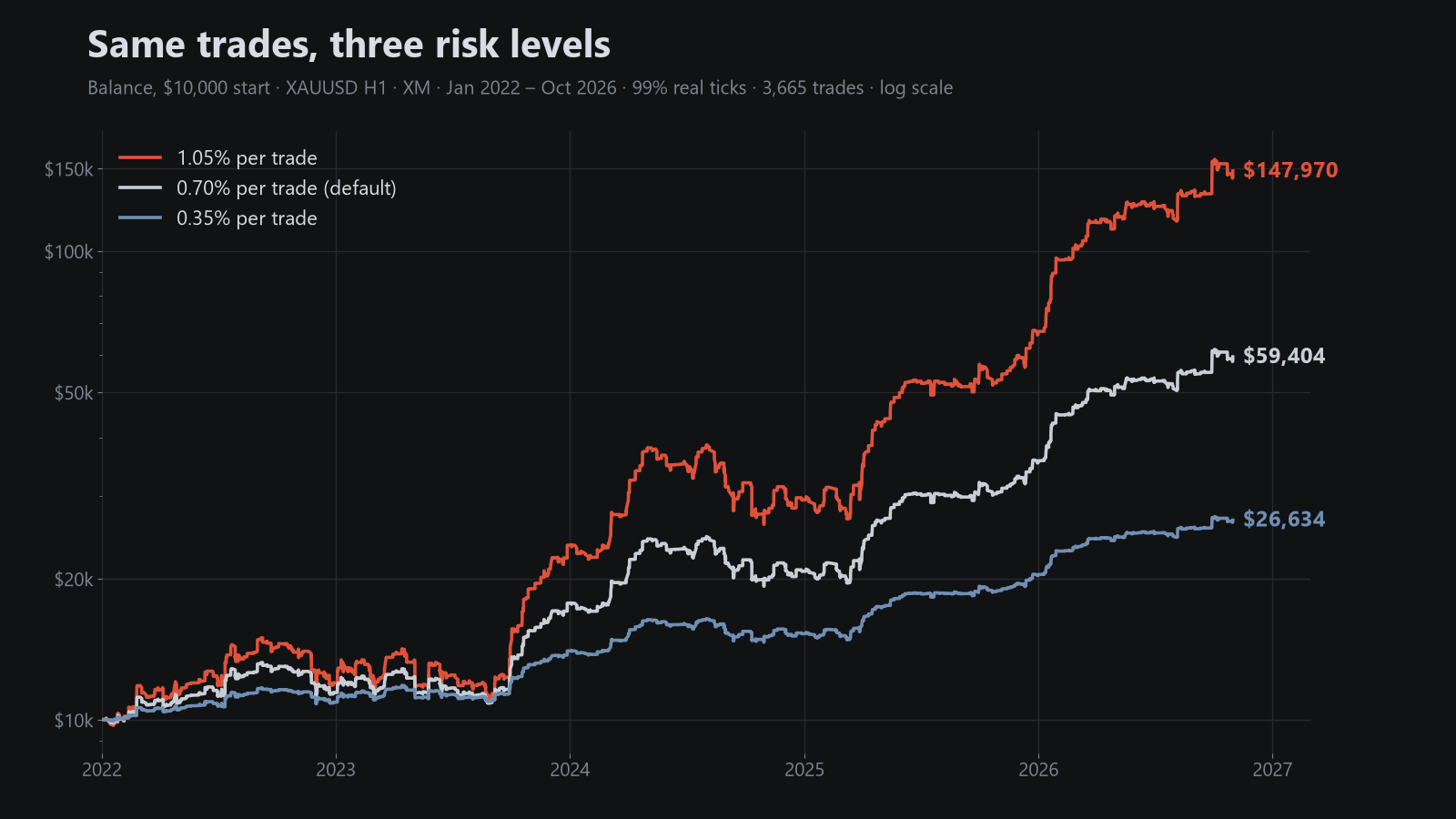
THE RESULTS
| Risk per trade | Net profit | Max equity drawdown |
|---|---|---|
| 0.35% | +$16,634 | 13.5% |
| 0.50% | +$27,675 | 19.3% |
| 0.60% | +$37,846 | 22.7% |
| 0.70% (default) | +$49,404 | 26.2% |
| 1.05% | +$137,970 | 38.7% |
All five levels were profitable in every calendar year.
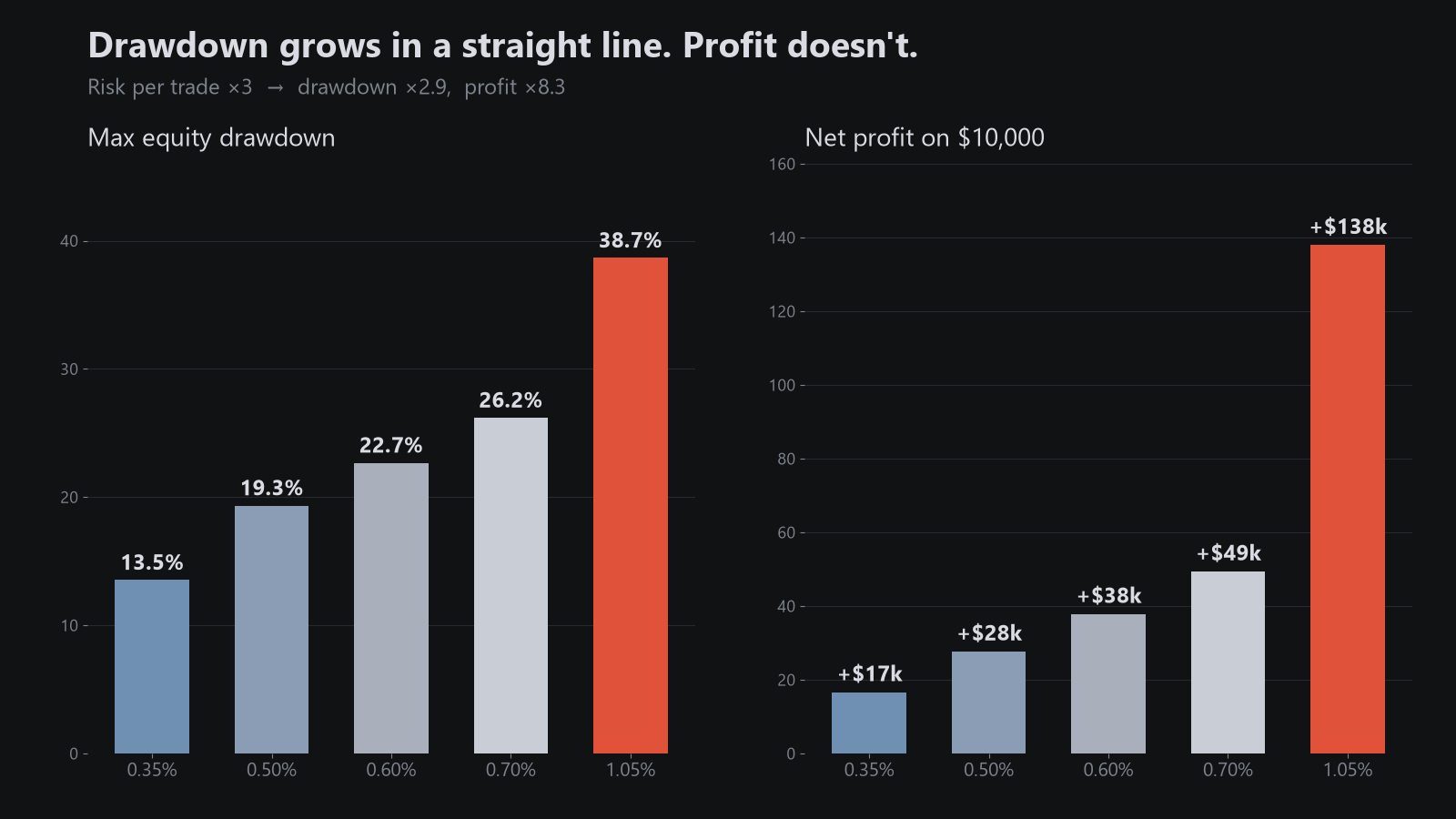
1. DRAWDOWN GROWS IN A STRAIGHT LINE. PROFIT DOESN'T.
Going from 0.35% to 1.05% triples the risk. The drawdown roughly triples with it, from 13.5% to 38.7%. Profit grows more than eightfold, from $16,634 to $137,970.
That's compounding: bigger lots on a bigger balance. It's also why the high setting looks so tempting in a backtest. The extra profit is real. The question is how much drawdown you want to carry for it.
2. DRAWDOWN ≈ 38 × RISK PER TRADE
Divide each drawdown by its risk setting (using the unrounded figures from the reports) and you get almost the same number every time:
- 13.53 ÷ 0.35 = 38.7
- 19.34 ÷ 0.50 = 38.7
- 22.67 ÷ 0.60 = 37.8
- 26.19 ÷ 0.70 = 37.4
- 38.66 ÷ 1.05 = 36.8
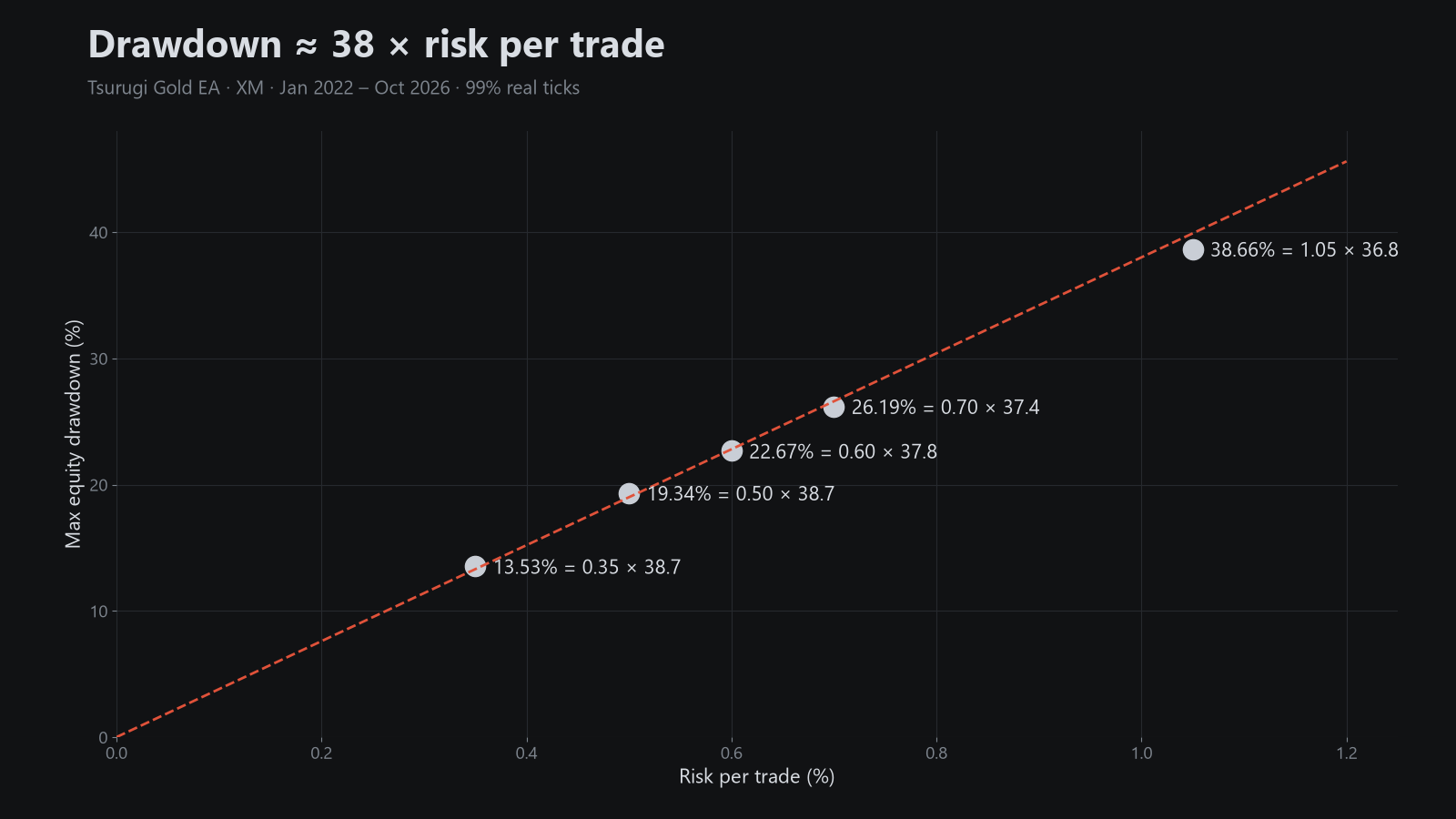
This gives you a simple way to choose. Start from the drawdown you can actually sit through, then divide:
Risk per trade = drawdown you can accept ÷ 38
- 10% drawdown → about 0.25% per trade
- 15% drawdown → about 0.4%
- 20% drawdown → about 0.5%
- 30% drawdown → about 0.8%
3. HOW TO DO THIS WITH ANY EA
The multiple is different for every EA, but you can find it the same way:
- Run one backtest at the EA's default risk, using "Every tick based on real ticks" if your broker provides the history.
- In the report, find "Equity Drawdown Relative".
- Divide it by the risk you used. That is your multiple.
- Divide the drawdown you can accept by the multiple.
Use equity drawdown, not balance drawdown. Equity includes the open trades, and that's the number your account actually goes through. In this test, balance drawdown was 2.6 to 6.3 percentage points lower than equity drawdown.
SWITCHING RISK IN TSURUGI
Tsurugi has three risk buttons on its chart panel, and every one of them was profitable in every year of this test:
- LOW (0.35%): +$16,634, max equity drawdown 13.5%
- MEDIUM (0.70%, default): +$49,404, max equity drawdown 26.2%
- HIGH (1.05%): +$137,970, max equity drawdown 38.7%
You can switch at any time without restarting the EA, and the new level takes effect from the next trade. If you want a level in between, set "Risk per trade" in the inputs.
Tsurugi Gold EA: $10,000 → $59,404 at default settings, profitable every year 2022–2026. No grid, no martingale, a real SL on every trade. Launch price $99, only for the first 10 copies.
Get Tsurugi Gold EA at $99: https://www.mql5.com/en/market/product/207107
All figures are from backtests. Past performance does not guarantee future results.